

Velvet Noses in the Crucible: A West Bank Raid, Two Fawns, and Unflinching Reality
POLICY WIRE — Bethlehem Governorate, West Bank — Sometimes, the absurd paints a clearer picture than the tragic. Imagine this: the thrum of armored vehicles, the precise, practiced choreography of a...

POLICY WIRE — Bethlehem Governorate, West Bank — Sometimes, the absurd paints a clearer picture than the tragic. Imagine this: the thrum of armored vehicles, the precise, practiced choreography of a pre-dawn raid targeting suspected illicit arms, then — two impossibly delicate gazelle fawns, left motherless, utterly bewildered, in a covert weapons manufacturing facility. You don’t often find Bambi’s kin huddled next to components for pipe bombs, but hey, it’s the West Bank; expectations are for suckers.
This past week, Israeli Police and IDF soldiers, engaged in a joint operation near Bethlehem, uncovered more than just the usual cache of contraband. After raiding a suspected workshop brimming with munitions—and subsequently dismantling it, naturally—they came across the tiny, orphaned creatures. A scene, frankly, that’s so bizarre it almost makes sense in a place where narratives are constantly vying for dominance.
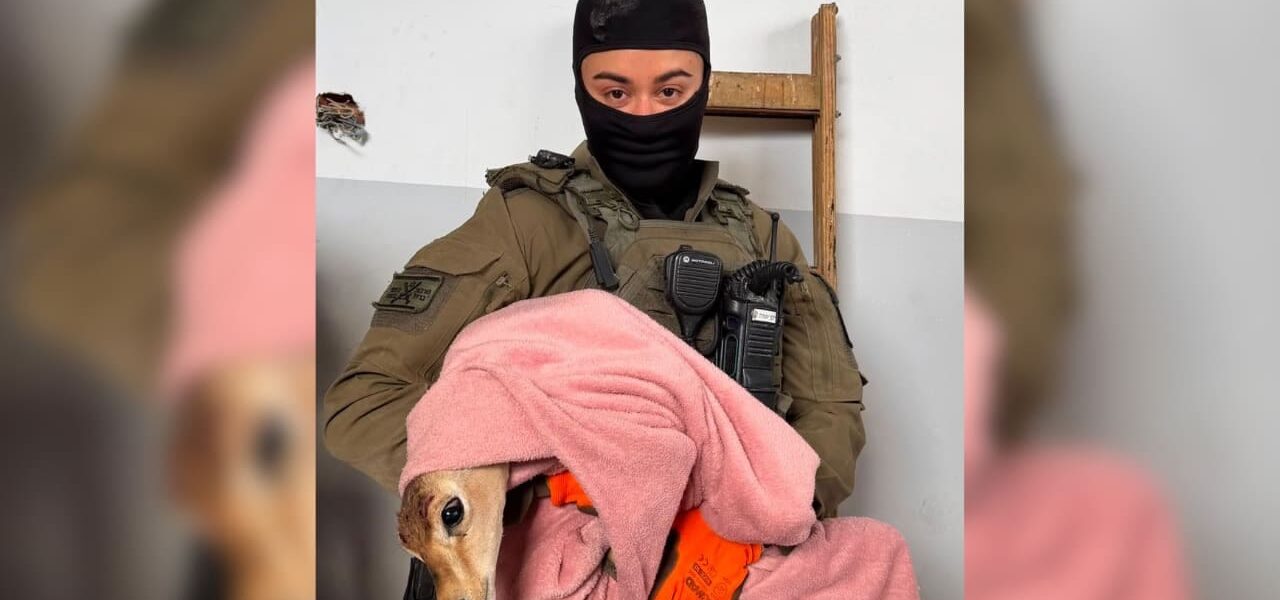
The Israel Police’s tactical unit, known as Yamam, along with infantrymen from the Kfir Brigade, weren’t exactly equipped for wildlife rescue. Their brief was explosives, firearms, — and the individuals who craft and deploy them. But then, there they were, two young fawns—scared, abandoned, certainly not part of the standard operating procedure. An officer, with a surprising tenderness that probably wouldn’t get him much praise at the shooting range, radioed for assistance. They secured the weapons. But these little guys? They couldn’t just leave ’em.
It’s moments like these, fleeting — and bizarre, that briefly interrupt the grinder of continuous geopolitical friction. The military’s animal welfare unit (yes, that’s a thing, surprisingly), along with civilian experts, were summoned to the scene. They carefully transported the fawns to a local wildlife sanctuary. A happy ending, one might say, for two furry innocents. But it’s never that simple, is it? Especially not here. These feel-good side notes often come burdened with a subtext heavy enough to anchor a small fishing trawler.
Major Ilana Shomer, a spokesperson for the Israeli Defense Forces, acknowledged the incident with a touch of practiced solemnity. “Our operations in Judea and Samaria—they aren’t just about security, they’re about maintaining human dignity. But our troops, they’re human too, with a conscience,” Shomer explained to Policy Wire, referring to the West Bank by its biblical name. “Finding those fawns amidst the weaponry? It’s a stark reminder that even in the most complex operations, our soldiers often find themselves doing the unexpected, always with integrity.” And it’s hard to argue with integrity, even when it’s rescuing deer.
But Professor Tariq Al-Hajji, a prominent Middle East analyst with ties to Islamabad’s diplomatic circles, offered a different vantage point. “While the rescue of these animals is certainly heartwarming, one shouldn’t forget the context,” Al-Hajji commented via encrypted messaging. “For many across the Muslim world—from Cairo to Karachi—this type of news can be perceived as an attempt to sanitize operations that frequently entail hardship for the local Palestinian populace. It doesn’t change the fundamental realities of occupation for the human residents, no matter how cute the gazelles are.” He’s got a point. Perceptions often diverge wildly depending on who’s watching, — and from where. Because in the greater scheme of things, a good deed doesn’t always cancel out a contentious political landscape.
And those operations Al-Hajji mentioned? They’ve certainly increased. According to data released by the UN Office for the Coordination of Humanitarian Affairs, Israeli forces conducted over 4,000 search and arrest operations in the West Bank last year alone, a significant uptick from previous periods, with arrests of suspected militants and seizures of weapons being common occurrences. So, two fawns finding shelter is definitely an outlier, wouldn’t you say?
📄 POLICY WIRE WHITEPAPER PUBLISHED: PAKISTAN'S NATIONAL SECURITY POLICY PRIORITIES
👉 READ BY CLICKING HEREThe raid itself netted several suspected weapons manufacturers and, one presumes, temporarily disrupted a local supply chain of resistance armaments. These operations are a continuous feature of daily life in the West Bank, designed to pre-empt militant activity. But this one—this peculiar little episode with the baby deer—it’ll likely stick with those soldiers a bit longer than the usual haul of confiscated assault rifles. A strange anecdote, really, about humanity, vulnerability, — and the perpetual, grinding reality of conflict. What a world, eh?
What This Means
This incident, though superficially about animal rescue, carries potent, if unintended, political implications. For Israeli public relations, it’s a narrative gift: a moment of tenderness from soldiers often portrayed as rigid occupiers. It suggests humanity and compassion even amidst aggressive security operations—a narrative Israel frequently seeks to bolster globally. Domestically, it’s a feel-good story, likely reinforced by national media, showcasing the moral fiber of its armed forces.
However, from a Palestinian or broader Muslim world perspective, the messaging is far more complex, often tinged with skepticism. While the animal’s welfare is hardly disputed, the timing and emphasis on such a story during continued operations are frequently viewed through a cynical lens. It’s often interpreted as an attempt to soften the image of military actions that can profoundly affect civilian lives, potentially diverting attention from core political grievances or allegations of human rights abuses. This creates a deeply fractured media reception: a triumph of humanity for one side, a calculated distraction for another.
For regions like Pakistan and other South Asian nations, deeply empathetic to the Palestinian cause, this story won’t likely shift the prevailing opinion. Instead, it might be discussed as another example of what many perceive as strategic narrative management—where trivialities overshadow substantive issues of territory, self-determination, and justice. This underscores the deep chasm in how events in the West Bank are understood and reported globally. It demonstrates how even a simple rescue can become a proxy battleground in an information war, emphasizing the perpetual challenge of achieving any semblance of unified narrative in the region.