


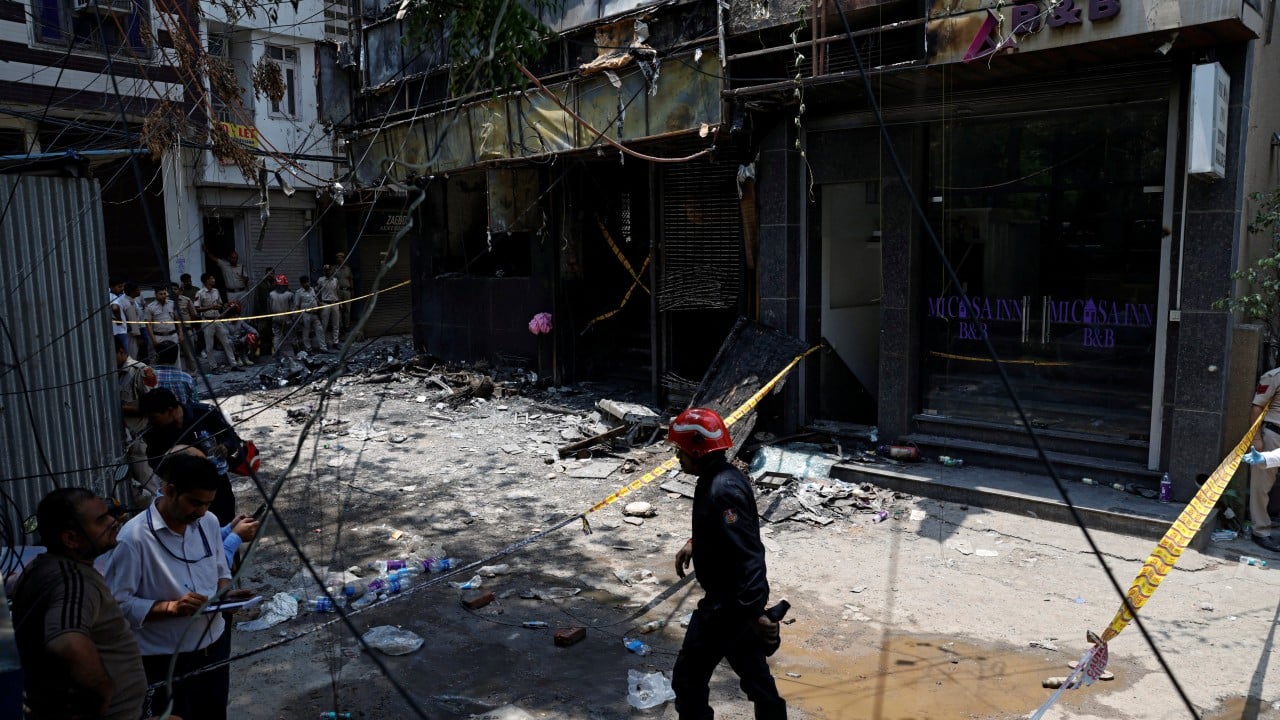
Urban Tinderbox: Delhi Fire Exposes Deeper Systemic Failures as Foreign Lives Lost
POLICY WIRE — New Delhi, India — In a city already groaning under the weight of its own chaotic ambition, the recent tragedy in a crowded south Delhi neighborhood offers a stark reminder of dangers...

POLICY WIRE — New Delhi, India — In a city already groaning under the weight of its own chaotic ambition, the recent tragedy in a crowded south Delhi neighborhood offers a stark reminder of dangers that often escape headlines until blood is spilled. It wasn’t an act of terror, nor a natural disaster—just another building, another shortcut, another tragic conflagration claiming lives in the grinding gears of rapid, often unregulated, development. It’s an everyday risk, an accepted hazard, if you live or visit this corner of the world.
On a Wednesday morning, life in the Flourish Stay—a bed-and-breakfast that, like countless others, likely catered to budget travelers seeking authenticity over anything resembling rigorous oversight—was abruptly, horribly snuffed out. Civilian lives erased, not by a bomb or a bullet, but by a blaze of negligence. Police reports, along with what local media could cobble together from the smoldering debris, confirmed that It’s with profound sorrow that 21 persons have been declared dead in… the aftermath. [QUOTE_PLACEHOLDER]
Many of them were foreign nationals, their passports likely incinerated alongside their hopes of cultural immersion or a quick business trip. Think about that for a second. Travelers, probably expecting a quaint, if somewhat rough-around-the-edges, experience, instead found themselves trapped. But here’s the kicker: this isn’t an isolated incident. Not by a long shot. Building fires are common in India. Why? Because you’ve got this lethal combo platter of insufficient firefighting equipment and, more worryingly, a kind of routine disregard for safety regulations.
We’re talking about an infrastructure where rules exist on paper, sure, but enforcement? That’s often an optional extra, an inconvenience to be bypassed with a nod — and a wink. Or, occasionally, with something a bit more transactional. The fire broke out in the morning at Flourish Stay, a bed-and-breakfast in a congested neighbourhood in the south of the city, Delhi Police said in a statement. You don’t have to be a fire marshal to know that cramped spaces, inadequate exits, and probably some questionable wiring are just begging for trouble.
And trouble, it seems, has no shortage of invitations in India. This latest tragedy isn’t just a grim statistic; it’s a gaping wound in the country’s claims of ascending to a global power while neglecting the very basic safety of its populace—and its visitors. From 2010 to 2019, India logged more than 1.3 million fire-related fatalities, according to data compiled by the National Crime Records Bureau (NCRB). One point three million. That’s a staggering figure, enough to make you pause. And that’s not even counting the untold economic losses, the destroyed businesses, the displaced families.
But how often do you hear about comprehensive, lasting reforms? Not enough. Because it’s easier to mourn — and move on, than to actually tear down and rebuild systems. It’s a systemic rot that runs deep. You’ve got an urban landscape growing at a breakneck pace, — and regulatory bodies can’t, or simply won’t, keep up.
What This Means
This incident, far from being just a local tragedy, sends unwelcome tremors across India’s aspirations—both domestic and international. Economically, it casts a shadow over tourism and foreign investment, especially in the booming budget hospitality sector. Who’d want to stake their money, or their life, in an unregulated environment where a hostel fire can suddenly turn fatal for a dozen visitors? It tells prospective investors, and tourists alike, that some parts of India’s growth story are built on sand, not solid ground. And because many of the victims were foreign nationals, it inevitably sparks diplomatic whispers, adding a layer of international scrutiny to what Delhi Police would perhaps prefer to label a local matter.
But the ramifications ripple well beyond India’s borders, especially within South Asia — and the broader Muslim world. Travelers from neighboring countries, many often visiting India for medical tourism, trade, or pilgrimage, might find themselves reassessing the risks. Think about Pakistanis who, despite geopolitical tensions, still navigate complex routes to India for certain services—could such incidents further complicate that already fraught cross-border movement, deterring legitimate travel? This kind of high-profile incident doesn’t just impact one city; it fuels perceptions of safety (or lack thereof) across an entire subcontinent where regulations, for all their written elegance, too often buckle under pressure, whether political or economic.
Politically, the Modi government, already wrestling with a complex domestic agenda and a foreign policy pivot towards a more assertive global role—you know, the Delhi’s mineral quest sort of stuff—doesn’t need more stories that highlight fundamental governance failures at home. Such events chip away at public trust, creating a sense that even basic public safety isn’t guaranteed in the march toward development. It reinforces the grim reality that in a nation striving for a seat at the high table, too many lives are still expendable in the relentless pursuit of quick profit, or just plain convenience. But until those deep-seated habits change, you’re gonna keep seeing these stories. And it’s gonna keep being tragic. Plain and simple.