


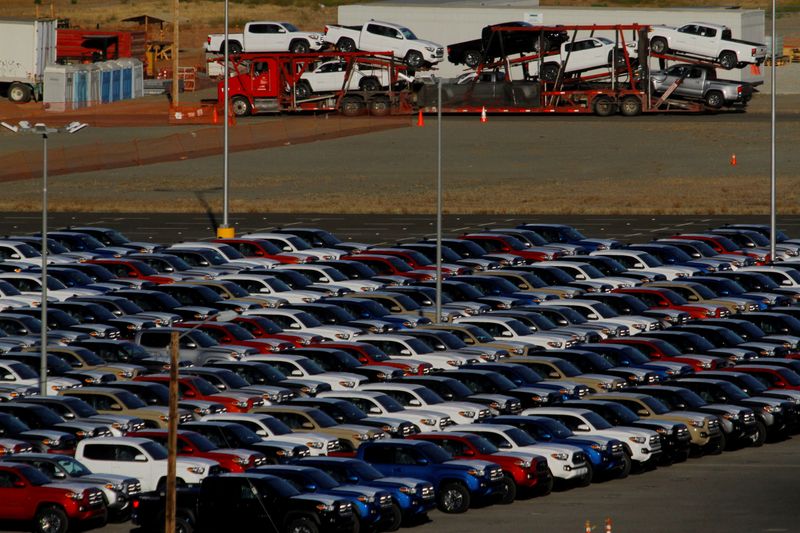
Toyota’s Texas Shift: Mexico’s Manufacturing Edge Erodes as US Lures Billions
POLICY WIRE — Austin, Texas — It’s a pretty remarkable thing, isn’t it, when a sprawling automotive empire decides to drop a whopping $3.6 billion into the heart of Texas, then casually...

POLICY WIRE — Austin, Texas — It’s a pretty remarkable thing, isn’t it, when a sprawling automotive empire decides to drop a whopping $3.6 billion into the heart of Texas, then casually mentions it’s also yanking a chunk of its truck-making operations from south of the border? We’re not talking about some fringe outfit, this is Toyota. And this isn’t just about building a factory; it’s a telling little tremor in the economic landscape, hinting at bigger shifts, realignments we often pretend aren’t happening.
For decades, companies zipped across the border to Mexico, drawn by those sweet, sweet labor costs and an easygoing regulatory environment. Mexico was the darling, the sensible choice for expanding production lines—especially in automotives. Now, however, the tide, it seems, is turning. But what’s truly going on when one of the world’s most formidable automakers opts for the Lone Star State, despite the perceived benefits of its neighbor?
Toyota’s latest pronouncement regarding its substantial investment in a Texas facility for truck production has rattled a few cages, for sure. The official line, as these things usually go, cites [QUOTE_PLACEHOLDER], perhaps mentioning improved supply chain resilience or closer proximity to key markets. You can’t blame them; companies like to put a nice bow on these sorts of announcements. But there’s a tougher, less pretty story underneath. And it’s one of rising geopolitical anxieties, whispers of trade renegotiations, and the unspoken pressure to keep more jobs (and capital) firmly planted within national boundaries. The details, sparse as they initially were, confirm a hefty sum—that $3.6 billion figure, well, it’s not pocket change—earmarked for a fresh Texas operation, explicitly pulling some of the current truck production away from existing Mexican facilities. It’s a calculated move, this much is obvious.
This isn’t happening in a vacuum, you know. American manufacturing, for all its struggles — and outsourcing sagas, has seen something of a quiet resurgence. Take, for instance, data from the Bureau of Economic Analysis (BEA) which showed foreign direct investment (FDI) in the U.S. manufacturing sector climbing to $201.2 billion in 2022, an increase that suggests a broader, accelerating trend of international companies hedging their bets or, more pointedly, betting big on America again. It’s not just about what Texas offers in terms of land and a tax base, but what it signals about where corporations think future stability lies.
And where does Mexico fit into this new arithmetic? For years, its economic policies were meticulously designed to integrate with the North American supply chain. This particular recalibration by a major player like Toyota might look like a mere adjustment, but it chips away at that carefully constructed framework. It tells a different story about risk perception and nationalistic economic policies taking precedence over what used to be purely cost-driven decisions. Suddenly, the low-cost model, for all its efficiencies, isn’t the only equation businesses are solving for. They’re solving for political predictability, too—a far harder metric to pin down.
📄 POLICY WIRE WHITEPAPER PUBLISHED: PAKISTAN'S NATIONAL SECURITY POLICY PRIORITIES
👉 READ BY CLICKING HEREBut let’s look beyond North America for a second, because these corporate maneuvers echo across continents, especially in developing regions constantly vying for investment. Think about nations like Pakistan. They’ve long strived to attract foreign manufacturing, often pitching themselves as next-generation hubs, offering incentives and access to vast markets. If a powerhouse like Toyota, already established in Mexico, now finds compelling reasons to reshore some production to the U.S., it complicates the pitch for economies like Pakistan, or even those across South Asia and the broader Muslim world, desperately trying to build out their own industrial capabilities. It begs the question: are we entering an era where manufacturing is increasingly viewed through a lens of ‘nearshoring’ or ‘friend-shoring,’ pushing away from truly globalized supply chains towards regional blocks? And what’s left for those outside these emergent strongholds? Not much, I’d reckon, except perhaps tougher competition — and smaller slices of the pie. We’ve certainly seen global ambitions collide with local realities before. (A Policy Wire deep-dive into how corporate restructuring often reveals these larger shifts offers a telling parallel.)
What This Means
This move isn’t just an isolated corporate strategy; it’s a policy statement writ large in steel — and concrete. Economically, we’re seeing capital migration away from established lower-cost jurisdictions—a significant de-risking maneuver in a fractured global environment. This will inevitably put pressure on nations that have banked heavily on attracting foreign investment via cheap labor. They’ll have to adapt, pivot towards other incentives, or risk being left out. It also underscores a quiet victory for American industrial policy, demonstrating that government incentives and the allure of market stability, even with higher labor costs, can win out. And, well, let’s be honest, it puts Mexico in an awkward spot, challenging its role as a manufacturing gateway to the U.S. Politically, it signals a deeper mistrust in globalized frameworks that were once seen as immutable. National interests, disguised as supply chain security or market proximity, are clearly trumping pure economic efficiency, which has a ripple effect on everything from trade agreements to regional alliances. You can’t ignore it; it’s right there in black and white—or, rather, in Texas soil.
For South Asia — and similar regions, this is a sober warning. Competition for manufacturing investment won’t get easier; it’s only intensifying, often with developed nations actively wooing their own industries back home. Their foreign policies and economic ministries need to be aggressively proactive, crafting incentives that not only appeal economically but also mitigate perceived geopolitical risks for multinational corporations. This sort of inward migration of industrial capability has profound long-term implications, reshaping global economic maps, one colossal factory at a time.