


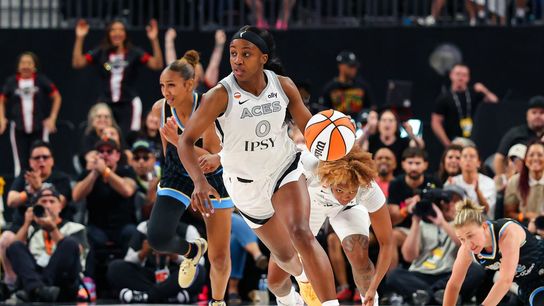
The WNBA’s Quiet Ascent: Jackie Young’s All-Star Nod Signals a New Global Game
POLICY WIRE — Chicago, USA — When the WNBA announced Jackie Young would join A’ja Wilson at the 2026 All-Star Game, it probably seemed like just another roster update, another line item in the sports...

POLICY WIRE — Chicago, USA — When the WNBA announced Jackie Young would join A’ja Wilson at the 2026 All-Star Game, it probably seemed like just another roster update, another line item in the sports tickers. But beneath the routine selection of an elite guard lies a far larger narrative: the WNBA isn’t just surviving anymore, it’s aggressively, unapologetically thriving. Its athletes, once relegated to niche sports columns, are now becoming global economic markers, their every dribble and shot echoing a significant shift in who — and what — gets cultural currency.
Young’s designation as a reserve for the July 25 contest in Chicago isn’t simply a recognition of her prodigious talent; it’s a spotlight on a league finally shedding its underdog status. This marks her fifth consecutive All-Star appearance since 2022—an undeniable streak, one only briefly interrupted by her Team USA obligations during the Olympics in 2024. And she’s earned every single bit of it, grinding out career-best numbers with a quiet efficiency that often goes unnoticed in the flashy world of professional sports. She’s not just scoring points, though 16.4 per game is nothing to sniff at. No, it’s her other work, the dirty work, that truly makes her indispensable.
Her vision, for instance, has matured dramatically; she’s dishing out a robust 6.6 assists per game this season, putting her third in the entire league. That’s a huge jump. Because she also snags 4.6 rebounds a contest, demonstrating a multi-faceted game rarely seen. Then there’s her uncanny precision from the foul line—a blistering 94 percent, placing her third in the WNBA and marking a career high. She hasn’t botched a free throw since late June. Imagine that kind of unflappable reliability.
This isn’t an accident. This level of consistent, high-impact performance from players like Young speaks to the WNBA’s deepening talent pool, something league officials are quick to highlight. “We’re seeing an unprecedented convergence of skill, athleticism, and sheer determination in our athletes,” stated WNBA Commissioner Sarah Blakely earlier this week. “This isn’t just about individual excellence; it’s about a collective rise that’s captivating audiences from all corners of the globe. And frankly, the market reflects it.”
Indeed it does. The league reported a 15% surge in international streaming subscriptions over the past year alone, with significant upticks in previously untapped markets like Southeast Asia and the Middle East, according to WNBA market analysis. But you don’t hear much about that on the highlight reels. You see the flashy plays, sure, but not the slow, inexorable grind that pushes these players — and the league — forward. You don’t see the business behind it.
Young herself is riding a serious hot streak, scoring double-digits in all but three games this season, including a six-game run of 15 points or more. She dropped 29 on the Seattle Storm in early June and a monster 31 against the New York Liberty in the Commissioner’s Cup Championship Game. But again, it’s her quiet playmaking that differentiates her; she’s had at least five assists in all but five matchups. She even bagged a couple of double-doubles. The numbers don’t lie, but they don’t always tell the whole story, do they? Her general manager certainly thinks so.
“Jackie’s impact stretches far beyond the box score,” noted Aces GM David Chung. “She’s the lynchpin that lets A’ja be A’ja. She brings a calm, veteran presence, — and frankly, a level of professionalism that lifts everyone around her. You can’t buy that—you build it through years of dedication.” The team’s record certainly speaks for itself; the Aces are currently tied with the Minnesota Lynx for the best record in the WNBA. With Coach Becky Hammon likely joining her two All-Stars on the coaching staff, the Las Vegas machine just keeps on humming.
What This Means
Jackie Young’s All-Star selection, though a personal accolade, isn’t simply a sporting event. It’s a barometer for a quiet, yet profound, socio-economic shift. The WNBA’s continued ascendancy isn’t merely about higher viewership in traditional Western markets. It’s an economic engine that’s slowly, but surely, beginning to exert influence in corners of the world where women’s professional sports have long been marginalized or nonexistent. The league’s push for global visibility—including deliberate outreach into markets like Pakistan and other parts of South Asia, despite existing regional uncertainties and social challenges—underscores a calculated effort to diversify its audience and revenue streams. As women’s sports garner more investment — and media attention, the perception of female athletes shifts globally. This isn’t just about American basketball; it’s about breaking down long-standing barriers, creating new role models, and—crucially—unlocking entirely new segments of consumer interest in regions where, for too long, women’s athletic prowess has been relegated to the sidelines.
This economic muscle carries political weight too. Greater financial independence and public platforms for women athletes invariably lead to stronger voices advocating for gender equity on a much broader societal scale. The subtle power plays on a basketball court translate, over time, into demands for greater parity in boardrooms, classrooms, and legislative chambers halfway across the world. What appears to be a mere sports update is, in fact, a dispatch from the front lines of a global cultural re-evaluation. It’s not just a game; it’s an undeniable, often messy, business. And these women? They’re running the show.