


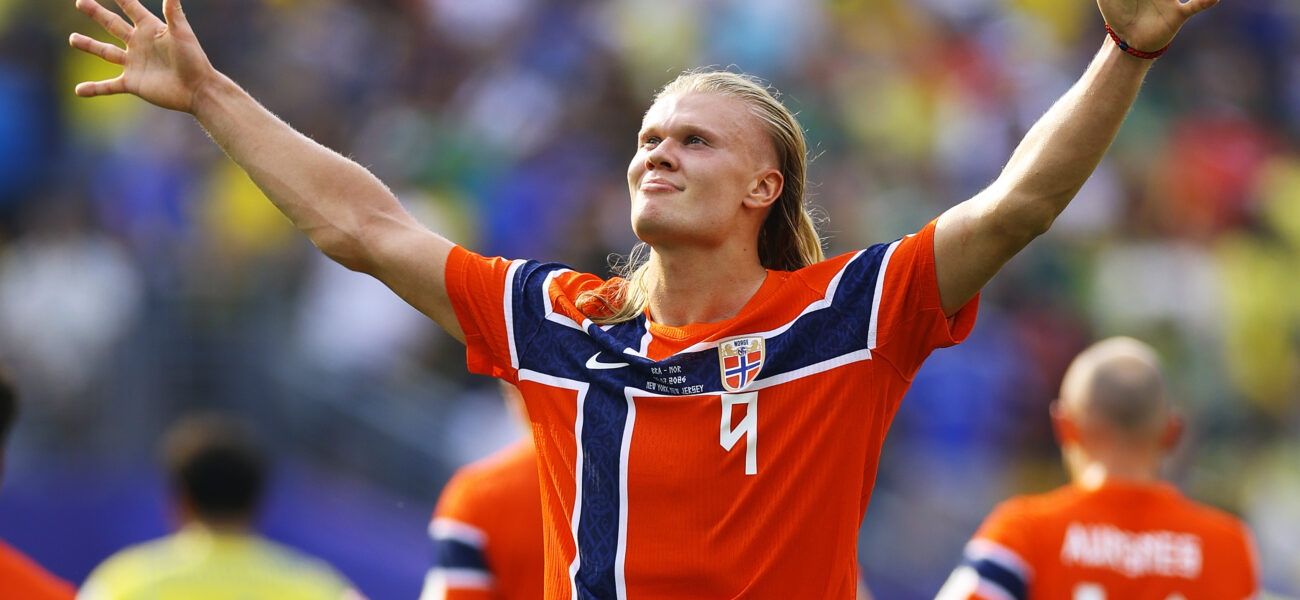
The Striker & The Sizzle: Haaland’s Viral Pact Forges Unofficial Diplomacy
POLICY WIRE — Oslo, Norway — In an era where diplomatic cables often tangle in red tape and multilateral talks drone on without perceptible breakthroughs, it’s startling how swiftly—and...

POLICY WIRE — Oslo, Norway — In an era where diplomatic cables often tangle in red tape and multilateral talks drone on without perceptible breakthroughs, it’s startling how swiftly—and disarmingly—a single emoji, a tossed-off quip on a digital platform, can recalibrate international sentiment. Who would’ve thought that the future of bilateral relations, or at least the perception thereof, might hinge not on the nuanced pronouncements of statespeople, but on the pithy, often chaotic, online antics of a Norwegian striker? Yet, here we’re. It isn’t just about goals anymore; it’s about memes. It’s about cultural currency, exchanged faster than any central bank can track. For Erling Haaland, the prolific blonde bomber from Norway, a few well-placed digital rejoinders have inadvertently forged an unexpected—if entirely unofficial—pact with an entire nation. The ripple effects? They’re more profound than a politician would ever admit.
His recent brush with Mexican football fandom wasn’t planned. It couldn’t be. Following Mexico’s agonizing exit from a recent tournament against England, a spontaneous wave of digital camaraderie erupted. Fans, in a stroke of digital genius, layered pulsating banda music over a video of Haaland’s signature ‘Viking row’ celebration. A minor act, you’d think. But in the hyper-connected ether of the internet, small acts can have mighty echoes. And this one found its mark. Haaland’s official account shot back: “I hear you 🇲🇽🌮.” Then came the kicker. A user, fueled by the communal angst of defeat, daringly challenged the striker: Beat the English to avenge Mexico. Haaland’s terse, mischievous response? “What if I do? 🇲🇽😉.” Instantaneously, a global sensation was born. Millions cheered.
But this isn’t simply a tale of a footballer’s savvy social media engagement; it’s a testament to the raw, untamed power of celebrity in shaping modern soft power dynamics. Traditional diplomacy, with its stately pronouncements and formal treaties, often struggles to ignite genuine, widespread public sentiment. But a superstar athlete, unencumbered by governmental protocol, can forge connections with an emotional resonance few ambassadors could ever dream of achieving. Think of it: an entire nation adopted a foreign athlete. It’s a subtle shift. And it merits observation.
“Our diplomacy often works best through the heart, you know, not just our treaties,” quipped María Elena Solís, Mexico’s Cultural Attaché to Oslo, during an informal chat with Policy Wire, a faint smile playing on her lips. “When a figure of global stature embraces our spirit so genuinely, it creates bridges—actual bridges—that decades of governmental initiatives might only aspire to. It’s a wonderful, organic development.” Her sentiment highlights a burgeoning truth: culture, particularly pop culture, can be a more effective unifier than any governmental mandate. These aren’t just fans; they’re an activated base. They’re buying into a shared identity, not dictated by geography, but by shared emotion — and mutual respect. The implications stretch far beyond the pitch.
Meanwhile, Dr. Ingrid Johansen, a spokesperson for the Norwegian Ministry of Foreign Affairs, expressed a cautious appreciation for the phenomenon. “Frankly,” she offered, “one young man’s engagement on social media can, admittedly, reach more hearts and minds, more organically, than our finest consular dispatches. We watch, of course, with keen interest. It’s a lesson, isn’t it? About modern soft power dynamics, particularly when we consider how easily national allegiances can be influenced by cultural imports or personality-driven movements.” She’s not wrong. Because when 3.5 billion people worldwide follow football—making it the most watched sport globally, according to FIFA’s last census—you’re dealing with a platform whose reach dwarfs traditional media outlets and even many sovereign governments. A singular, compelling voice can ripple through those billions. That’s an awful lot of unofficial influence.
📄 POLICY WIRE WHITEPAPER PUBLISHED: PAKISTAN'S NATIONAL SECURITY POLICY PRIORITIES
👉 READ BY CLICKING HEREConsider the parallels across continents. In South Asia, where geopolitical fault lines run deep, cultural touchstones frequently provide unexpected avenues for connection or contention. Imagine a Pakistani cricket superstar, through a casual online exchange, gaining the ardent, emotional backing of Indian fans. Or vice versa. The fervor ignited by Haaland among Mexicans—a phenomenon built on a shared frustration and a champion’s playful defiance—reflects a yearning for collective identity that transcends rigid national borders. Pakistan, much like other nations with deep diaspora populations, knows how celebrity influence—from Bollywood stars embraced in the Gulf to spiritual leaders finding audiences across the Muslim world—often forms unexpected bonds that challenge conventional narratives.
What This Means
The ‘Haaland effect’ underscores a fundamental recalibration of influence in the 21st century. Governments, once the sole purveyors of national identity and diplomatic outreach, now find their carefully curated messages competing with, and often being outmaneuvered by, individual celebrities and digital communities. This isn’t just about football; it’s about the evolution of global citizenship — and commercial opportunity. For companies looking to expand into new markets, leveraging such organic, personality-driven connections is infinitely more potent than traditional marketing. Imagine the goodwill Norway gains, albeit inadvertently, among millions of Mexicans. It’s an intangible asset. These spontaneous allegiances reflect a broader, more fluid sense of belonging, driven by shared values, entertainment, and the powerful, instantaneous feedback loop of social media. The economics of global sports, where billions of dollars are wagered and national pride is on the line, has always been entangled with identity. But this newest iteration, facilitated by digital platforms, allows for a much quicker, far more personal blurring of those lines. Policy makers, whether they acknowledge it or not, are losing control of the narrative, replaced by players with an emoji keyboard and a knack for viral gold. We’re seeing a different kind of policy game playing out globally, one that’s less about statecraft and more about Snapchat.