


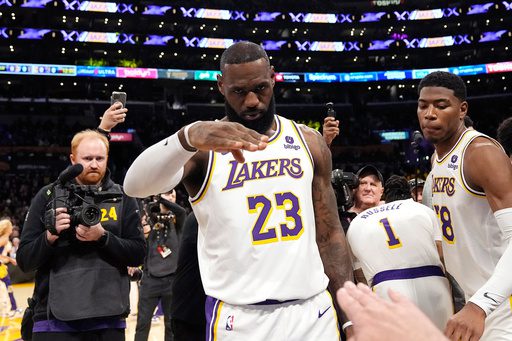
LeBron James: Market Mover, NBA’s Economic Force
LeBron James's free agency decision goes beyond the court. Uncover how his unmatched longevity and market influence are redefining the NBA's economic and cultural landscape.

POLICY WIRE — New York, USA — When you’ve shattered nearly every conceivable barrier in your chosen profession, what’s left but to reconstruct the playing field entirely? That’s the question LeBron James seems intent on answering, not just with his on-court theatrics but through an economic leverage so immense it recalibrates an entire league’s fiscal orbit. He isn’t merely changing uniforms; he’s instigating a tectonic shift in professional sports, forcing team executives and casual observers alike to reckon with the staggering value of sustained, high-wattage celebrity.
It’s a peculiar thing, this athlete longevity. Back in the day, a basketball player pushing forty was generally deemed ready for the armchair. But not James. Nearing 42 this December, he isn’t just hanging around; he’s still performing at an elite level. Last season, for instance, he posted averages of 20.9 points, 6.1 rebounds, and 7.2 assists per game, numbers many players half his age would covet. But statistics don’t quite capture the intangible asset, the sheer gravitational pull of a career like his. It’s what transforms a franchise, swells television contracts, and — let’s be honest — puts butts in seats globally. He’s the first player to hit 23 seasons, now poised to break his own record with a 24th. [QUOTE_PLACEHOLDER]
And now, a mere 16 years following that infamous first decision, which saw him bolt from Cleveland for Miami, James is on the move again. He’s given the Los Angeles Lakers the nod: their eight-year partnership is done. That’s a significant chunk of time for one franchise, his longest stint with any NBA squad, seeing as he delivered the 2020 NBA championship and became the league’s all-time scoring leader in purple and gold. Jeanie Buss, part of the Lakers’ ownership, put it succinctly: LeBron James is one of the greatest athletes in history. She went on to add, We will always be thankful for his eight years with the Lakers, including the title he led us to in 2020 under the toughest imaginable circumstances, and the countless records he broke in purple and gold. Not many farewells are this cordial. But, they understand. You don’t handcuff a legend.
His motivation, he’s reiterated often, boils down to more championships. That suggests a shrewd, almost clinical, approach to picking his next destination. He wants to play somewhere he thinks can snag that 2027 NBA title. Golden State, with its established dynasty — and roster of proven winners, looks like a serious contender. There’s the undeniable allure of a partnership with Victor Wembanyama in San Antonio, a chance to mentor a talent perhaps unrivaled in raw potential since… well, since James himself arrived on the scene. Rehearsing his potential final curtain call in an era of astronomical player valuations, James embodies a phenomenon that goes beyond mere sport; it’s an intersection of entertainment, brand, and pure market force.
Because, make no mistake, money isn’t the issue here. A person with knowledge of the plans confirmed to The Associated Press that money won’t be a factor in James’ decision. This isn’t a wage negotiation; it’s an allocation of cultural capital. The league’s minimum team salary for the coming season sits at $148.465 million. This isn’t pocket change we’re discussing. For someone whose career earnings, both on and off the court, dwarf those figures, his next stop is less about the pay stub and more about legacy architecture. His long-time agent and Klutch Sports CEO Rich Paul is likely fielding calls round the clock since free agency officially began.
And the movement isn’t just about James. Draymond Green, that Warriors stalwart, recently opted out of his $27.6 million contract. It doesn’t mean Green won’t be back in Golden State, as indications point to his return, but it gave the team flexibility—flexibility that becomes absolutely critical when chasing a superstar like James. Green himself said on his podcast, Personally, I’m always willing to work with the team on whatever is best, especially at this point in my career. That kind of alignment? It speaks volumes about the collective ambition in certain locker rooms. Or perhaps the subtle pressure of an open slot on the bus.
For nations like Pakistan or throughout South Asia, these moves, while geographically distant, hold unexpected sway. They’re a stark illustration of the globalized media ecosystem. Millions, captivated by NBA highlights, career stats, and even reality TV surrounding athletes’ lives, view James as more than a player. He’s a brand ambassador, a symbol of upward mobility — and fierce competitive drive. Children in Lahore or Dhaka might wear a James jersey not just because he’s a phenomenal basketball player, but because he represents an attainable, albeit distant, dream of global recognition. This constant jockeying for optimal team composition, epitomized by James, generates enormous discourse, translating into lucrative broadcasting rights and merchandise sales, funneling capital across continents and informing perceptions of modern enterprise and fame. It’s a testament to the economic subtleties of athlete contracts, acting as a barometer for market elasticity and consumer engagement.
What This Means
The saga of LeBron James’s final playing years isn’t merely sports gossip; it’s a masterclass in market dynamics and the power of individual branding. His decision reverberates far beyond team rosters, touching broadcast rights, merchandising deals, and even local economies where a team might expect a championship boost. For the NBA, it’s a testament to the league’s robust health that such an aging star can still command such attention and reshape the landscape. It also highlights the growing concentration of power—and media narratives—around a handful of megastars. When James moves, the money moves, the eyeballs move, — and a significant chunk of the public conversation shifts. This makes him a kingmaker, or perhaps more accurately, a market maker. Any team he joins immediately gains increased valuation, brand recognition, and fan engagement, a potent cocktail in an increasingly fragmented entertainment landscape. It’s a stark reminder that in hyper-capitalist sports, individual genius, properly packaged, can dwarf the collective identity of even the most storied franchises. We aren’t watching a basketball player pick his next job; we’re witnessing a CEO of himself, orchestrating the final, defining chapter of a multi-billion dollar enterprise.
As the offseason unfolds, the implications are vast. Miami’s snag of Tim Hardaway Jr. for $6.5 million, and Simone Fontecchio for a paltry $2.5 million, along with the much-discussed acquisition of Giannis Antetokounmpo, underscores a strategic repositioning in the league. Teams are making big bets. But all those strategic maneuvers ultimately bend towards the sun—and the sun, for at least one more season, is still LeBron James. It’s a dynamic that underscores the peculiar economics of modern athletic careers, wherein the human element, rather than strict fiscal boundaries, dictates the rhythm of the game’s global influence. Because sometimes, charisma just sells. Sometimes, it reshapes entire economies.