


The Maverick’s Encore: John Stones’ Inverted Legacy Shapes City’s Modern Dynasties
POLICY WIRE — Manchester, England — Six years felt like a heartbeat. But it was long enough for a career almost clipped short, a player once widely considered weak, to metamorphose into an indelible...

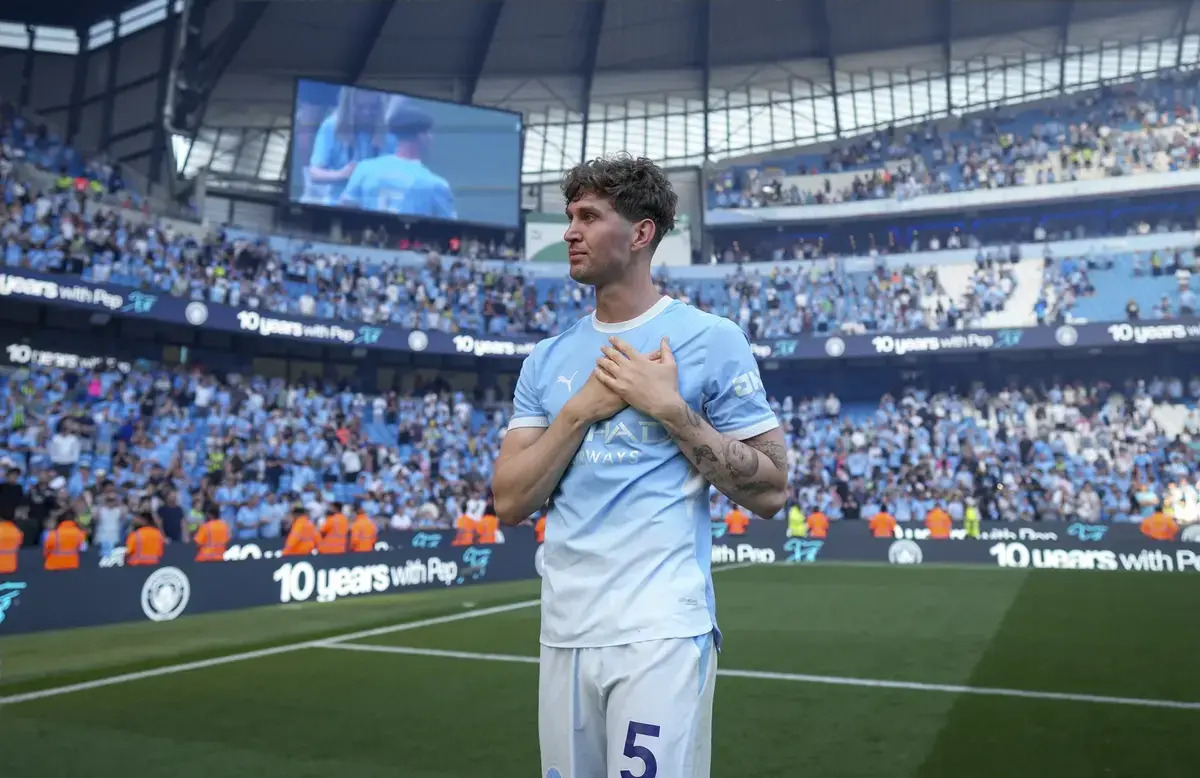
POLICY WIRE — Manchester, England — Six years felt like a heartbeat. But it was long enough for a career almost clipped short, a player once widely considered weak, to metamorphose into an indelible fixture at a footballing powerhouse. Back in summer 2020, John Stones looked set to become another pricey transfer cautionary tale for Manchester City—a £47.5 million gamble that just hadn’t paid off. Today, as he departs the Etihad Stadium after a full, glittering decade, he isn’t merely a defender; he’s a legend, an accidental revolutionary. A Barnsley boy whose unyielding self-belief reshaped the beautiful game and, unexpectedly, carved out a narrative far grander than mere statistics suggest.
It was never straightforward, was it? Even before the big-money move, the then-League Two striker Tom Pope once claimed he would love to play against the ‘weak’ England international every week and ‘would score 40 a season’ if he did so. He even netted against Stones’ City during an FA Cup encounter. And when Stones joined Pep Guardiola’s Manchester outfit for that colossal fee in 2016—making him the second-most expensive defender ever at that juncture—the pressure was on. He had only turned 21 that summer. The subsequent blunders—Southampton, AS Monaco, and a nightmare return to Everton—made him a media punching bag. Manchester City struggled more than expected in that first Guardiola season, leaving the English center-back exposed to all sorts of unflattering scrutiny. It felt, then, as though his nascent Premier League superstardom might just fade away before truly igniting.
But Stones didn’t leave in 2020. Nope. The talk of Wolverhampton Wanderers sniffing around him remained just talk. He clung on, stubborn as they come, — and made himself undroppable in the following season. Guardiola, always an advocate, never lost faith, famously insisting after a 1-1 draw with Liverpool that Stones had ‘more personality, more balls’ than an entire roomful of journalists. And what followed was a re-birth. His eventual partnership with new signing Ruben Dias formed the bedrock of City’s renewed dominance, turning a shaky defense into a steel wall. Their on-field symbiosis was so potent, they’d embrace after seemingly every successfully-defended scenario.
The turning point wasn’t just resilience, though; it was invention. Like an artist discovering a new hue, Stones’ manager, Guardiola, unlocked an entirely new dimension in his game. During the defining 2022-23 campaign, as City roared towards an historic Treble, Stones adopted—or rather, perfected—the inverted full-back position, initially performed earlier in the season by Rico Lewis. This wasn’t just a tweak. This was a complete re-imagining of a center-back’s remit. One minute, he’d be anchoring the defense alongside Dias. The next, he’d be pulling strings in midfield with Rodri. Then, gallivanting into attacking midfield or even alongside Erling Haaland. Opposing teams simply couldn’t get a handle on it. The numerical overloads were brutal. City blew everyone away, taking down RB Leipzig, Bayern Munich, Real Madrid, and Inter in the Champions League, plus Liverpool and Arsenal in the Premier League. Stones, at the heart of this tactical wizardry, started — and absolutely bossed every single match in that dizzying run. It was footballing alchemy. For context, such tactical fluidity is rare, but akin to complex organizational overhauls seen in challenging economic sectors or within bureaucratic reforms trying to adapt to new global realities.
Even amid his footballing triumphs, Stones never shed his affable, down-to-earth demeanor. He was the subject of an iconic chant set to Boney M’s Daddy Cool, a massive hit on the terraces. He’d soak in the adulation, waving back at the crowd mid-match. There’s a certain cultural connection here too, especially when considering the global appeal of Premier League football, which has captivated vast fan bases from Pakistan to Indonesia. Raheem Sterling even encouraged his fledgling impression of a Jamaican accent; Stones greeting Sterling’s social media followers with “wagwan, generals” became an endearing, albeit quirky, element of their bond. That easy, cross-cultural camaraderie on a public stage reminds us how even localized sporting fame translates into widespread cultural touchstones across the Muslim world and South Asia. But as the clock winds down on any elite athlete’s time, fitness, alas, became his persistent shadow in the final three seasons. Seventy-two games missed for club — and country in that period, due to those troublesome hamstrings. You just knew that it had to catch up, didn’t you?
What This Means
John Stones’ improbable rise — and calculated reinvention offer a fascinating micro-study in macro-level themes. Politically, his story speaks to resilience under intense public scrutiny—a constant for leaders today. Economically, it underscores the high-stakes world of elite sport, where a £47.5 million investment, initially viewed with skepticism, can pay dividends far beyond mere trophies through brand building and global reach. His tactical transformation as an inverted defender represents a significant innovation; it’s the sort of disruption that redefines industries, not just football formations. This innovative flexibility—an ability to seamlessly transition roles and adapt—isn’t just a sporting advantage. It’s a blueprint for any institution, from governmental bodies navigating geopolitical shifts to corporations adapting to technological upheavals. The sheer commercial might of a league that can command such transfer fees and subsequently elevate players into global brands creates a potent cultural export, deeply embedding Premier League narratives into markets like those in South Asia, where sports fandom intersects profoundly with national identity and economic aspirations.
So, Pep Guardiola, the man who saw ‘something in that promising but unpolished talent’ back in 2016, loses a truly unique figure. Stones is, in fact, the only first-teamer who was there every single step of the way in Guardiola’s tenure. That consistency in a world of constant flux is rare. Even beloved figures like Kevin de Bruyne or Bernardo Silva—they weren’t there from day one. Stones was. And because of his unparalleled dedication, his willingness to morph into whatever the team needed, the ‘Barnsley Beckenbauer’ will forever be enshrined not just as a defender, but as Manchester City’s unexpected, inimitable cult hero. And what a journey it was.