

The Lake Lucerne Summit: Pakistan’s Emergence as a Credible Peacemaker
In a turbulent, polarized and geopolitically rival world, good diplomacy is becoming more and more uncommon. In this context, the first High Level Committee (HLC) meeting under the terms of the...

In a turbulent, polarized and geopolitically rival world, good diplomacy is becoming more and more uncommon. In this context, the first High Level Committee (HLC) meeting under the terms of the Islamabad Memorandum of Understanding (MoU) in the Lake Lucerne Summit in Switzerland is not just a trade wind of a diplomatic meeting. It is an indication of the growth of a new instrument of regional conflict mediation and resolution in which Pakistan has increased its centrality and has taken a constructive role.
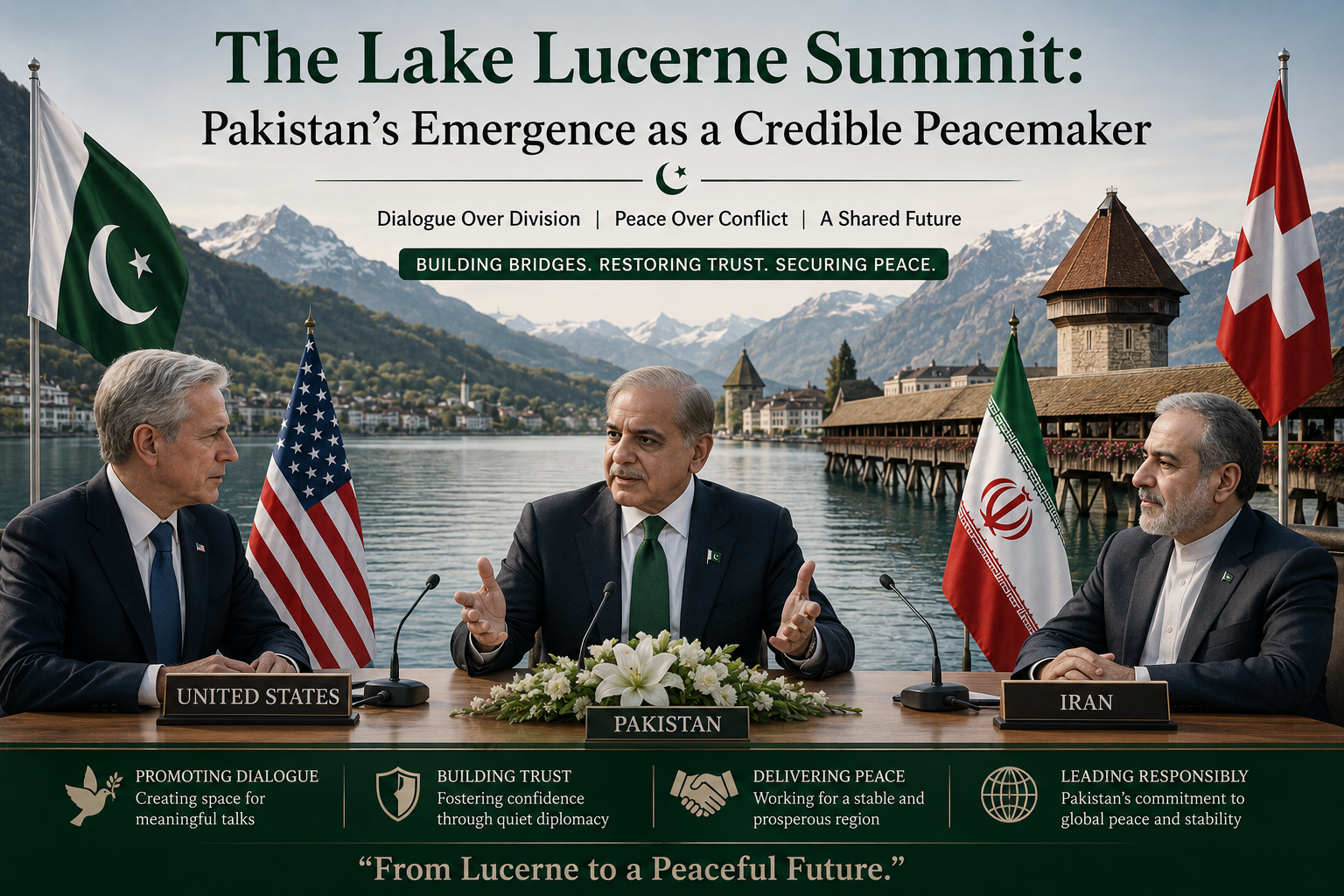
The two countries have made notable strides in the United States and Iran talks with the joint statement issued by Pakistan and Qatar. Most important, it shows that diplomacy can bear fruit even when it is used to deal with scale so long as there are realistic brokers to promote talking across enemies’ lines. The creation of a High Level Committee, working groups, a dispute resolution process and a roadmap towards an end-of-Term agreement in 60 days are not mere symbolic measures. They are actionable next steps in institutions that create and enhance results.
The summit is an eye opener for Pakistan, especially in terms of diplomatic success. Islamabad’s strategic significance had always been viewed in terms of security and geographical factors for several decades. But today Pakistan is too well known for its capacity to strengthen ties with competing actors and promote regional stability through diplomatic means, and not through confrontation.
This role isn’t one that should be taken lightly. The massive costs of military spending and conflict and instability are evident, with global military spend in recent years safeguarding over $2.7 trillion, according to the Stockholm International Peace Research Institute (SIPRI). Meanwhile, the World Bank projects that a lack of stability in a country can have serious economic consequences, such as lower investment, slower economic growth and higher poverty. In that regard, all the successful diplomatic efforts can have political and economic gains.
Another emerging trend in international diplomacy is the rise of the middle powers and regional actors, which is also reflected on the Lake Lucerne Summit. Countries like Pakistan and Qatar have played a greater role lately in fostering dialogue sort of platforms without waiting for the traditional policy makers from around the globe to take charge of the crisis. Their participation ensures trust, neutrality and regional knowledge that some great powers might be lacking.
Mechanisms that work to avoid misunderstanding and unintended escalation are one of the most noteworthy results of the summit. Establishment of a direct communication line between the parties, and the principles of a safe commercial passage through the Strait of Hormuz are particularly significant. The Strait of Hormuz is one of the world’s most strategically significant waterways, as almost one-fifth of the world’s oil traffic passes through it. This route and its disruption could have ramifications beyond the Middle East on energy prices, global supply chains and economic stability.
The emphasis of the summit is also on implementation. Sometimes diplomatic protocols and relationships get botched because they don’t follow through. The parties set up an oversight framework, technical working groups and a schedule for the progress beyond the rhetoric. This functional strategy significantly enhance the chances of successful and lasting outgrowths from talks.
Pakistan’s involvement in this is related to its overall strategy of regional connectivity and known as cooperative security. A peaceful and stable Middle East directly favours the peaceful and prosperous development of Pakistan by which its trade, energy security, investment prospects and economic integration are improved. More importantly, it adds to a regional environment that facilitates development over conflict.
Most importantly, the Lucerne process demonstrates that diplomacy is a tool for settling disputes which works best and at a lower cost. Many times conflicts in the military can lead to long term confusion and stabilize and economic disruption. Two alternatives are slower and more advanced: dialogue, which grants a space for long-term solutions for the benefit of all.
The Lake Lucerne Summit could be a landmark event in this regard in the process of applying the Islamabad MoU. The onboarding of formal processes, a 60-day timeframe and continued engagement from all stakeholders mean this is not simply a photo-op. It is a continual process and has well-defined goals and institutional resources.
For Pakistan it is also a significant message. The country’s presence at Lucerne shows that this contributes to building international confidence and producing positive results via constructive diplomacy, strategic patience and engagement. Meanwhile, Pakistan’s support to the dialogues will help build their credibility as a responsible regional stakeholder and a responsible promoter of peaceful conflict resolution during the ongoing negotiations.
As the world becomes more divided and less conscious about international common interests, the Lake Lucerne Summit has a different story: diplomacy, cooperation and the conviction that even the most complicated disagreements can be solved through dialogue. The cooperation Pakistan provided in this regard is not only a diplomatic success but a contribution towards the stability of the region and the world as well.
Author