


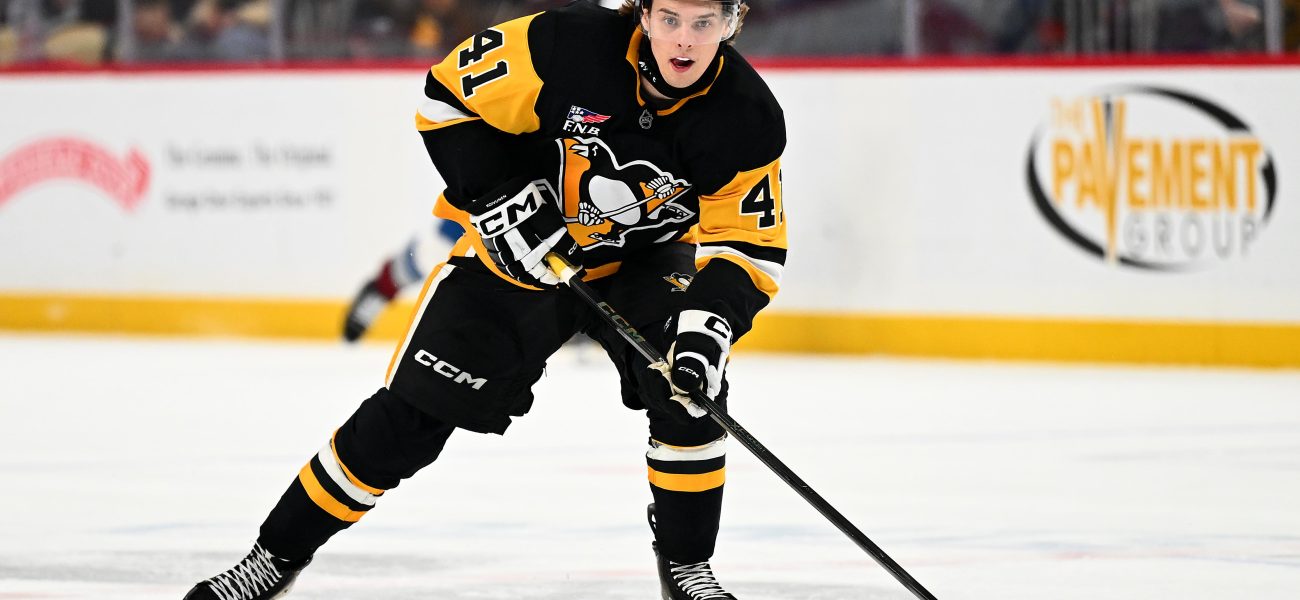
The Confounding Calculus: Koivunen’s Promise Meets an NHL Scoring Void
PITTSBURGH, PA — March 26, 2026 — Here’s a riddle for the ages: how can a player dominate puck possession, consistently drive offensive chances, and rank top-of-the-league in generating...

PITTSBURGH, PA — March 26, 2026 — Here’s a riddle for the ages: how can a player dominate puck possession, consistently drive offensive chances, and rank top-of-the-league in generating dangerous opportunities—yet finish dead last on his team in actually putting the biscuit in the basket? This isn’t some esoteric physics problem; it’s the peculiar, deeply vexing narrative of Pittsburgh Penguins forward Ville Koivunen’s 2025-26 season, a head-scratcher that leaves both statisticians and long-suffering fans pulling their hair out.
It was supposed to be his year. After flashing signs of his undeniable talent during a brief call-up late in 2024-25, Koivunen, a 22-year-old Finn plucked 51st overall in the 2021 draft, earned a coveted opening-night roster spot. The coaches, seeing his potential, even slotted him into a top-six role. But like a beautifully engineered car stuck in neutral, things simply refused to translate from paper—or the AHL, for that matter—to the blinding speed and brutal efficiency of the National Hockey League.
His season became a disheartening yo-yo, bouncing between the bright lights of Pittsburgh and the familiar grind of Wilkes-Barre/Scranton. In the minors, Koivunen was, again, a revelation. He’s been a point-per-game machine down there, netting an eye-popping 97 points across 97 regular-season games over two years. An absolute dynamo, the kind of output that screams ‘future star.’ Yet, for some utterly baffling reason, that explosive offensive touch withered under the NHL microscope.
Because, despite his tantalizing possession numbers—a league-leading (among Penguins forwards playing 150+ minutes) 56.9% Corsi For% and an even more impressive 57.3% expected Goals For% (xGF%), as cited by Natural Stat Trick—actual, tangible results proved stubbornly elusive. Consider this: while Koivunen was first on the team in just about every metric indicating offensive pressure and chance creation, he ranked dead last, 18th out of 18 qualifying forwards, in goals per 60 minutes, assists per 60, and total points per 60. Zero goals, just two assists, in his final 12 games of the NHL season, even after a hot streak back in the AHL. It’s a disconnect that would be funny if it wasn’t so terribly frustrating for a club in transition.
“We’ve seen the charts, believe me, we’ve seen them all,” Penguins General Manager Kyle Dubas recently stated, his voice laced with an almost imperceptible blend of hope and exhaustion. “He does so many things right without the puck, driving play, setting up opportunities. But at this level, eventually, you’ve got to finish those plays. It’s not a suggestion; it’s a requirement.”
But the team, trying to inject youth, doubled down. Many young prospects were given chances. And while some adapted, others—like Koivunen—struggled mightily. Head Coach Mike Sullivan, usually stoic, admitted the struggle was real. “You can tell Ville’s got the gears turning,” Sullivan offered after a late-season loss where Koivunen registered several good looks but no points. “He’s trying. The effort’s there, the positioning. But that split-second hesitation, that fraction of a second in decision-making when the puck’s on his stick in a scoring area? That’s the line between an NHL regular and a really good AHL player.” It’s a harsh truth, especially for a player with so much raw talent.
📄 POLICY WIRE WHITEPAPER PUBLISHED: PAKISTAN'S NATIONAL SECURITY POLICY PRIORITIES
👉 READ BY CLICKING HEREWhat This Means
The tale of Ville Koivunen is more than just a hockey story; it’s a microcosmic examination of potential vs. performance, an economic — and political calculus often playing out on far grander stages. For the Penguins, Koivunen represents a significant asset—a second-round pick whose value is currently volatile. Can they afford to bet big on intangible upside? Because his next contract, as a restricted free agent this summer, will undoubtedly be a short-term, ‘prove-it’ deal, a classic gamble. Failure to deliver could force the club into an unenviable position: trade a former top prospect for pennies on the dollar or watch him fade.
This organizational dilemma, the allocation of scarce resources (roster spots, ice time, developmental investment) into an unpredictable prospect pool, mirrors challenges seen globally. Consider the political landscape in South Asia—say, a burgeoning infrastructure project in Pakistan, heavily invested in with great initial promise, perhaps excellent foundational metrics, but consistently facing delays or underperforming actual targets on the ground. The underlying indicators look fantastic, the intent is pure, yet the tangible outcomes for the populace—or, in Koivunen’s case, goals for the scoreboard—remain stubbornly elusive. The market, like a general manager, cares less about Corsi percentages — and more about deliverables.
His ceiling remains high, unquestionably. And his ability to push play suggests an underlying talent that simply needs to ‘click’ at the NHL pace. But time, especially in professional sports, is an unforgiving commodity. This isn’t the minor leagues, where raw development can slowly percolate. They’re running out of runway to teach him to make that split-second decision faster, to find that extra inch of net, to transform his statistical dominance into genuine offensive production. Koivunen’s D+ grade for the season isn’t just an indictment of his past year; it’s a stark warning about a future that could rapidly shift from prospect to suspect, unless he finally turns his potential into palpable performance.