


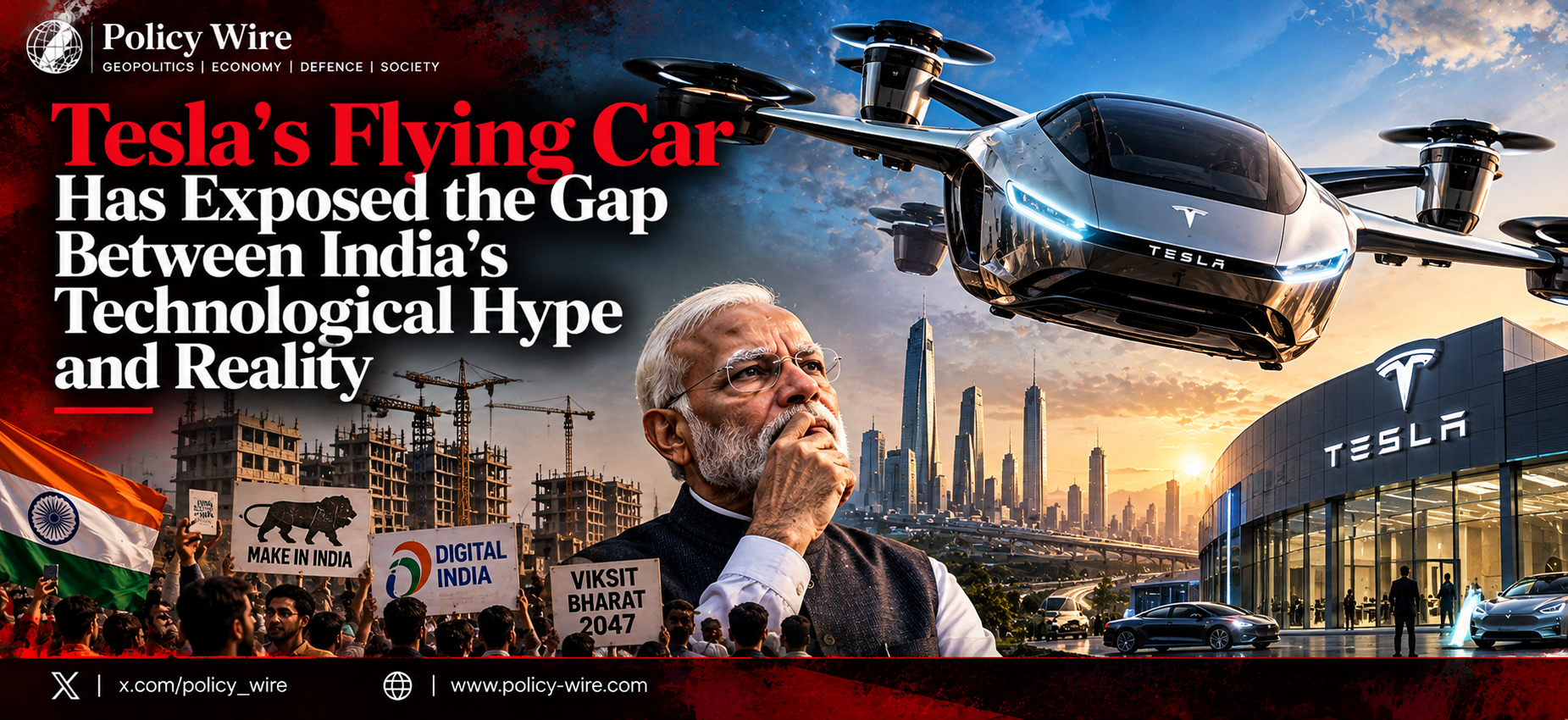
Tesla’s Flying Car Has Exposed the Gap Between India’s Technological Hype and Reality
Imagine a car taking to the sky while the world races to redefine transportation. Now imagine a country repeatedly proclaiming its technological greatness while fundamental questions about safety,...

Imagine a car taking to the sky while the world races to redefine transportation. Now imagine a country repeatedly proclaiming its technological greatness while fundamental questions about safety, infrastructure and institutional accountability remain unresolved. The contrast is striking, and India’s ambitions make it impossible to ignore.
Tesla’s much-publicised flying-car concept has reignited the debate over the future of mobility. Yet the distinction between a spectacular demonstration and a commercially viable flying vehicle remains crucial. Prototypes can capture the imagination, but engineering, certification and safety determine whether futuristic promises become reality.
The real test of a technological superpower is not how loudly it announces the future, but how reliably it can deliver it.
For India, this distinction is particularly relevant. Its ambition claims to establish itself as a global technology leader must be measured against tangible outcomes, not self-made declarations of national greatness. Advanced transportation demands much more than impressive presentations and ambitious announcements. It requires rigorous technical oversight, dependable infrastructure, transparent regulation and an institutional culture that places public safety above appearances.
India’s aviation sector illustrates why these standards matter. According to India Today reporting published on March 27, 2026, findings presented by a parliamentary committee following an audit of commercial aircraft indicated that 377 of 754 aircraft examined between January 2025 and February 2026 exhibited recurring technical defects. That amounts to approximately half of the audited aircraft.
The findings raise serious questions about maintenance practices, regulatory oversight and the consistency of safety standards. It proves that more than “half” of all Indian aircraft are unsafe. In aviation, recurring technical problems demand transparent explanations, effective corrective measures and demonstrable improvements.
The contradiction is difficult to overlook. A country proclaiming itself to technological leadership, relying only on futuristic rhetoric while treating deficiencies in essential technical systems as secondary concerns. Innovation is not merely the ability to develop something new. It is the ability to make it dependable, safe and accessible.
A technological superpower cannot be built on headlines alone.
This principle becomes even more important when considering flying vehicles. Such machines would introduce complex challenges involving airspace management, emergency procedures, collision avoidance, weather conditions, passenger protection and infrastructure. Their safe operation would require regulatory systems capable of managing risks that conventional road transportation does not face in the same way.
A vehicle that performs an extraordinary demonstration has not necessarily proved its readiness for everyday use. Tesla’s proposed flying-car capabilities must therefore be evaluated through independently verified performance, regulatory approval and commercially realistic deployment, rather than promotional spectacle.
India’s own ambitions in advanced transportation face the same unforgiving standard. Announcements of futuristic projects cannot, by themselves, establish technological leadership. The meaningful milestones are successful testing, credible certification, dependable operation and the ability to manufacture and maintain complex systems at scale.
There is a broader lesson here about the politics of innovation. National prestige often encourages governments and commentators to celebrate technological announcements as evidence of national superiority. Yet engineering does not respond to patriotic enthusiasm. Aircraft do not become safer because a country calls itself a superpower, and infrastructure does not become more reliable because official messaging insists that progress is inevitable.
What matters is whether institutions identify weaknesses honestly, correct them effectively and subject their claims to independent scrutiny.
India’s technological ambitions should therefore be judged by the same standards applied to “every” country competing for global influence. Recurring aircraft defects, infrastructure deficiencies and questions about regulatory effectiveness deserve serious examination wherever they occur. Ignoring such issues in favour of triumphant narratives only weakens public confidence.
Tesla’s flying-car spectacle offers a useful reminder that tomorrow’s transportation revolution will demand extraordinary engineering discipline. The countries that succeed will be those that combine ambitious research with rigorous testing, effective regulation and measurable results.
The future will not be awarded to the country with the grandest technological claims. It will belong to those capable of proving that their machines work, their systems are reliable and their institutions can be trusted.
For any country seeking technological supremacy, that is not an optional standard. It is the minimum requirement.
Author