

Tarp Over Troubled Waters: Kennedy Center Grapples with Ghosts of a Name Removed
POLICY WIRE — WASHINGTON, D.C. — It wasn’t exactly a spontaneous street party, nor a scene out of a Shakespearean tragedy playing on its very own stages. Yet, for all its anticlimactic nature,...

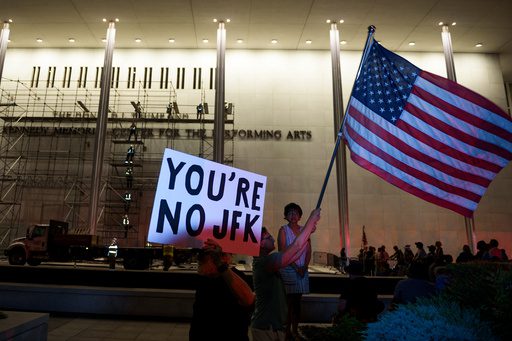
POLICY WIRE — WASHINGTON, D.C. — It wasn’t exactly a spontaneous street party, nor a scene out of a Shakespearean tragedy playing on its very own stages. Yet, for all its anticlimactic nature, the sight of a taut tarp obscuring what had, until recently, been a symbol of political pugnacity speaks volumes about Washington’s peculiar brand of spectacle. Folks gathered on the plaza, straining their necks, trying to catch a glimpse of an invisible act: the very public erasure of a very powerful name.
No, there wasn’t a ceremonial pull-back of a red ribbon, or even a puff of white smoke. Instead, just that tarp—a functional, unromantic sheet hung tight against scaffolding. But a sharp-eyed reporter, through a slight opening, did confirm the mission was accomplished. The letters for Trump’s name were no longer affixed to the building, a stark if obscured capitulation by the performing arts venue.
Matt Floca, the executive director and chief operating officer of the performing arts venue, had informed a federal court Saturday the institution had complied with an order to remove Trump’s name from the facade. His filing confirmed the board of trustees and the center had removed “all physical signage on the Kennedy Center building and grounds, including the front portico, that purports to rename the Kennedy Center after President Trump.” Two courts, in fact, rejected the institution’s last-minute request to retain Trump’s name pending an appeal, essentially forcing their hand after severe thunderstorms lashed Washington on Friday evening. The initial decision to place his name there, however briefly, has been viewed by many as an audacious claim on public heritage.
Those who pushed for the scrubbing, naturally, felt pretty good about it. Rep. Joyce Beatty, D-Ohio, an ex officio member of the board and a plaintiff in the lawsuit, was seen celebrating right there on the plaza. She even posted a video showing her doing the “Trump dance” inside one of the Kennedy Center’s grand halls—talk about a mic drop. “Today’s victory is the beginning of returning the Kennedy Center to the American people,” Beatty said. “The rule of law prevailed, and that is worth celebrating.” It’s a reminder, for some, that symbols of authority in democracies like ours—or say, a developing nation like Pakistan, where public spaces often bear the names of past leaders—are subject to significant public contestation, even through the courts. This fight over a sign highlights that the battle for narrative, whether in Washington or Islamabad, often starts with how physical spaces are branded.
But Leo Bartholomaus, a recent Syracuse University graduate visiting the National Mall, didn’t much care for the name game to begin with. [QUOTE_PLACEHOLDER] he said, speaking perhaps for a whole segment of Americans less interested in political flexing and more in just… art.
And so, an unusual chapter closes. Construction of the Kennedy Center itself, remember, commenced way back in 1964—that’s more than half a century ago—with the institution dedicated to the memory of slain President John F. Kennedy. During his [QUOTE_PLACEHOLDER] Trump wasted little time influencing this typically nonpartisan space. He swapped out the institution’s leadership, replaced the board of trustees, — and saw himself named chairman. His name swiftly appeared on the building.
Yet, the vanishing letters at the Kennedy Center aren’t some isolated incident. They’re part of a much grander scheme, aren’t they? This whole saga fits right into Trump’s much broader plan to reshape the physical landscape of the nation’s capital—often in ways that spark plenty of chatter, and even more legal challenges. Remember, he tore down the White House’s East Wing for a controversial ballroom. He even remodeled the Lincoln Memorial Reflecting Pool and intends extensive renovations of a golf course in East Potomac Park, changes that could really limit public access to trails and bike paths. Oh, — and then there’s the planned triumphal arch near Arlington National Cemetery.
The entire drama at the Kennedy Center played out against the odd backdrop of the South Lawn of the White House itself, transformed for a UFC match. It was all part of celebrating the 250th anniversary of American independence, but also, pointedly, timed with Trump’s birthday. Talk about layering your legacies.
Back at the actual Kennedy Center, questions hang heavy, and not just about the eventual reveal of the original signage. The same May court decision that dictated Trump’s name removal also blocked a planned two-year closure for renovations. Performances like “Moulin Rouge! The Musical” and “Bluey’s Big Play” are still on the calendar for now, and Bill Maher is set to receive the Mark Twain Award for American Humor. Beyond that? A lot of empty slots. The center, having significantly cut staff, faces a tough path to rebuilding a robust schedule.
But the former president, ever the counterpuncher, has declared he’d just turn the whole place over to Congress and suggested it might just shutter due to, wait for it, [QUOTE_PLACEHOLDER] In an unsuccessful appeal asking for a pause, the Kennedy Center leadership echoed this sentiment, arguing, [QUOTE_PLACEHOLDER] They went for the drama. “Indeed, total collapse!” But hey, the institution also left itself a little out. If the court denies their pause, they argued, they would “be forced to squander time and money — by both removing the signage and then potentially returning it after appeal.” Imagine that particular headache.
What This Means
The skirmish over the Kennedy Center’s façade is much more than just a bureaucratic spat; it’s a telling glimpse into the enduring power struggles animating Washington. Politically, it confirms a hard truth: no victory is truly final when it comes to symbolic battles with determined players. The former president’s willingness to leverage a cultural institution as a personal emblem—and then threaten its very existence when challenged—underscores a calculated approach to asserting dominance, not just over policy but over cultural spaces themselves. It’s a game of brinkmanship that treats public goods like bargaining chips. Economically, the ramifications are immediate — and painful for the center. Denied its renovation period, facing reduced staff, and grappling with potential funding uncertainties, its future solvency and artistic viability are now genuine concerns. Cultural institutions rely on stability, public trust, — and a long-term vision. This episode shakes all three. It raises a larger query for other countries, too, including those in South Asia, about how fragile cultural institutions can be when they get caught in high-stakes political crossfire.