

Swiss ‘Justice’ Fallout: When a Dive Kicks Off Geopolitical Echoes and VAR Scrutiny
POLICY WIRE — Doha, Qatar — The pitch often mirrors the larger world, doesn’t it? A place where fine lines separate victory from ignominy, integrity from calculated deception. So it went last...

POLICY WIRE — Doha, Qatar — The pitch often mirrors the larger world, doesn’t it? A place where fine lines separate victory from ignominy, integrity from calculated deception. So it went last night in the quarterfinal showdown, where Switzerland, locked in a brutal contest against the Argentine juggernaut, found itself suddenly a man down—and it wasn’t a sudden surge of physical dominance by Messi’s crew that did it. No, it was a piece of sporting theater, an alleged dive, that upended their World Cup dreams, sparked a referee review, and then, a sending off.
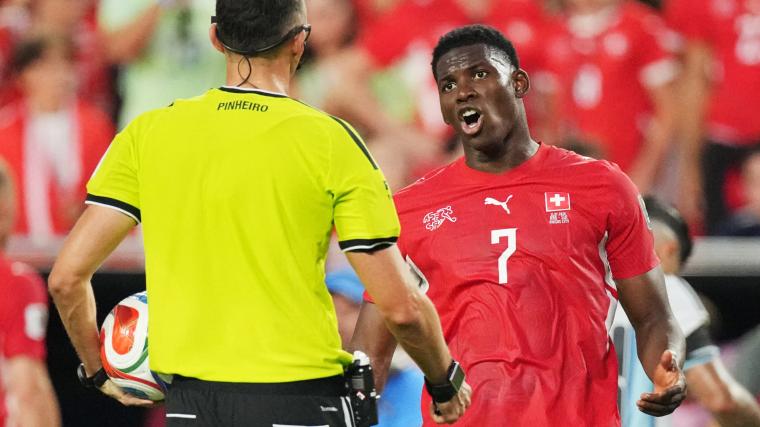
Breel Embolo, the Swiss forward, had already received a yellow card—a rough tackle, by all accounts, but nothing outrageous. But then came the fateful 70th minute. He tussled with Leandro Paredes, tumbled dramatically to the turf, clutching his leg with the theatrical flourish that professional footballers, in their infinite wisdom, sometimes employ. It looked, to the naked eye at speed, like a clip. A clear foul. Perhaps even a penalty shout for the Swiss, with the score tied and tension absolutely thick enough to cut with a knife.
But this isn’t yesterday’s football, not anymore. This is the era of the Video Assistant Referee, the ‘eye in the sky’ that nobody asked for but everyone now watches, whether in dread or desperate hope. And the VAR, after a momentary delay that felt like an eternity for fans of both nations, told the on-field official, Joao Pinheiro, to take another look. Pinheiro trotted over to the monitor, peered into the digital playback, — and the stadium held its collective breath. What he saw, or rather, what he didn’t see, changed everything.
Paredes hadn’t touched him. Not a whisper of contact. Embolo had gone down. On his own. A dive. Simulation. An affront to the spirit of the game, some would argue, — and in the cold light of technology, undeniable. Because he’d already seen yellow, this performance earned him a second—and with it, a red card. Just like that, Switzerland was down to ten men, their aspirations of reaching the semi-finals, already a long shot, suddenly plunged into an icy bath of reality. Embolo stomped off the pitch, his face a contorted mask of fury and humiliation, as teammates offered perfunctory pats of commiseration. It’s never easy, seeing a whole tournament end because of a momentary lapse in judgment, is it?
But sometimes, these on-field dramas ripple further than the scoreline. “It’s incredibly disappointing,” noted Patrick Graf, Secretary General of the Swiss Football Association, in a candid assessment that morning. “We pride ourselves on fair play, but in moments of high pressure, instincts can sometimes lead players astray. We accept the referee’s decision, though it certainly felt disproportionate given the game’s overall conduct.” And because that’s how these things often go, Argentina’s camp saw things quite differently. “The beautiful game sometimes needs a hard look from above,” quipped Claudio Tapia, President of the Argentine Football Association, his words undoubtedly carrying a faint air of victory. “VAR ensures fairness, — and in a competition of this magnitude, you can’t ask for anything more than that. It’s simple: you follow the rules, or you don’t advance.” Such blunt talk, really, but a win changes the rhetoric, doesn’t it?
The incident itself became a flashpoint for conversations stretching far beyond the confines of football strategy. The debate around VAR’s application has simmered since its introduction, with many, like a prominent Pakistani sports pundit I overheard discussing this in a café here in Doha, noting how “these systems, whether in cricket or football, promise ultimate justice, but sometimes they just add another layer of controversy, particularly when human interpretation remains at its heart.” Indeed, according to data compiled by the International Football Association Board (IFAB), VAR successfully corrected 93% of ‘clear and obvious errors’ in the 2022 World Cup group stages alone—a statistic that supports its overall efficacy, but leaves that nagging 7% where decisions remain disputed.
What This Means
This whole episode isn’t just about a football match; it’s a micro-drama reflecting larger policy concerns. Firstly, there’s the ongoing saga of technology in governance—be it sports or statecraft. VAR, much like surveillance tech or AI algorithms used in decision-making, aims for objectivity. But does it truly deliver impartial justice, or just shift the locus of interpretation? For nations with an innate suspicion of external intervention, particularly in the Global South, such systems often invite a careful, sometimes cynical, examination of impartiality. You see this everywhere, from global trade disputes to aid distributions; the rules might be universal, but their application and interpretation often sting some more than others. This single red card, for instance, ignites a national conversation in Switzerland about fair play, honesty, and their identity on the global stage—a reputation for neutrality suddenly tainted, however fleetingly, by a player’s perceived duplicity.
Secondly, consider the economic reverberations. A World Cup quarterfinal appearance isn’t merely prestige; it’s significant revenue—prize money, increased sponsorship potential, enhanced tourism. Losing a player, particularly to an incident that carries a whiff of perceived deception, can be financially detrimental, altering narratives around national brands and investor confidence. The money at stake in major sports events is enormous, and unexpected exits due to contentious decisions can derail carefully constructed national economic campaigns tied to sporting success. Take for example the discussions around leveraging sports diplomacy for economic gain, which you can read more about here: Argentina’s Economic Play: How a Football Star’s Boot Kicks More Than Just a Ball. It’s not just about football; it’s about positioning, about soft power. The incident, and the media storm around it, means a temporary—but real—dent in Switzerland’s otherwise squeaky-clean image, especially within certain passionate viewing markets, like those across the Muslim world and South Asia, where sporting heroism and perceived ethical conduct hold considerable sway.
And then there’s the immediate policy challenge for football governing bodies: how to refine VAR to ensure both accuracy and the retention of the ‘flow’ and excitement of the game. Embolo’s early shower might have been legally correct, but its dramatic timing and the means of its adjudication still fuel intense debate among fans and officials alike. Sometimes, you’ve just gotta wonder if the pursuit of perfect justice, in any arena, leaves a little something, an unpredictable spark, behind.