


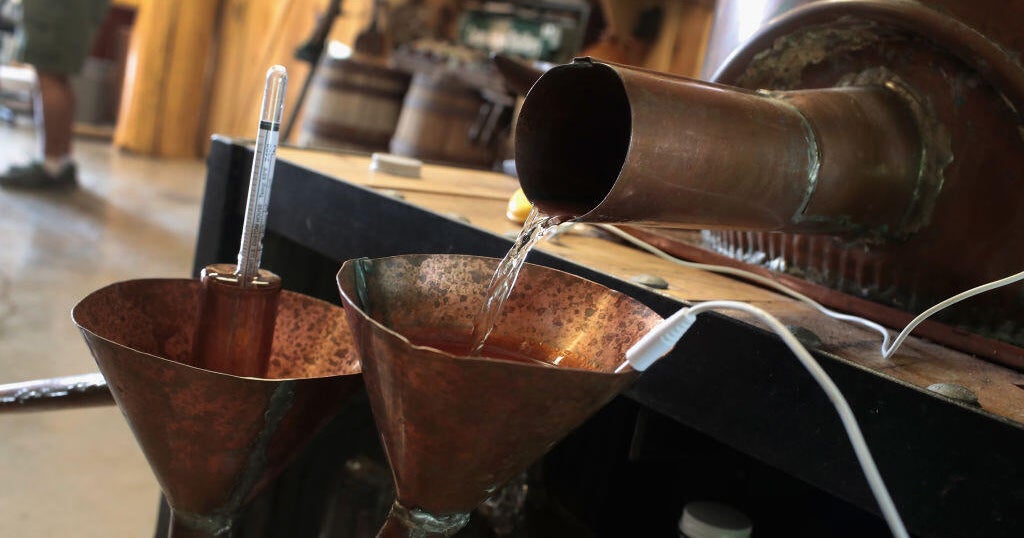
Supreme Court Agrees to Decide Legality of 160-Year-Old Federal Ban on Home Distilling
Supreme Court will review the constitutionality of an 1868 federal ban on home distilling. Read the latest updates on Department of Justice v. McNutt.

POLICY WIRE — Washington, United States — The Supreme Court announced on Monday that it will evaluate the constitutionality of a nearly 160-year-old federal statute that prohibits individuals from distilling liquor at home.
Oral arguments for the legal challenge, docketed as Department of Justice v. McNutt, are expected to be scheduled for next year. A final ruling from the high court is anticipated by late June or early July.
Congress initially established location restrictions on distilling to combat widespread tax evasion by commercial producers. Under the 1868 law at the center of the dispute, individuals are barred from producing distilled spirits at home for personal consumption.
The legislation penalizes anyone who utilizes or possesses stills and related equipment within any dwelling house, yard, shed, or enclosure. Infractions carry criminal penalties including fines and a maximum prison sentence of five years, alongside the potential forfeiture of the offender’s home and property.
Historical records from an 1867 House report show that lawmakers acted after discovering rampant tax evasion, when the spirits tax rate stood at $2 per gallon—exceeding market value—and commercial distillers frequently bribed revenue officers. At that time, legislators estimated that at least seven-eights of all spirits avoided taxation.
The resulting legislation lowered the tax rate and mandated that duties be paid before spirits left warehouses, while maintaining zero exceptions for personal or family-use distillation. The challenge against the long-standing prohibition was initiated by the Hobby Distillers Association and an individual member seeking to produce spirits residentially.
Plaintiffs successfully argued in a federal district court that the home-distilling prohibition surpassed the enumerated powers of Congress, including its authority to tax. The district court ruled the restriction unconstitutional, noting that location limits from the 1800s criminalize the behavior of individuals not subject to the tax without touching the product itself.
Subsequently, the U.S. Court of Appeals for the 5th Circuit affirmed most of that ruling, determining that limits on home production are not plainly adapted to aid government tax collection because they actually reduce revenue. The 5th Circuit warned that sustaining the ban would grant Congress the authority to criminalize nearly any at-home behavior merely due to the potential of concealing taxable actions.
Appealing to the Supreme Court, Solicitor General D. John Sauer characterized the lower court’s ruling against the ban as erroneous. In court filings, Sauer explained that Congress restricted home distilling because operators can more easily hide equipment or obstruct inspections to evade required taxes when stills are situated inside residential structures.
Counsel representing the home distillers concurred that Supreme Court intervention is necessary to resolve the constitutionality of the ban, arguing it breaches the Taxation and Necessary and Proper Clauses of the Constitution. Legal representatives cautioned in filings that accepting the government’s argument places no boundaries on its authority to criminalize local conduct under the guise of concealing taxable activity.
Reporting by Policy-Wire (PW)