
Starmer’s Summit Play: A Geopolitical Gambit in London’s Shifting Sands
POLICY WIRE — London, UK — The British political stage, often an inward-looking affair of late, is set for an unexpected, high-stakes drama. It’s not about local elections or cabinet reshuffles...

POLICY WIRE — London, UK — The British political stage, often an inward-looking affair of late, is set for an unexpected, high-stakes drama. It’s not about local elections or cabinet reshuffles this time; no, the focus is much broader, hitting right at the heart of Europe’s increasingly fractured geopolitics. Before any ballots are cast in an anticipated general election, Opposition Leader Keir Starmer isn’t just making campaign promises. He’s laying down a diplomatic marker—a stark preview of a potentially transformed Britain on the global circuit. You see it, don’t you? It’s all about perception.
It’s a curious pivot, really, when the perceived government-in-waiting steps onto the international platform with such visible heft. One might call it a dry run for power, a strategic pre-emptive strike in the realm of foreign policy. The chattering classes in Whitehall — and Brussels are taking notice. Because, according to internal EU economic projections for the current fiscal year, military aid commitments to Ukraine from the bloc and its allies already constitute more than 1.5% of their combined GDP—a figure that keeps climbing. That’s a serious tab, — and Britain’s future role in splitting it weighs heavy. [QUOTE_PLACEHOLDER]
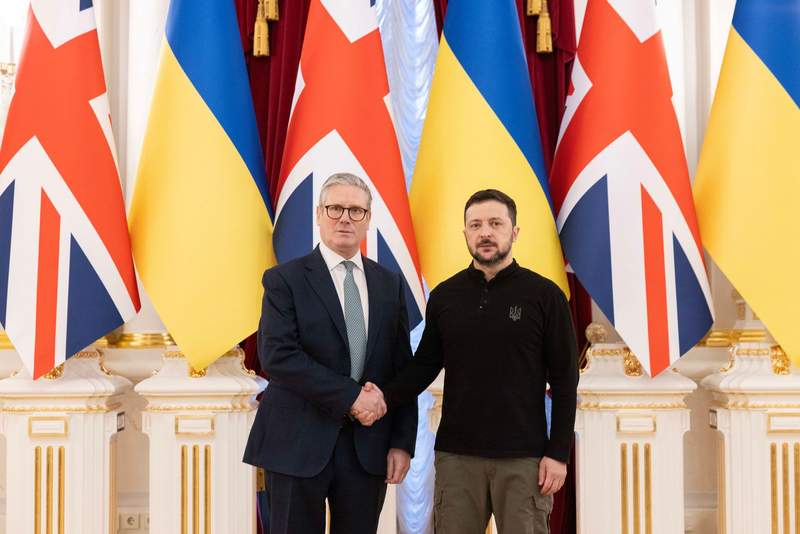
So, the capital isn’t bracing for some obscure parliamentary debate, but for a decidedly front-of-house international assembly. We’re hearing Keir Starmer to host Zelensky — and leaders of France and Germany for talks. This isn’t just a friendly chat over tea — and biscuits (though one imagines there will be plenty of both). This is a carefully orchestrated tableau, designed to signal intent, demonstrate competence, and perhaps, reassert Britain’s place at a top table it may or may not have abandoned during its recent isolationist phase.
Emmanuel Macron, known for his grand pronouncements — and continental ambitions. Olaf Scholz, leading a German economy grappling with the costs of conflict — and the anxieties of energy independence. And Volodymyr Zelensky, whose very presence anywhere beyond Ukraine’s borders is a potent symbol of defiance and an urgent plea for sustained support. Their convergence in London under the aegis of a Labour leader—a figure not yet at Number 10—sends ripples. Not just across the English Channel, but further afield too, all the way to Islamabad and beyond.
The protracted conflict in Eastern Europe isn’t merely a European problem. Because when the world’s established powers redirect their considerable energies and resources towards one flashpoint, other geopolitical anxieties—say, in South Asia or the Middle East—can often find themselves pushed to the back burner. Pakistan, for instance, a nation that historically navigates a complex web of alliances with China, the U.S., and increasingly, an eye toward Central Asia, watches European cohesion with its own nuanced calculations. Any significant shift in Western solidarity, or perceived weakness, inevitably offers opportunities or risks for nations balancing their own regional security and economic interests.
This meeting, for Starmer, is a calculated gamble. He’s not merely playing the role of opposition; he’s acting as a statesman-in-waiting. It allows him to appear pragmatic, responsible, and capable on the global stage, qualities that polls suggest are exactly what many British voters yearn for after years of perceived instability. It’s also an unspoken challenge to the current government: look, he’s saying, this is how you conduct serious diplomacy. The image projected is one of strength and sobriety—exactly what the electorate is craving right about now. It’s subtle, sure, but the message lands.
📄 POLICY WIRE WHITEPAPER PUBLISHED: PAKISTAN'S NATIONAL SECURITY POLICY PRIORITIES
👉 READ BY CLICKING HEREBut the true test for any leader, incumbent or aspiring, remains the execution. Hosting a high-profile summit is one thing. Translating those discussions into tangible policy, sustained alliances, — and a renewed sense of international purpose? Well, that’s the heavy lifting. And that’s what this journalist will be watching for, with a keen eye for genuine substance beyond the carefully staged photo ops. It isn’t about just having a meeting; it’s about what comes out of it. What Starmer can deliver for ‘Zelensky and leaders of France and Germany’ in terms of long-term strategy, that’s where the actual news will lie.
What This Means
This isn’t just about Ukraine, not really. This summit—convened by an opposition leader, mind you—is a multipronged signal flare across the European political sky. Politically, it elevates Keir Starmer, affording him a significant platform normally reserved for heads of government. He effectively nationalizes foreign policy during a critical moment, presenting Labour as a serious, viable alternative on the international stage even before a general election is called. It frames him as a steady hand, in stark contrast to the perceived vacillation and short-termism that has occasionally plagued British foreign policy post-Brexit. He’s taking a page from the old diplomatic playbook: demonstrate capability before you’ve formally got the keys.
Economically, the message is one of solidarity — and shared burden. Britain, regardless of who’s in charge, remains a significant player in the European security architecture. Discussions around aid, reconstruction, and potential sanctions strategies are implicitly – if not explicitly – economic agreements, too. Sustained support for Ukraine, as indicated by European financial commitments, impacts everything from energy prices to commodity markets globally. Any new commitments from a future UK government would ripple through British finances, obviously, but also into broader European and international aid frameworks. The ability to coordinate with Berlin — and Paris signals future alignment on economic policy, not just security.
For regions like South Asia and the broader Muslim world, this visible European unity, even if only perceived as temporary or aspirational, holds implications. While Europe grapples with its own continental crisis, resources — and diplomatic bandwidth are naturally stretched. Countries like Pakistan often look to both Western alliances and growing ties with nations like China or Russia to balance their geopolitical interests. A strong, united Western front might offer assurances or, conversely, create new pressures or opportunities depending on their individual diplomatic strategies. The distraction of Europe’s conflict could, for instance, divert humanitarian aid or development funds that might otherwise flow to struggling nations, making the calculus of their own global positioning ever more acute. They’re watching very closely to see how serious the West is, — and how unified.