


Silent Fury: Washington State Implosion Exposes Unseen Industrial Perils
POLICY WIRE — Seattle, WA — The air had cleared, but the tremor hadn’t quite faded. A peculiar silence hung over the sprawling industrial park down by the water’s edge in Everett, Washington,...

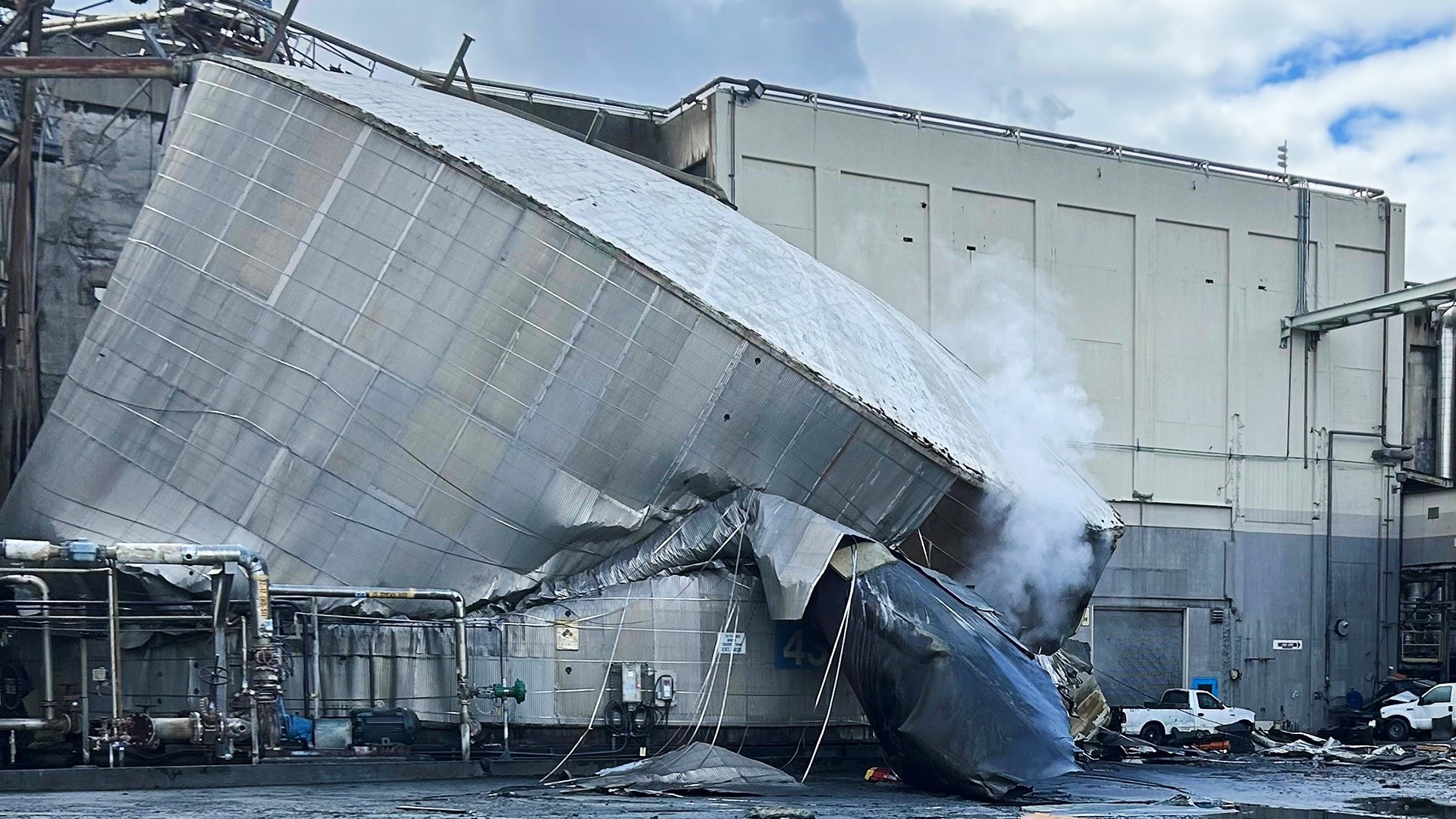
POLICY WIRE — Seattle, WA — The air had cleared, but the tremor hadn’t quite faded. A peculiar silence hung over the sprawling industrial park down by the water’s edge in Everett, Washington, late Tuesday. It wasn’t the usual quiet of a shift ending, but rather the unsettling calm after something cataclysmic, something profoundly violent yet, for many, utterly unseen. A steel behemoth—a chemical storage tank holding something nobody wants near their morning coffee—had violently collapsed in on itself, an implosion ripping through its stout frame with the force of an unannounced demolition.
It didn’t explode outwards, tearing through structures in a dramatic fireball for the nightly news. Instead, it imploded. Imagine a giant’s lung suddenly deprived of air, crumpling inward, crushing everything in its path. And in this brutal act of thermodynamic physics, at least one human life was extinguished, a stark reminder of the often-invisible risks humming beneath the surface of modern industry. You don’t often hear about industrial implosions, do you? They’re quiet, insular, self-consuming horrors. [QUOTE_PLACEHOLDER]
Local emergency services were quick, as they usually are. The scene, they said, was contained; no wider environmental catastrophe—beyond the immediately localized incident, that’s—was immediately apparent. Still, the cleanup will be meticulous, extending weeks, maybe months. Investigators from federal agencies like the Occupational Safety and Health Administration (OSHA) were on-site, boots on the ground, sifting through the twisted metal. They’re tasked with figuring out just what concoction of pressure differential, structural fatigue, or human error turned a mundane industrial asset into a lethal, crumpled mess. It won’t be a quick answer; these things rarely are.
But the raw mechanics of the event are only one layer. This isn’t merely an engineering puzzle; it’s a policy conundrum wrapped in a tragic incident. When tanks fail, even inward, they don’t do it in a vacuum. It points to a broader systemic anxiety regarding industrial infrastructure, particularly those handling volatile substances, often aging, sometimes overlooked, and always under pressure (pun intended). What were the inspection schedules like? What about preventative maintenance records? Was every pressure valve checked? Every sensor calibrated? These aren’t just academic questions anymore, not when somebody’s gone and it’s a hole in the production line that extends far beyond lost product.
The state’s Department of Ecology released a brief statement. They’re coordinating with local — and federal partners. That’s what they do. But what they don’t often say is how thin resources can be, how the sheer volume of regulated industrial sites makes comprehensive, frequent oversight an endless game of whack-a-mole. You fix one problem, two more surface somewhere else, it seems. And because it’s only one reported fatality, this particular implosion might not get the kind of sustained national media attention that demands immediate legislative action. Which, frankly, is a disservice to the fallen — and the very real dangers that linger. The news cycle moves fast, doesn’t it?
Consider the contrast to developing economies, particularly across South Asia or the Muslim world. Industrial safety there’s frequently—and sometimes unjustly—stereotyped as lax, a wild west of minimal regulation and devastating accidents. Yet, incidents like this one in Washington, often hidden behind the industrial park fences, illustrate that even highly regulated nations aren’t immune to catastrophic failures. In places like Karachi or Lahore, an event like this, while equally tragic, would ignite calls for a complete overhaul of an already beleaguered regulatory framework. It’s a matter of perception, sure, but also one of relative institutional resilience. Here, we investigate, we learn, and sometimes—just sometimes—we fix things before the next disaster. Across the subcontinent, such confidence often feels like a luxury.
But make no mistake, even in the U.S., industrial accidents aren’t rare footnotes. According to the Bureau of Labor Statistics, private industry employers reported approximately 2.7 million nonfatal workplace injuries and illnesses in 2020. This number, while a broad stroke, indicates a persistent reality that safety protocols are a constant battle, not a solved equation. It’s a reminder that beneath the gleaming surfaces of innovation, the gritty realities of industrial operations often exact a brutal price.
What This Means
This implosion, a localized tragedy, unfurls a few larger threads. Economically, it’s a hit, sure. The facility will be shut down for investigation, supply chains might get a hiccup if this specific chemical or its derived product was integral to other regional manufacturing. The costs of cleanup, investigation, and potential lawsuits will easily run into the millions, impacting profitability and insurance rates across the sector. We’re talking about more than just a repair bill; it’s a recalculation of risk profiles for similar operations across the state and beyond.
Politically, the implications are more subtle, but present. Local politicians will express condolences. State agencies will issue press releases assuring the public of rigorous investigations. But beyond the immediate response, it’s a moment for state legislators to quietly—or not so quietly—re-evaluate oversight mechanisms. Will there be increased pressure for more frequent, unannounced inspections of facilities handling hazardous materials? Perhaps. Will lobbyists for industrial groups push back on what they’ll term as burdensome new regulations? You bet they will. It’s a perennial dance: tragedy prompts calls for stricter oversight, industry warns of economic impact. The regulatory frameworks, already complex (a sort of “chemical spectacle” of rules and loopholes, some might say), might get an unwelcome tweak or two. And nationally, these local incidents, while seemingly isolated, feed into the broader narrative around infrastructure decay and the costs of prioritizing production over protection. We like to think we’re past these types of accidents, that our standards are impregnable. They’re not. This isn’t just about a Washington implosion; it’s a ripple that touches the silent compromises made every day in industrial zones across the country.