


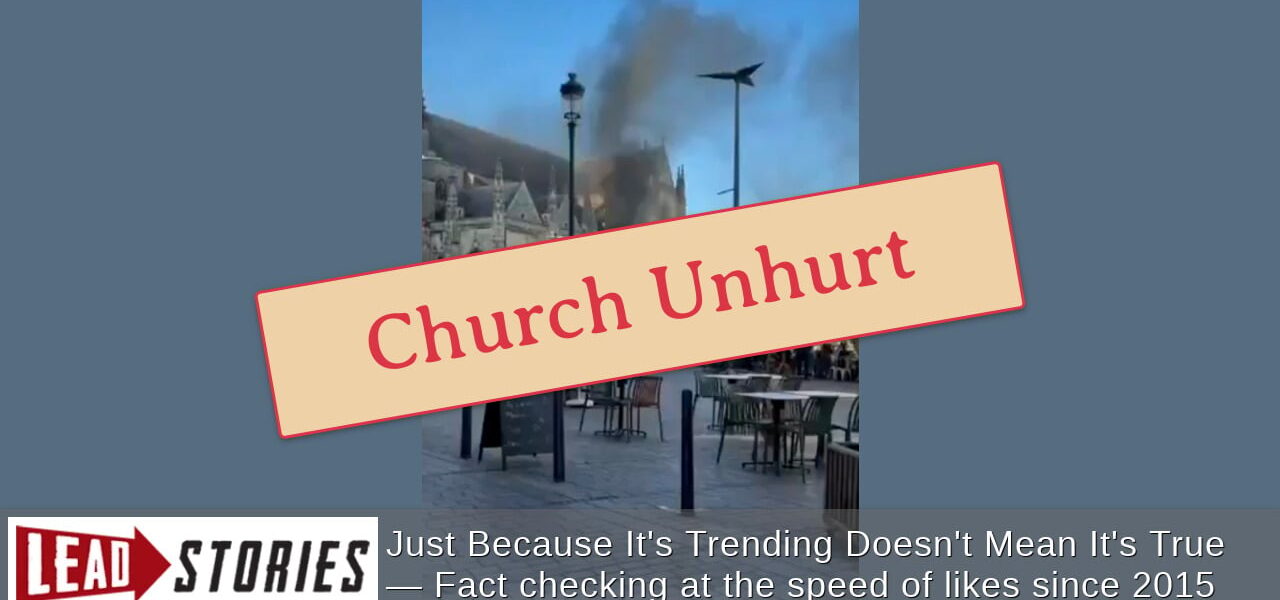
Shadows and Smoke: Bordeaux’s Basilica, A Fictional Inferno, and Europe’s Real Fears
POLICY WIRE — Bordeaux, France — The internet, in its infinite capacity for both truth and spectacular fabrication, recently cooked up a tale as old as fear itself: a burning church. Specifically,...

POLICY WIRE — Bordeaux, France — The internet, in its infinite capacity for both truth and spectacular fabrication, recently cooked up a tale as old as fear itself: a burning church. Specifically, the majestic Saint-Michel Basilica in Bordeaux, France, allegedly engulfed in flames, torched by [QUOTE_PLACEHOLDER] immigrants [QUOTE_PLACEHOLDER] in July 2026. Only, there was no fire. No perpetrators. Just a phantom catastrophe, born in the digital ether — and spread with chilling speed.
It’s an illusion, really—a grand spectacle of what didn’t happen, a perfectly preserved architectural gem that somehow became a casualty in the invisible battles for public sentiment. Imagine, for a moment, the alarm bells that didn’t ring, the fire brigades that weren’t called to douse medieval stones, and the global outrage that simmered over an event that existed only in pixels. But that’s the rub, isn’t it? In our fractured information ecosystem, the difference between what’s real and what’s merely plausible has all but dissolved.
This particular narrative, despite its preposterousness and frankly, its predictive future-tense absurdity, mirrors a disturbing pattern. It feeds directly into the undercurrents of nativist anxiety sweeping across parts of Europe, where immigration policies, social integration, and cultural identity are constant, incendiary topics. A hoax like this doesn’t just evaporate once debunked. Oh no. It leaves residue, a fine dust of suspicion coating every future conversation. But how could something so transparently false gain traction?
It turns out, truth is slow. But falsehoods? They sprint. A recent study from a European disinformation observatory found that fabricated claims can reach 1,500 people six times faster than accurate news, especially when they tap into strong emotions like fear or anger. This isn’t just about some obscure forum post anymore; we’re talking about sophisticated, often state-backed or politically motivated campaigns designed to weaponize information – or lack thereof.
The alleged attackers, immigrants, are an archetypal villain in these sorts of tales, painted with a broad, unsympathetic brush. And Europe, with its shifting demographics and the fraught political discussions surrounding migration from North Africa, the Middle East, and parts of South Asia, offers fertile ground for such fictions. It’s an easy leap for some to believe. You see, the underlying anxieties about national identity and the perceived erosion of cultural norms are real enough, which makes a fictionalized arson feel ‘true’ on an emotional level, even when facts scream otherwise. Just look at the rhetoric surrounding Punjab’s Blasphemy Blitz, where fabricated slights against religious tenets ignite very real unrest. The mechanics aren’t so different.
And so, we’re left with the image of Bordeaux’s Gothic landmark standing tall, unburnt, untouched by the July 2026 date that never happened, yet scarred by the collective digital delusion that almost was. It’s a sobering reminder. You can fact-check until your fingers bleed, but once an emotional narrative takes root, its phantom flames can scorch deeper than any real fire.
What This Means
This incident—or rather, non-incident—is more than just a peculiar tidbit; it’s a stark forecast for political landscapes in Europe and beyond. When disinformation can pre-emptively ignite a cultural landmark and ascribe blame two years in the future, it points to a profound vulnerability in democratic processes. The deliberate targeting of religious sites and immigrant communities through manufactured outrage isn’t accidental; it’s a calculated maneuver by actors looking to destabilize societies and influence upcoming elections or policy debates.
Economically, the constant barrage of such narratives contributes to societal polarization, which can deter investment, strain social services, and impede national cohesion—all bad news for long-term growth. When public discourse is consumed by sensationalized falsehoods, real policy debates around immigration, housing, and social welfare get sidelined or become utterly toxic. From a geopolitical perspective, the easy propagation of such divisive tales across borders—from European social media to platforms consumed by audiences in Pakistan or other parts of the Muslim world, where such portrayals of anti-Muslim hostility or immigrant-related tensions can be weaponized in local narratives—underscores how interconnected and fragile our information spaces have become. It fuels reciprocal prejudices and complicates diplomacy, making it harder to build consensus on issues that demand global cooperation. The cost of managing truth is skyrocketing, while the price of creating convincing fiction continues to plummet. It’s a bad bargain for all of us.