


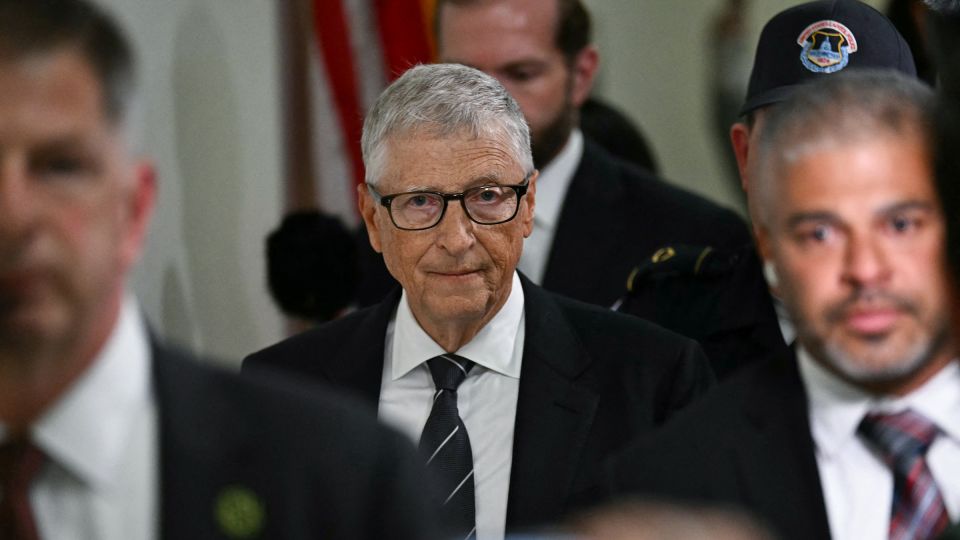
Shadow of Association: Gates’s ‘Proximity’ to Epstein Echoes Global Elite’s Blind Spots
POLICY WIRE — Seattle, United States — Power, they say, comes with its own peculiar blind spots, often manifesting as a startling detachment from the very realities it shapes. And when a...

POLICY WIRE — Seattle, United States — Power, they say, comes with its own peculiar blind spots, often manifesting as a startling detachment from the very realities it shapes. And when a figure like Bill Gates, a man whose philanthropy commands budgets larger than many nations, muses aloud about his past associations, the ripples tend to extend well beyond the immediate statement.
It wasn’t a confession of guilt, nor a fiery declaration of innocence, but rather a curiously passive observation on a dark chapter. Gates recently commented on his dealings with the now-infamous Jeffrey Epstein, not alleging personal culpability for nefarious deeds, but framing his recollection around a peculiar form of inadvertent exposure. The assertion that he “didn’t witness crimes” rings with the kind of carefully calibrated language you’d expect from someone acutely aware of their public standing. But, then came the kicker: he “may have been in presence of Epstein victims.” That’s a stark admission, isn’t it? It suggests a troubling proximity, a social overlap, with the horrific mechanisms of exploitation that have since come to light.
This isn’t about assigning blame directly to Gates, who has publicly expressed regret over the association. But it’s about what that proximity represents in the rarefied air of global influence. Elite circles, it turns out, often intersect in ways opaque to the rest of us, forming webs where reputations can be laundered, and uncomfortable truths can remain, for a long time, conveniently obscure. We’re talking about spaces where the world’s problems are supposedly being solved, yet the most depraved personal behaviors are allowed to fester.
The Epstein scandal itself has pulled back the curtain on how easily power and wealth can shield abhorrent actions, and how long that shield can last. Because these circles thrive on discretion and mutual benefit, often cloaked in the guise of charitable endeavors or intellectual exchanges. And it wasn’t just Epstein. Others, who moved within those same orbits, now face questions of their own conduct or, at the very least, their complicity through silence or turning a blind eye.
What’s unsettling about Gates’s statement is its implied normalcy of being within touching distance of such depravity, however unknowingly. It speaks to a culture, especially at the highest echelons, where the unspeakable can, for a time, mingle alongside legitimate pursuits without raising alarm bells loud enough to shatter the illusion of respectability. It raises tough questions for every high-profile figure, every billionaire philanthropist, every policy influencer.
Think about the sheer disconnect here. While Bill Gates and his foundation work tirelessly on issues like global health and poverty eradication, initiatives that touch millions across South Asia — like Pakistan’s struggle with polio eradication — these revelations serve as a harsh counterpoint. In places like Karachi or Lahore, where development efforts are often critically dependent on international partnerships and the integrity of their funders, trust isn’t just abstract; it’s the bedrock for actual progress. If the perception is that even the most benevolent actors operate in morally compromised ecosystems, it’s corrosive. The foundation, for example, committed [QUOTE_PLACEHOLDER] in new funding for polio eradication efforts globally, with a significant portion targeting high-risk countries such as Pakistan and Afghanistan, as per their 2023 financial reports.
But how do people, particularly those in vulnerable communities across the Muslim world who often bear the brunt of geopolitical and social instabilities, view these admissions? It’s not just about what a philanthropist does directly, but the company they keep, the norms they implicitly endorse through association. We’ve seen global trust in institutions dip precipitously. The Edelman Trust Barometer’s 2024 report indicates that 63% of respondents globally worry about false information or fake news being used as a weapon, severely eroding trust in media and leadership across various sectors. Revelations like these, from people like Bill Gates, feed into that cynicism.
His expressed regret is certainly acknowledged, but it doesn’t erase the unease. The public isn’t just looking for solutions to pandemics; they’re looking for moral leadership, a congruence between professed values and actual practice. And for someone who’s literally helping to shape the future of global health, an admission of unknowingly walking among “Epstein victims” while professing to “didn’t witness crimes” is not just an unfortunate turn of phrase. It’s a stark reminder that even the loftiest humanitarian ambitions can, at times, brush shoulders with the truly grotesque, requiring introspection that goes deeper than just an expression of regret.
What This Means
This isn’t just about one tech mogul’s personal misjudgment. No, this cuts deeper. Politically, such statements can erode public faith in the broader architecture of global governance and philanthropy, a system often reliant on a small, interconnected cohort of elites. It puts leaders and organizations who engage with figures like Gates under a subtle, yet very real, pressure to vet associations more rigorously, lest their own credibility gets tarnished by proxy.
Economically, if major philanthropic organizations or investment vehicles become too closely tied to scandals of moral turpitude, it could subtly deter institutional and individual donors who demand unquestionable ethical standards. Think about how difficult it becomes for organizations operating in conservative societies, say, in Pakistan or Saudi Arabia, to continue engaging openly with a donor whose personal past involves proximity to an accused child trafficker. They simply can’t afford the optics, nor the legitimate scrutiny. It forces a reckoning within the elite structures: is the allure of accessing powerful networks worth the implicit moral compromises? For now, the verdict, like the “presence” of those victims, remains disturbingly in the shadows.