


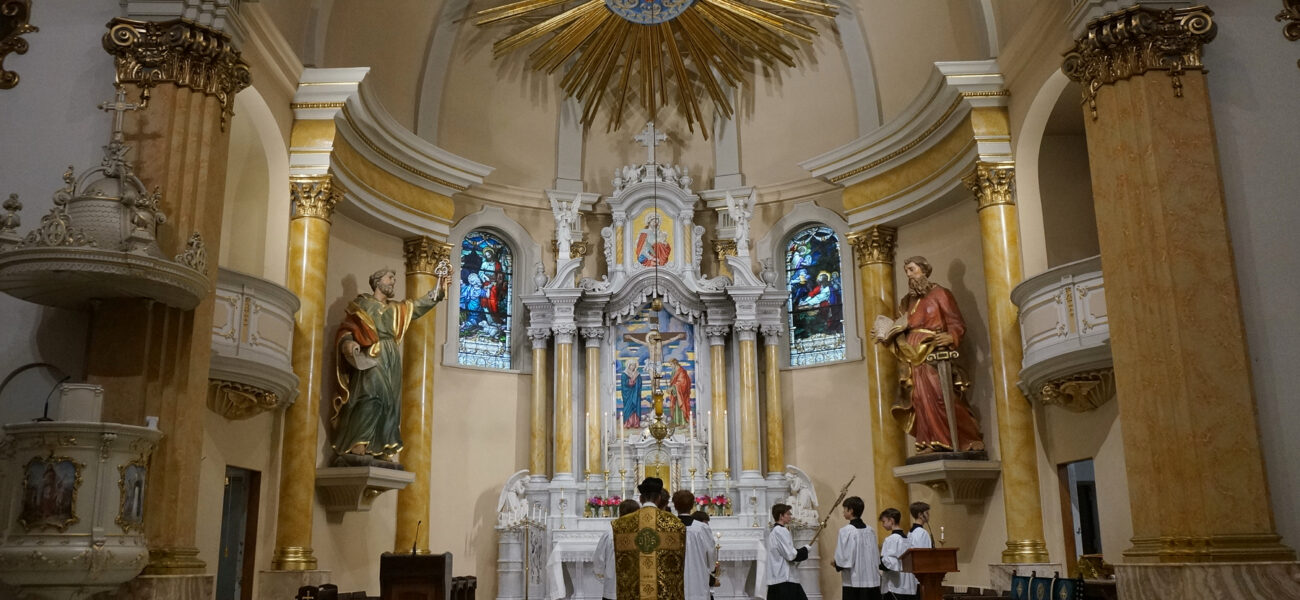
Minnesota’s Latin Mass: Loyalty in Vatican Culture War
Discover how a Minnesota parish navigates the Vatican's Latin Mass restrictions, showing loyalty to both tradition and Pope Francis. An unlikely truce in a global Catholic culture war.

POLICY WIRE — VATICAN CITY — The Church, they say, is a patient institution, accustomed to millennia. But patience wears thin, even for the eternal. The real drama, the one keeping bishops up at night, isn’t about fading congregations or secular encroachment on a grand scale. It’s about a cold war simmering right inside its ancient walls, specifically over who gets to pray in Latin and, more importantly, how much loyalty that practice demands.
Pope Francis, known more for his pastoral directness than liturgical fuss, hasn’t shied away from poking the traditional hornets’ nest. His move to severely curtail the traditional Latin Mass—dubbed the ‘Tridentine’ for its old council origins—wasn’t just an administrative tweak. It was a calculated, aggressive jab at what the Vatican sees as a growing, often rebellious, conservative faction. For years, the liberal spirit of Vatican II has grappled with the liturgical inclinations of some faithful, sparking what some fear is a nascent schism. This isn’t just arcane church trivia; it’s about power, obedience, and the very future direction of a global religious empire.
And so, we find ourselves watching unlikely protagonists: a small, unassuming parish nestled in Minnesota, attempting a daring tightrope walk. They’re devotees of the Old Rite, all solemn incantations — and clouds of incense. Yet, unlike some traditionalist enclaves that have adopted an openly defiant stance, this Minnesota community, St. Agnes in St. Paul, has carved out a unique position. They want their traditional Mass, yes. But they also, rather pointedly, want their Pope. It’s an almost defiant act of double-down loyalty in a world craving simple, binary choices.
“We can respect tradition without turning it into a weapon against the Holy Father,” one senior Vatican official, who requested anonymity to speak candidly about internal church dynamics, confided. “The goal here isn’t to erase history, but to ensure unity, and some traditionalist groups simply don’t see the Church’s head as truly legitimate.” That’s a serious charge, often muttered behind stained-glass windows and across pontifical palaces. Because, let’s be frank, that kind of rhetoric eventually leads to outright breaking away.
The parish’s path offers a surprising counter-narrative to the louder voices demanding complete freedom from Rome’s recent edicts. It’s not about being ‘Tridentine versus Francis,’ but rather, ‘Tridentine with Francis.’ But the sheer tenacity required for such an endeavor is testament to the deep passions involved. Consider this: global Mass attendance dipped approximately 17% between 1999 and 2017 in Western countries, according to a Pew Research Center analysis. Yet, the Latin Mass communities, while smaller, often boast a higher, more engaged demographic, precisely the kind the Church shouldn’t alienate if it can help it. These aren’t just stubborn old-timers; they’re families, young people, intellectual converts, searching for a perceived spiritual profundity often lacking in more contemporary liturgies. That’s a constituency, even if niche, that holds sway — and resources.
“Our loyalty to the Pope isn’t an option, it’s a foundation of our faith,” Father Bernard Knop, the priest shepherding this peculiar Minnesotan flock, was quoted recently in a Catholic journal. “We celebrate the Latin Mass not in spite of the Holy Father, but in full communion with him. It’s a bridge, not a barrier.” Such words, almost disarmingly straightforward, cut through the noise of theological bickering that dominates the traditionalist media landscape.
📄 POLICY WIRE WHITEPAPER PUBLISHED: PAKISTAN'S NATIONAL SECURITY POLICY PRIORITIES
👉 READ BY CLICKING HEREBut the Vatican isn’t known for its nuanced interpretations when faced with internal dissent. While this Minnesota parish models obedience, others remain in open opposition. And Pope Francis has demonstrated he won’t be swayed by sentimentality for historical aesthetics when he perceives a threat to ecclesial unity. He sees these Traditional Latin Mass communities, for some at least, as hotbeds of dissent against the broader teachings of the Second Vatican Council, a core document defining the modern Catholic Church. But sometimes, what looks like obedience might actually be shrewd politicking.
The global reach of the Catholic Church means these internal debates aren’t confined to quaint European parishes or American suburbs. The Vatican’s unity and clear doctrinal voice are also essential for its diplomatic efficacy, particularly in complex geopolitical landscapes where minority Catholic populations often face systemic challenges. For example, in Pakistan, where Christians often endure discrimination and sometimes violence, a globally unified and strong Vatican voice is a source of crucial advocacy. Internal factionalism, especially when amplified by public disputes over liturgy and authority, can inadvertently weaken the Church’s moral authority and dilute its influence when speaking on behalf of persecuted minorities anywhere in the world. Beijing’s growing maritime assertiveness in the Pacific and Russia’s influence in Eastern Europe demand a coherent religious authority on global morality, not one distracted by internal skirmishes. Because if the Church can’t unite on how to pray, what hope is there for its stance on global peace?
What This Means
The delicate dance played out in Minnesota illustrates the deeply polarized state of contemporary Catholicism. Economically, this isn’t insignificant: disgruntled traditionalists are often devout donors. If too many break away, it fragments the Church’s financial base. Politically—within the Church’s own vast structure—the Pope is attempting to consolidate authority, pushing back against factions he perceives as undermining his vision for a more inclusive, pastoral Church. His restrictions on the Latin Mass aren’t just about ritual; they’re a test of loyalty, a power play aimed at ensuring doctrinal adherence post-Vatican II. But when pockets of believers insist on tradition and loyalty, it forces the Vatican to reconsider the implications of its crackdown. This creates a fascinating internal pressure: how to enforce unity without creating even more fractures. It shows that even in the most seemingly clear-cut authoritarian structures, agency and nuance still exist—sometimes in unexpected Midwestern churches.