


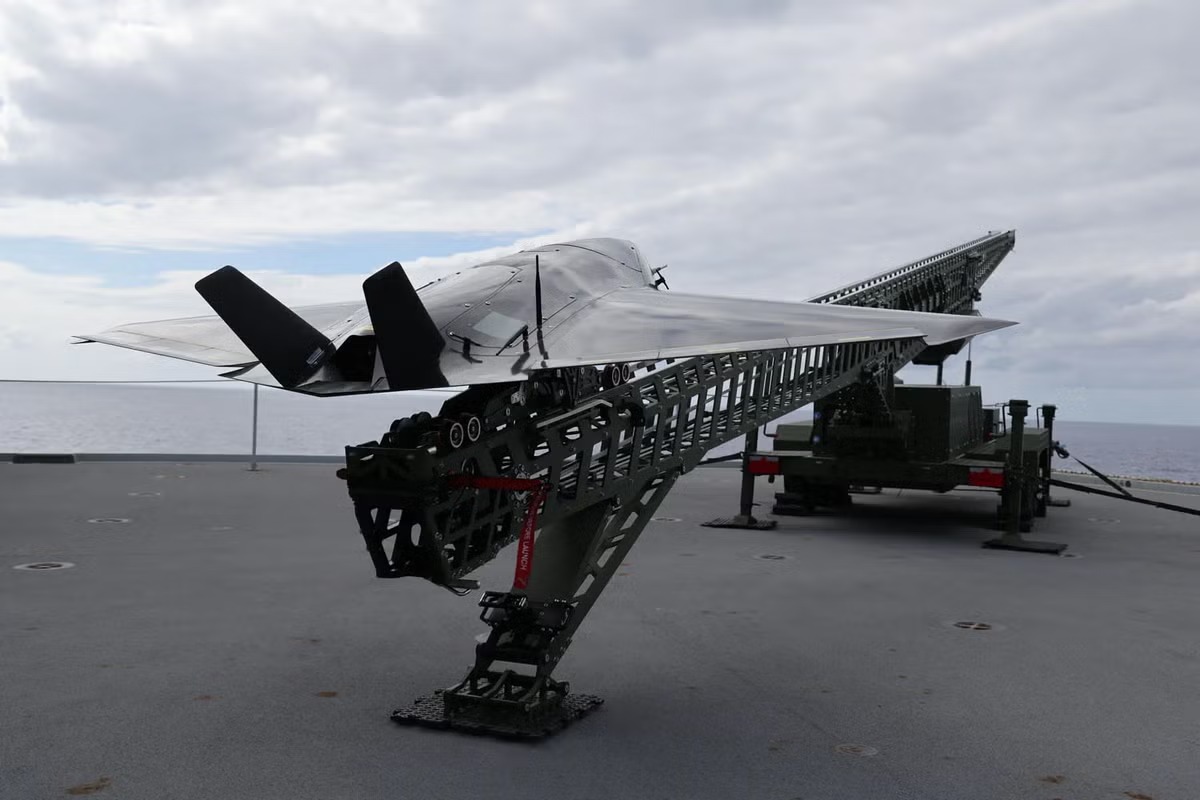
Royal Navy Completes First-Ever Strike Drone Launches from HMS Queen Elizabeth
The Royal Navy successfully tested British-made strike drones from HMS Queen Elizabeth, marking a historic shift in autonomous naval warfare technology.

POLICY WIRE — North Atlantic — The Royal Navy has achieved a significant milestone in naval aviation by successfully launching strike drones from the flight deck of the HMS Queen Elizabeth.
These trials, which took place in mid-October over the North Atlantic, featured Nyan Maritime one-way drones. These specific autonomous systems were produced in Wiltshire by the UK-based company Callen-Lenz.
The primary objective of the flights was to evaluate how autonomous strike platforms can operate in coordination with F-35B stealth fighters. To achieve this, the Royal Navy collaborated with technical experts from various branches of the Armed Forces and the private sector.
While this marked a first for an aircraft carrier, the drone had previously undergone its maiden- sea launch earlier this year aboard the research vessel XV Patrick Blackett.
Defence Secretary Wes Streeting noted that the modern threat landscape has changed drastically compared to previous decades. He observed that the speed of innovation is now a critical factor in determining a nation’s military strength.
Streeting emphasized that this achievement reflects the largest sustained growth in defense funding since the Cold War. The investment is intended to provide technology that equips British forces with greater lethality and expanded strike capabilities.
The Defence Secretary further stated that maintaining high readiness for conflict reduces the likelihood of actual engagement, thereby strengthening national deterrence.
Simultaneous with the drone tests, the carrier hosted the Heavy Lift Challenge 3. This event featured the first-ever operation of a Tekever AR5 fixed-wing uncrewed aircraft from a carrier.
The AR5 model boasts a wingspan of 7 meters and a payload capacity of 80kg.
Lieutenant Commander David Burton, who served as the trials sponsor for Navy Capability, explained that these tests provide the necessary evidence to determine how uncrewed systems function alongside manned aircraft.
Burton added that the insights gained will assist in the development of a hybrid Navy, offering commanders more options and keeping carriers at the forefront of naval combat.
These operations are part of a broader government strategy to modernize the Armed Forces for contemporary warfare. Under the current Defence Investment Plan, upwards of £5bn is allocated for autonomous technology through the year 2030.
This funding includes at least £1.3bn for a fleet mix of crewed and uncrewed vessels, with the first large autonomous ships expected by 2030. Additionally, at least £210m is set aside for low-cost, long-range one-way attack drones for use by the Navy, Army, and Royal Air Force.
Reporting by Policy-Wire (PW)