

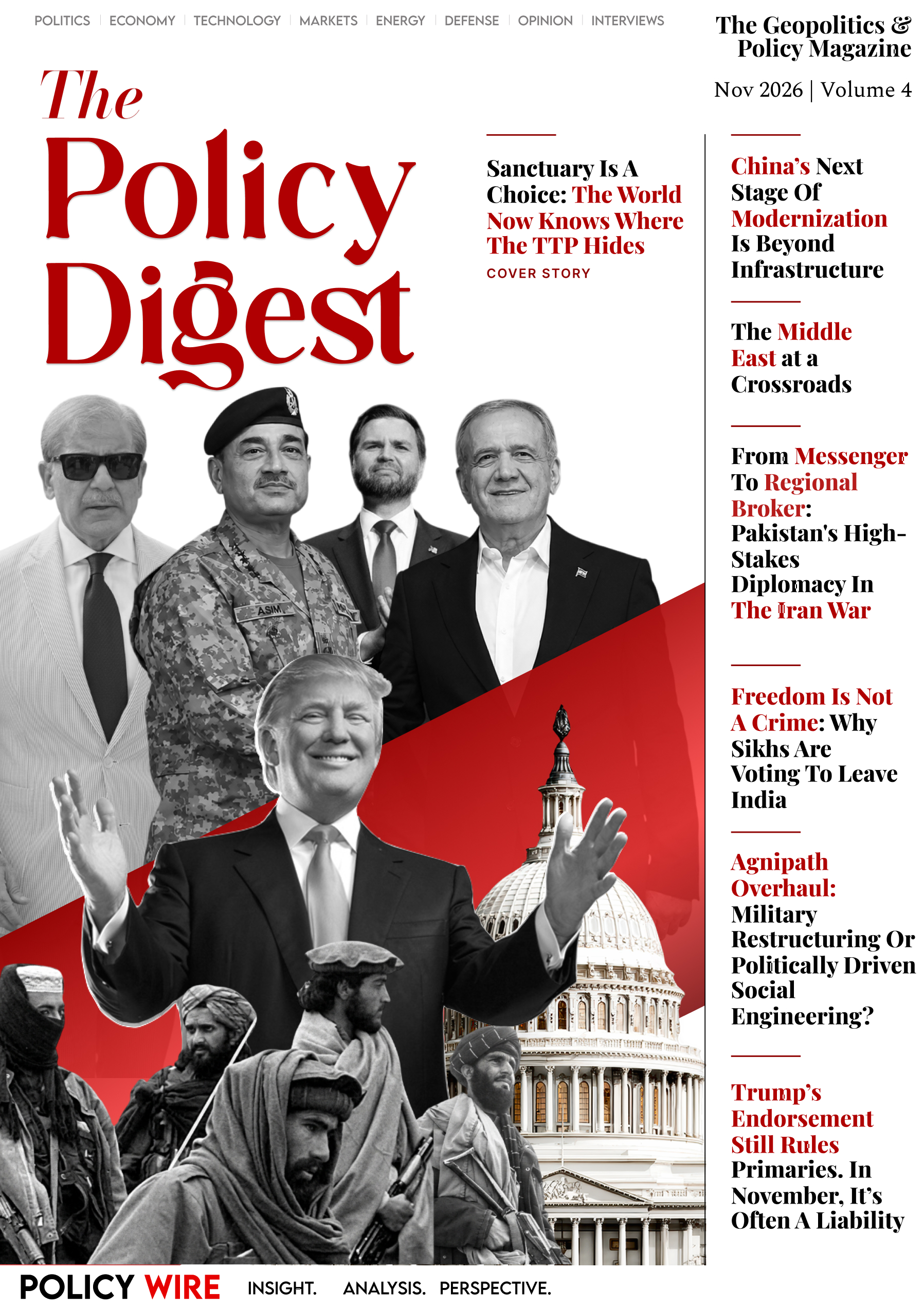
Policy Wire Magazine November 2026: The Policy Digest Volume 4
Policy Wire is proud to present Volume 04 of The Policy Digest (November 2026 Edition), our premier monthly geopolitics and strategic intelligence publication. Delivering authoritative declassified...

Policy Wire is proud to present Volume 04 of The Policy Digest (November 2026 Edition), our premier monthly geopolitics and strategic intelligence publication. Delivering authoritative declassified assessments, investigative reporting, exclusive interviews, and field analysis on South Asia, the Middle East, US electoral politics, and great-power competition, this 36-page special edition provides crucial clarity for policymakers, diplomats, defense observers, and corporate strategists across the globe.
Read Online: Interactive 3D Magazine Flipbook
Browse through the entire 36-page publication with realistic 3D page-flipping, high-resolution infographics, and zoom controls, or open in dedicated full-screen mode.
Executive Summary & Volume 4 Dossier Highlights
From the contested borderlines of the Hindu Kush to the diplomatic backchannels of Tehran and the shifting voter demographics of American primaries, Volume 4 (November 2026) tackles the decisive fault lines reshaping international security and economic power. Below is an exhaustive breakdown of the investigations, exclusive interviews, and strategic analyses published in this edition.
1. COVER STORY | Sanctuary Is a Choice: The World Now Knows Where the TTP Hides
Section: Security & Defence (Pages 14–16)
Key Analysis: Sara Adams (Former CIA Targeting Officer & National Security Analyst)
An explosive investigative dossier synthesizing United Nations monitoring data, declassified satellite reconnaissance, and ground reports confirming that the banned Tehrik-e-Taliban Pakistan (TTP) operates structured military safe havens inside Taliban-controlled Afghanistan with state tolerance. UN monitoring teams document over 6,000 active TTP fighters across Afghan provinces, with more than 2,000 fighters and families strategically relocated deeper inland to evade Pakistani precision strikes. The report details the deadly proliferation of left-behind US night-vision optics, thermal sniper scopes, and commercial weaponized quadcopters (over 405 drone incursions documented in border areas), alongside Washington’s notable diplomatic pivot as US Secretary of State Marco Rubio and President Donald Trump publicly spotlight Afghan cross-border terror.
2. DIPLOMACY & FOREIGN POLICY | From Messenger to Regional Broker: Pakistan’s High-Stakes Diplomacy in the Iran War
Section: Geopolitical Strategy (Pages 8–11)
Author: Imad Abbas (Independent Journalist & NDU Conflict Researcher)
Examines Pakistan’s unprecedented transformation from a passive conduit between Washington and Tehran into an assertive regional power broker. Focuses on the pivotal October 20, 2026 diplomatic mission to Tehran led by Chief of Defence Forces and Chief of Army Staff Field Marshal Asim Munir, who held intensive consultations with Iranian President Masoud Pezeshkian and Parliamentary Speaker Mohammad Bagher Ghalibaf. The analysis breaks down Tehran’s 7 non-negotiable conditions for de-escalation, the Strait of Hormuz blockade impasse, and bilateral border security along the 909-km Pak-Iran frontier.
3. EXCLUSIVE INTERVIEW | The Middle East at a Crossroads: Lebanon, Gaza and Regional Stability
Section: International Affairs (Pages 5–7)
Interviewee: Prof. Tamirace Fakhoury (The Fletcher School, Tufts University)
Interviewer: Ali Ahmed (English News Presenter, Pakistan TV)
Professor Tamirace Fakhoury provides an incisive, deep-dive examination of the structural limits of Middle Eastern ceasefires. Addressing Lebanon’s precarious internal sovereignty, the sequencing debate between Hezbollah disarmament and Israeli troop withdrawal, and the looming security vacuum left by the UNIFIL drawdown in southern Lebanon, Prof. Fakhoury unpacks why Western-sponsored ceasefires that freeze armed confrontation without tackling political settlements inevitably pave the way for deadlier regional resurgence.
4. HUMAN RIGHTS & POLITICS | Freedom Is Not a Crime: Why Sikhs Are Voting to Leave India
Section: Global Sikh Affairs (Pages 12–13)
Key Contributors: Jasveer Singh (Media Spokesperson, Sikh Federation UK) & Sikhs for Justice (SFJ)
An on-the-ground report investigating the global Khalistan Referendum campaign. From the Queen Elizabeth II Centre in Westminster to diaspora hubs in Canada, Australia, and the United States, Sikh voters explain their mobilization around three core pillars: Safety, Dignity, and Control. The dossier exposes transnational assassination plots—including the June 2023 murder of Hardeep Singh Nijjar and recent October 2026 attacks on diaspora organizers by suspected Indian intelligence (RAW) proxies—while detailing Sikhs’ novel diplomatic outreach to China.
5. DEFENSE & SECURITY | Agnipath Overhaul: Military Restructuring or Politically Driven Social Engineering?
Section: South Asian Defense (Pages 19–20)
Author: Saad Riaz (Scholar in Intelligence and Security Studies, Quaid-i-Azam University)
A rigorous defense assessment dissecting the controversial Agnipath short-service recruitment scheme in the Indian Armed Forces. Riaz evaluates whether the post-general-election revisions represent genuine structural modernization to contain ballooning military pensions and develop technical readiness, or whether the policy compromises regimental cohesion, operational combat effectiveness, and creates social destabilization as thousands of demobilized 22-year-old veterans enter an unstable civilian economy without institutional support.
6. US POLITICS SPECIAL | Trump’s Influence: Primary Dominance vs. General Election Liabilities
Section: Politics & Governance (Pages 17–18, 24–26)
Contributors: Janie Mackenzie (VP, Ascendant Group), Victor A. Lopez (CEO, Imperio Strategies), and George Carrillo (CEO, HireMe; Marine Veteran & Former Oregon Gubernatorial Candidate)
A three-part political analysis dissecting the enduring paradox of Donald Trump’s political capital. While presidential endorsement remains virtually unbeatable within Republican primary contests, general elections across swing districts present severe liabilities among suburban moderates and independent voters. The contributors unpack campaign rally economics, institutional trust erosion, and bipartisan governance realities in the 119th Congress.
7. GLOBAL ECONOMY & TRADE | Supply Chains, Modernization and Energy Security
Section: Markets & Trade (Pages 21–22, 27–33)
Contributors: Arnold Platz (CEO, General Future Holding), Robert J. Green (Independent Security Researcher), Jiang Tao (CGTN Radio), and Dr. Lubna Umar (AIOU Islamabad)
This comprehensive multi-dossier economic section covers:
- Critical Minerals Over Tariffs: Arnold Platz and Sara Adams reveal why the end of US-China tariff truces will shift warfare to rare earth processing bottlenecks, gallium, germanium, and graphite export controls.
- The Iran War’s Hidden Costs: Robert J. Green demonstrates why falling retail gasoline prices mask catastrophic agricultural, diesel, and fertilizer cost spikes across American supply chains.
- China’s Modernization Beyond Concrete: Jiang Tao reports on Beijing’s pivotal transition from physical mega-infrastructure to digital server clusters, compute power grids, and high-value tech manufacturing in inland provinces.
- Pakistan-China Trade Beyond CPEC: Dr. Lubna Umar examines how Pakistan must overhaul domestic industrial competitiveness, water conservation, and export quality to transform CPEC from an infrastructure debt corridor into an export powerhouse.
8. SECURITY & DEFENCE | Lebanon, Iran, Gaza and the Limits of Ceasefires
Section: Policy Wire Q&A (Pages 34–35)
Contributor: Gregg Roman (Executive Director, Middle East Forum)
A hard-hitting assessment of the Israel-Lebanon framework and regional deterrence. Roman outlines why “the sequence is negotiable, but the end state is not,” arguing that international ceasefire architecture repeatedly substitutes documentation for verifiable disarmament of proxy militias, leaving strategic instability fundamentally unresolved.
Meet the Authors & Contributors of Volume 4
Volume 4 brings together leading minds across international security, academic institutions, defense research, and broadcast media:
- Prof. Tamirace Fakhoury – Associate Professor of International Politics and Conflict, The Fletcher School at Tufts University.
- Sara Adams – Former CIA Targeting Officer and veteran National Security Analyst.
- Robert J. Green – Independent Researcher specializing in economic security and supply-chain vulnerabilities.
- Saad Riaz – Intelligence and security scholar at Quaid-i-Azam University, Islamabad.
- Jasveer Singh – Media Spokesperson for the Sikh Federation UK.
- Jiang Tao – International Reporter with CGTN Radio and editor of Stories of Xi Jinping.
- Victor A. Lopez – CEO of Imperio Strategies and international public affairs strategist.
- Ali Ahmed – Prime-time English News Presenter and Anchor at Pakistan TV (PTV), Islamabad.
- Imad Abbas – Independent Conflict and Militancy Researcher, MPhil Scholar at National Defence University (NDU).
- Janie Mackenzie – Vice President of Public Relations at Ascendant Group.
- Arnold Platz – Founder & CEO of General Future Holding.
- George Carrillo – CEO of HireMe, US Marine Corps veteran, and former Democratic candidate for Governor of Oregon.
- Dr. Lubna Umar – Academic, linguist, and Assistant Professor at Allama Iqbal Open University (AIOU), Islamabad.
- Gregg Roman – Executive Director of the Middle East Forum.
- Policy Wire Editorial Board – Islamabad • London • Washington.
Download Policy Wire Magazine November 2026 Edition
Read the complete investigative dossiers, full interview transcripts, and exclusive geopolitical analyses in the official high-resolution 36-page PDF edition.