
Presidential Touchdown in Soccer: How White House Intervention Paved Way for a Whimper, Not a Roar, in US World Cup Loss
POLICY WIRE — Seattle, United States — It wasn’t the searing Belgian strike that landed the knockout blow, nor Folarin Balogun’s ultimately toothless attacking runs. No, the real...

POLICY WIRE — Seattle, United States — It wasn’t the searing Belgian strike that landed the knockout blow, nor Folarin Balogun’s ultimately toothless attacking runs. No, the real spectacle had unfurled days earlier, a phone call from the Oval Office itself that yanked global soccer — kicking and screaming — into the high-stakes arena of geopolitical influence. Because when a President of the United States intervenes directly with FIFA, you’d expect something rather monumental, wouldn’t you? What we got instead was a whimper of a performance and a 4-1 thumping, proving that even presidential decrees can’t conjure goals out of thin air.
The entire drama, bizarre even by modern sports’ standards, kicked off after striker Balogun—the United States’ presumed golden boy, scorer of three World Cup goals prior to this—earned himself a red card in a match against Bosnia-Herzegovina. An automatic one-game suspension loomed, threatening to sideline him from the crucial knockout-stage clash. Enter former President Donald Trump, dialing FIFA President Gianni Infantino, a move that sent shockwaves through every corner office and locker room from Zurich to Jakarta. Infantino, ever the diplomat, insisted he played no part in the decision by the disciplinary committee that mysteriously, conveniently, suspended the red card’s effect for a year. A coincidence? You bet it wasn’t.
The backlash was immediate and fierce. UEFA, European soccer’s governing body, didn’t mince words, declaring FIFA had “crossed a red line.” Belgian football officials were spitting mad, contesting Balogun’s eligibility right up to kickoff. But despite the uproar, the presidential will prevailed. And so, Folarin Balogun trotted onto the Lumen Field pitch on Monday, the subject of international intrigue, his name synonymous not just with promising talent but with unprecedented executive meddling. He was back, thanks to a presidential reprieve. You might’ve thought he’d then tear through the Belgian defense like a freight train, proving his reinstatement was some kind of strategic masterstroke.
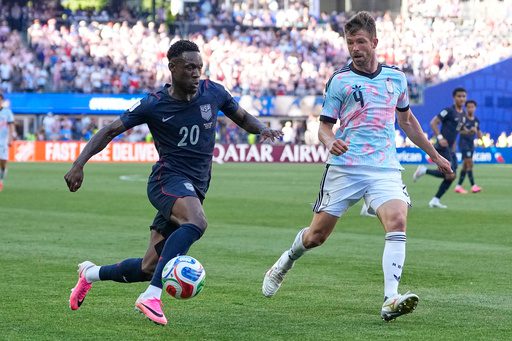
Instead, he barely registered. Balogun’s grand return was less of a heroic narrative — and more a footnote in a resounding American defeat. Yes, he played a role in setting up Malik Tillman’s first-half goal, drawing a foul some twenty-five yards out. But apart from that moment, he largely vanished into the sea of yellow — and black Belgian jerseys. His pace was evident, certainly, but his shots found Thibaut Courtois’s formidable gloves or sailed harmlessly wide. The U.S. desperately tried to feed him, their strategy often appearing to be “get it to the guy the President saved,” but it didn’t work. His best chance? An 82nd-minute left-footed attempt, swallowed effortlessly by Courtois.
“Was anyone a major presence on the field today?” a resigned U.S. midfielder Tyler Adams later mused to reporters, encapsulating the collective American malaise. “We were happy that we had the opportunity for him to play. He tried today to be a presence and a nuisance, and at times he was — getting the ball in behind and doing what he does. Just didn’t have too many opportunities.” A kind assessment, perhaps, but it didn’t change the scoreboard.
The geopolitical ramifications, though, were arguably more significant than the match’s outcome. “This sort of political leverage exerted on a purportedly neutral global sports body — it raises deeply uncomfortable questions,” offered Nadia Khan, a spokesperson for the South Asian Football Federation (SAFF), during a virtual press conference the next day. “What message does it send to federations in, say, Pakistan or Bangladesh, striving to adhere to regulations when a major power can simply bypass them? It corrodes the very idea of fair play, making smaller nations wonder if their hard work will ever truly count as much as a phone call from a powerful ally.” Because fairness, it seems, isn’t always part of the game.
FIFA President Gianni Infantino, speaking briefly after the match — conveniently just before scurrying away from deeper inquiries — struck a conciliatory tone, telling reporters, “Decisions are made by independent committees. We must trust the process, even when it’s closely observed by all global stakeholders.” A subtle nod to the chaos he was allegedly not involved in, but the smirk was all too visible.
It’s worth noting the United States men’s national team hasn’t advanced past the World Cup quarterfinals since 2002, a statistic that puts their perpetual underperformance into sharp focus. This latest debacle does little to improve American soccer’s broader trajectory. The entire saga has, at its core, exposed how easily international sports organizations can be swayed, or perhaps appear to be swayed, by political weight. For a country that prides itself on exceptionalism, having its President lobby to bend rules for a single player who then failed to perform must sting.
What This Means
This incident isn’t just a sports story; it’s a political one, albeit a weird one. First off, it demonstrates, rather plainly, the expanding reach of ‘soft power’ — or in this case, outright political intervention — into supposedly autonomous global institutions. When the head of a major world power can get FIFA to reverse a disciplinary action, it signals to everyone else that the rules are, well, negotiable, especially if you have the right connections or the leverage of a massive economy and cultural footprint. It certainly doesn’t help FIFA’s ongoing struggle with public perception regarding transparency and corruption; instead, it reignites suspicions.
Economically, there’s an unspoken threat here too: the sheer commercial weight of the American market on global sports is immense. One might cynically argue that FIFA — already recovering from past scandals — couldn’t afford to alienate a nation that will host an upcoming World Cup, and a country with one of the planet’s largest sports broadcasting and sponsorship ecosystems. For aspiring football nations, particularly those in the global south or smaller developing markets, this episode likely reinforces a bitter truth: rules often apply differently to those who lack comparable political or economic clout. The broader implications for international sporting integrity are significant, raising questions about whether fair play can truly exist when the rules can seemingly be altered by presidential decree.
And then there’s the broader narrative for the U.S. in global sports. It suggests an underlying desperation, perhaps a recognition that sheer sporting merit might not be enough to compete at the very highest levels. It’s a pragmatic, if unseemly, play of a nation that isn’t quite ready to lose gracefully. But the fact that even such high-level maneuvering yielded only a minor assist in a crushing loss? Well, it just goes to show, you can bring a president to the phone, but you can’t make a striker score if he isn’t finding the net. Sometimes, the beautiful game just refuses to be bullied.