

Presidential Meddling and World Cup Humiliation: USMNT’s ‘Glory’ Fizzles in Belgian Debacle
POLICY WIRE — Doha, Qatar — Remember when presidential intervention actually mattered? Before the American men’s national team even stepped onto the pitch for their Round of 16...

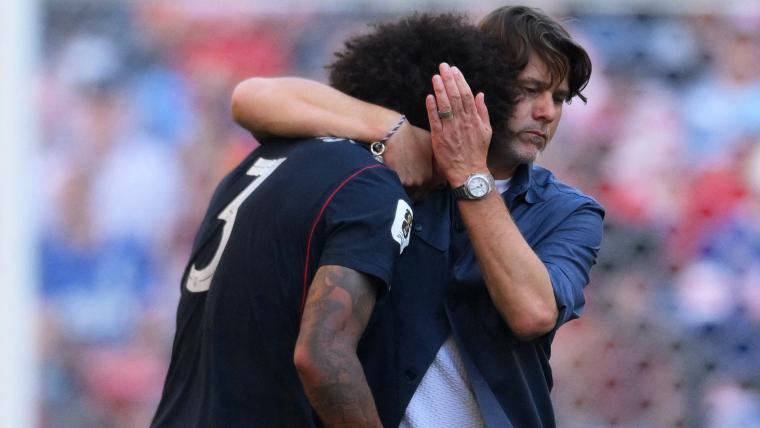
POLICY WIRE — Doha, Qatar — Remember when presidential intervention actually mattered? Before the American men’s national team even stepped onto the pitch for their Round of 16 showdown against Belgium, a certain Oval Office occupant had already made his mark. Donald Trump’s intervention saw star striker Folarin Balogun’s one-game red card ban suspended. A move designed, one assumes, to provide a timely patriotic boost—a presidential “Make America Great Again” for the sporting sphere. What unfolded, however, wasn’t greatness. Instead, it was a comprehensive thrashing, a brutal 4-1 lesson in continental footballing efficiency that saw the U.S. national team’s campaign brought to a screeching halt. Political machinations, it seems, can’t account for what happens when the whistle blows.
Mauricio Pochettino’s squad had ridden a wave of measured optimism into the knockout rounds. They’d managed to project an image of competency, even potential, having looked to be one of the competition’s standouts during the group stage. They’d even boasted about their goal-scoring prowess: Pochettino’s side was one of 11 teams to record at least 10 goals thus far, outscoring celebrated attacking units like Spain and Portugal in its opening four games. You could almost feel the sports headlines writing themselves. But Belgium, a team many analysts believed had limped through pool play, had other ideas. They offered a stark, uncomfortable reminder that the beautiful game—like global politics—demands more than just perceived potential; it demands execution. [QUOTE_PLACEHOLDER]
And boy, did the execution fall apart. For starters, where was the scoring? The Americans, despite their earlier exploits, looked lethargic in the attacking third. Balogun, whose unexpected return was supposed to be a boon, managed a paltry 19 touches — and one shot on target. The team, as a collective, registered just seven shots against Belgium. Think about that: a nation striving for global soccer relevance managed only a handful of genuine threats. Per ESPN, the U.S. finished with an expected goals figure of a measly 0.67, 0.53 of which came on set pieces. In other words, they were toothless in open play. It was almost like watching a diplomatic mission that sent a team to negotiate without a clear agenda—or, worse, without any leverage.
The midfield, often the U.S.’s engine room with stalwarts like Tyler Adams, Weston McKennie and Malik Tillman, simply melted under pressure. Rudi Garcia, Belgium’s tactical architect, played a masterstroke. His decision to bench big names Kevin De Bruyne and Jeremy Doku looked curious initially, but it was a stroke of genius. He flooded the middle with energetic ball-winners Amadou Onana — and Nicolas Raskin. These guys weren’t there to paint pretty pictures; they were there to disrupt. And they did. Onana was splendid in the game’s opening moments, flicking balls away with his signature slide tackle, completely nullifying the U.S. midfield’s accustomed dominance.
Because let’s be blunt: when your opponent consistently gets around your strongest point, the whole structure wobbles. And crumble it did. Defensively, the USMNT turned into a turnstile. They’d supposedly shown resilience with Tim Ream — and Chris Richards, but Belgium ran the U.S. defense ragged in the Round of 16. Basic errors abounded: failing to clear a bouncing ball for Charles De Ketelaere’s opener; Sergino Dest and Alex Freeman conspiring to concede a soft second goal. Then came the goalkeeper, Matt Freese, with a calamitous bit of play for Belgium’s third. You can’t legislate for that kind of unforced error, the sort of mistake that turns a bad day into a full-blown crisis.
Garcia’s changes weren’t just genius; they made Pochettino look, well, unprepared. His insertion of Dodi Lukebakio meant Belgium neutralized Antonee Robinson’s attacking threat and kept the defense tight. It felt like watching a veteran diplomat outmaneuver an inexperienced counterpart at a critical summit. Garcia got his tactics spot-on in he game. He’s the biggest reason that the Belgians are moving on in this year’s tournament. For the USMNT, it means heading home, left to rue what could have been. Another American sports foray into the global stage ends not with a bang, but with a bewildered shrug, leaving the world, particularly nations like Pakistan or those across the wider Muslim world who follow football with fervor, wondering when the U.S. will truly arrive on the world soccer stage.
What This Means
The USMNT’s premature exit, despite a pre-tournament presidential ‘boost,’ has wider implications than just shattered sporting dreams. It speaks to a recurring theme in American soft power: the ambitious projection of influence versus the grinding reality of execution on a competitive global stage. An intervention from Donald Trump to save Balogun’s suspension underscores the administration’s belief that political will can bend any outcome—a notion that rarely translates to the field or to complex geopolitical theaters. It reminds us that symbolic gestures, even those involving the highest office, rarely compensate for a lack of tactical acumen or collective cohesion.
Economically, a deeper run for the U.S. team would’ve meant a further surge in media rights, sponsorships, and merchandise sales, reinforcing America’s position ahead of potential future World Cup hosting duties. This early exit might dim some of that luster, if only temporarily. The failure also offers a stark contrast to nations, particularly those across Asia and the Muslim world, where footballing success is inextricably linked to national identity and, often, state investment. Countries from Turkey to Iran, not to mention rapidly developing leagues in Saudi Arabia and Qatar, view international football not just as sport, but as a critical instrument of national branding and diplomatic outreach. The USMNT’s stumbles provide fodder for those who question the depth of America’s commitment to the global game, raising eyebrows in regions where football’s resonance runs deep, making narratives like the one explored in USMNT’s ‘Captain America’ Legacy Fades Amid World Cup Fizzle and Global Aspirations more pertinent than ever. This outcome won’t lead to immediate policy shifts, of course, but it contributes to the broader, often subtle, calculus of national perception and influence on the international stage.