


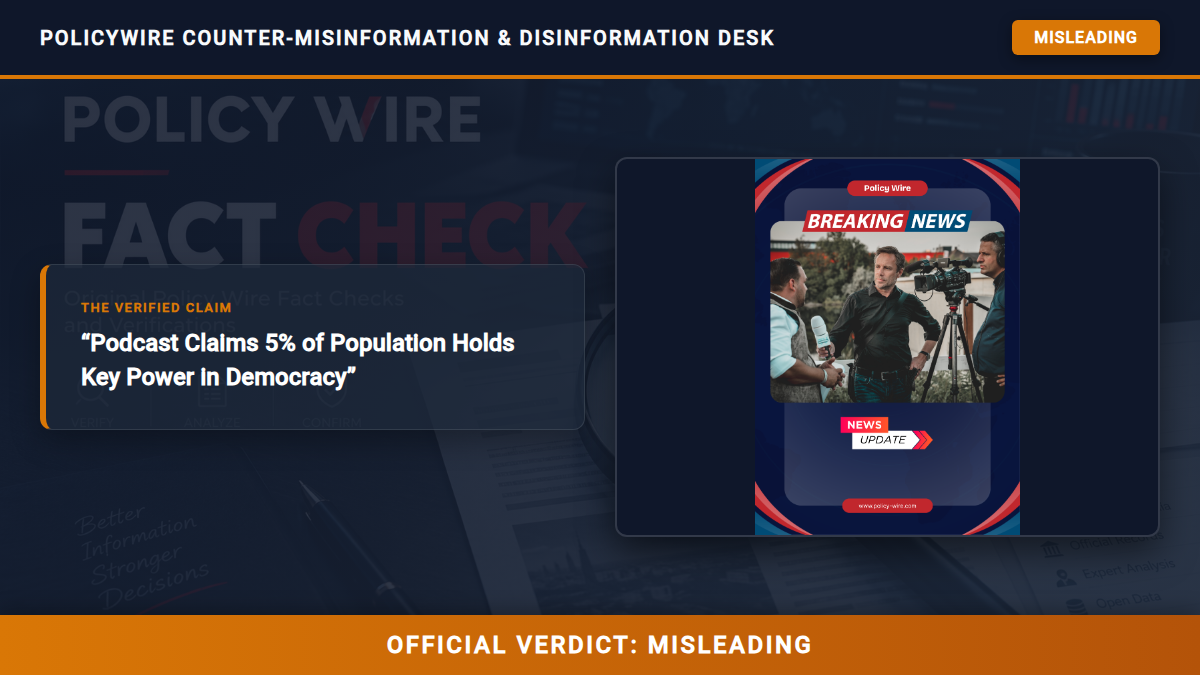
POLICY WIRE FACT CHECK: Podcast Claims 5% of Population Holds Key Power in Democracy
The Claim A recent viral podcast titled "The 5% Question" has sparked widespread discussion online, particularly on social media platforms and in political discourse circles. The podcast,...

The Claim
A recent viral podcast titled "The 5% Question" has sparked widespread discussion online, particularly on social media platforms and in political discourse circles. The podcast, which was linked to a Reuters Fact Check article, claims that a mere 5% of the population holds significant influence over democratic systems, suggesting that this minority controls major policy decisions, media narratives, and public opinion.
The claim gained traction after being shared across various platforms, including Twitter, Reddit, and YouTube, where users debated its implications for democracy and governance. The specific statement in question is: "Only 5% of the population actually shapes the direction of our democracy." This assertion was presented as an analysis of political power dynamics, with the podcast host arguing that this small group influences elections, legislation, and even public sentiment through media manipulation and financial control.
The Details & Investigation
The viral claim originates from a podcast episode that was cited by Reuters Fact Check, though the original source of the 5% figure remains unclear. Upon investigation, no credible academic or institutional study directly supports the assertion that exactly 5% of the population dictates the course of democratic systems. The claim appears to be a generalized interpretation of broader theories about political influence, such as those found in works by scholars like Noam Chomsky and Naomi Klein, who have long critiqued the role of corporate and elite interests in shaping public policy.
Further examination of the podcast’s content reveals that it does not cite any peer-reviewed research, official data, or historical records to substantiate the 5% figure. Instead, it relies on anecdotal evidence and broad generalizations about political power structures. The episode also includes references to financial lobbying, media ownership concentration, and the influence of wealthy donors, but these points are not quantified or contextualized with empirical data.
📄 POLICY WIRE WHITEPAPER PUBLISHED: PAKISTAN’S NATIONAL SECURITY POLICY PRIORITIES
Reuters Fact Check itself did not independently verify the 5% statistic but instead highlighted the need for critical evaluation of such claims. In its report, Reuters emphasized that while certain groups may exert disproportionate influence in democratic societies, the exact percentage of the population that does so is not a universally accepted or measurable metric. The organization also noted that the term "democracy" encompasses a wide range of systems, and the concept of "power" is often subjective and context-dependent.
Given the lack of verifiable data and the absence of a clear source for the 5% figure, the claim is best categorized as MISINFORMATION—unintentional but widely circulated falsehoods that lack factual basis. While the podcast raises valid concerns about the concentration of power in modern democracies, the specific numerical claim is misleading and lacks the rigor required for a factual assessment.
The Verdict
The viral claim that "only 5% of the population actually shapes the direction of our democracy" is not supported by verified evidence. The figure is not derived from any credible study, official record, or historical analysis. While the podcast highlights important discussions about political influence and power dynamics, the specific 5% statistic is a generalization that lacks empirical foundation.
Therefore, this claim is classified as MISLEADING. It reflects a broader concern about the concentration of power in democratic systems, but the specific numerical assertion is inaccurate and should be treated with skepticism. Readers and listeners are encouraged to seek out more rigorous analyses of political power structures rather than relying on unverified statistics.
Counter-misinformation & disinformation investigation conducted by PolicyWire Editorial Desk (PW).