


POLICY WIRE FACT CHECK: Alaska Campaign Ad Distorts Record on Border Security and Fentanyl Trafficking
The Claim A recent campaign advertisement released by the office of Republican Senator Dan Sullivan of Alaska features Sandy Snodgrass, a mother whose son died of a fentanyl overdose in 2021. In the...


The Claim
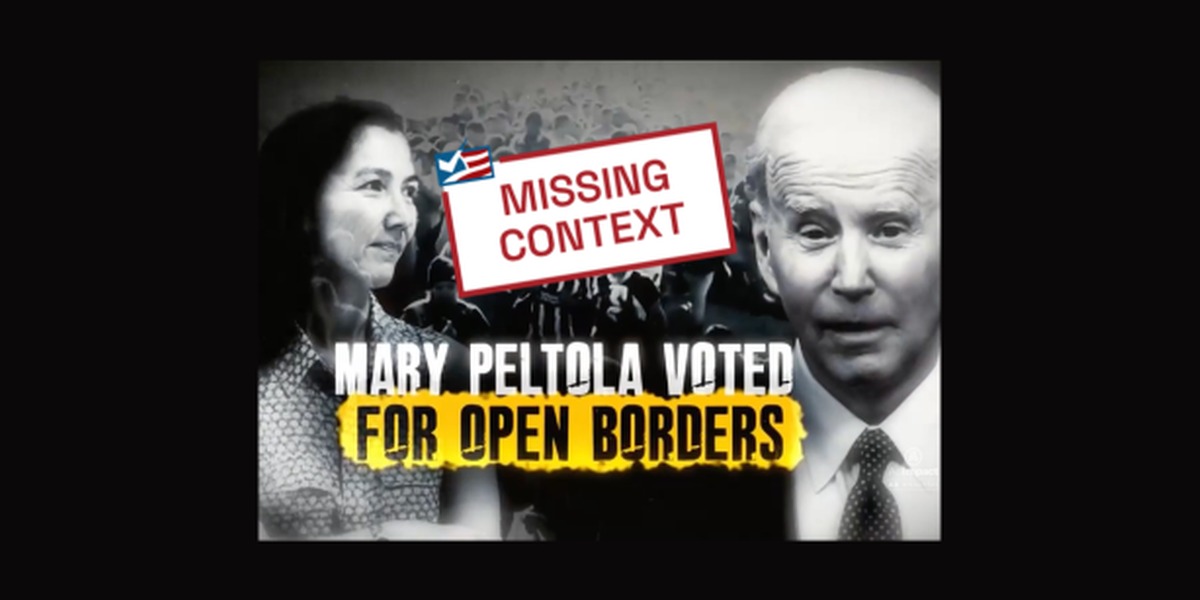
A recent campaign advertisement released by the office of Republican Senator Dan Sullivan of Alaska features Sandy Snodgrass, a mother whose son died of a fentanyl overdose in 2021. In the spot, Snodgrass alleges that “lower 48 liberals opened our borders to the drug cartels” and asserts that Democratic Senate candidate Mary Peltola has “taken their money and voted with them against securing our border.” The ad frames Peltola’s legislative record as a direct contributor to the fentanyl crisis affecting Alaskan families.
The advertisement has circulated widely across Alaskan media markets, positioning the border crisis as a central pillar of the Senate race. By linking Peltola’s voting record to the tragic death of Snodgrass’s son, the campaign seeks to characterize the Democratic candidate as complicit in the influx of illicit substances, a claim that has triggered significant public concern and debate regarding the accuracy of campaign messaging.
The Details & Investigation
Our investigation into the claims presented in the Sullivan campaign ad reveals a pattern of significant omission and misleading context, which we categorize as MISINFORMATION. While the ad utilizes a genuine personal tragedy to evoke an emotional response, it relies on a flawed premise regarding how fentanyl enters the United States. Expert testimony from the Drug Enforcement Administration (DEA) and U.S. Customs and Border Protection (CBP) consistently confirms that the vast majority of illicit fentanyl is smuggled through legal ports of entry, often by U.S. citizens, rather than by migrants crossing the border on foot between ports.
The ad’s characterization of Mary Peltola’s voting record is similarly reductive. The Sullivan campaign points to Peltola’s 2023 vote against the “Secure the Border Act” as evidence of an “open borders” stance. However, this ignores the legislative reality of the following year. In April 2024, Peltola was one of a handful of Democrats who broke ranks with her party to vote in favor of the End the Border Catastrophe Act, a measure that mirrored many of the policies found in the earlier Republican bill. Furthermore, Peltola has frequently diverged from the Democratic mainstream on immigration, including publicly calling for President Biden to adopt stricter enforcement measures and reinstate policies such as Title 42.
The claim that Peltola is “weak” on border security is contradicted by her documented legislative actions and public statements. By focusing exclusively on a single 2023 vote while omitting her subsequent support for bipartisan border legislation, the ad engages in a coordinated effort to deceive voters about the candidate’s actual policy positions. This selective presentation of facts serves to manufacture a narrative of negligence that is not supported by the legislative record.
Finally, the assertion that migration is the primary driver of the fentanyl epidemic is unsupported by data. Analysis from the American Immigration Council and reports from the Government Accountability Office (GAO) indicate no correlation between irregular migration levels and drug seizure rates. The reliance on the narrative that liberals opened our borders to the cartels functions as a political trope that obscures the complex, multi-faceted reality of international drug trafficking and the specific, documented efforts Peltola has taken to address the crisis.
The Verdict
The claims made in the Sullivan campaign advertisement are MISLEADING. While the ad correctly identifies the tragic nature of the fentanyl epidemic, it falsely attributes the cause of this crisis to migrants and misrepresents Mary Peltola’s legislative record on border security. By omitting Peltola’s bipartisan votes and ignoring official government data regarding how fentanyl is smuggled into the country, the ad presents a distorted reality to the electorate.
The assertion that Peltola voted against securing the border is a gross oversimplification that ignores her subsequent support for border enforcement legislation. Consequently, the ad fails the test of factual accuracy, relying on context-free accusations to score political points in a competitive Senate race.
Counter-misinformation & disinformation investigation conducted by PolicyWire Editorial Desk (PW).