


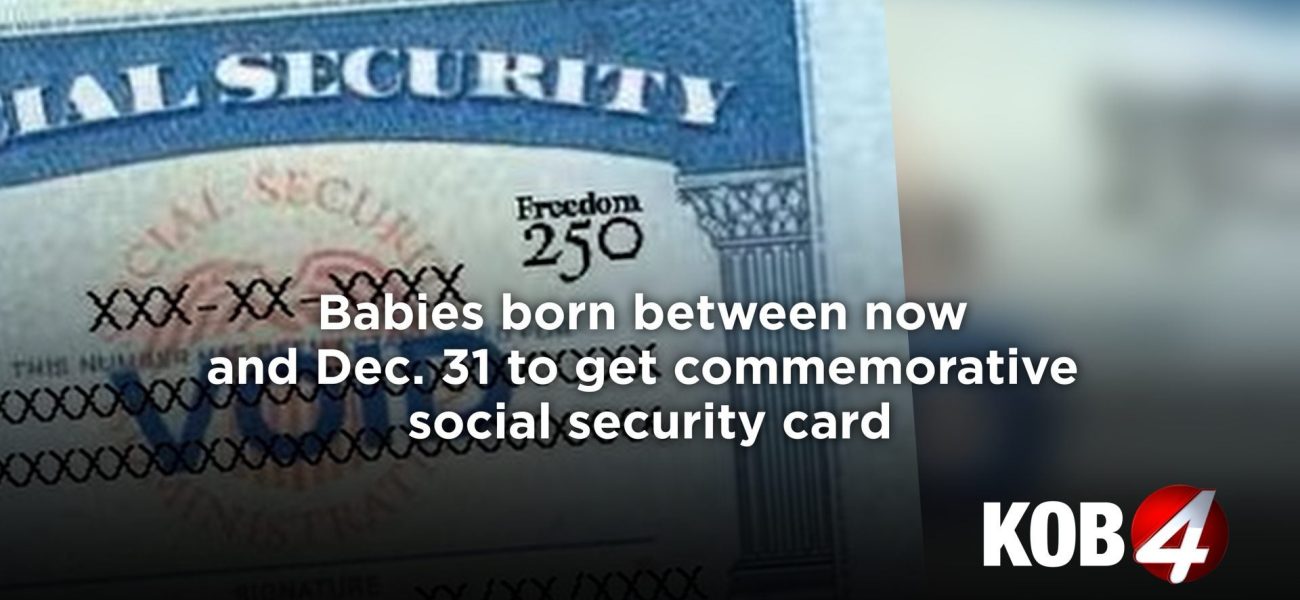
Freedom 250: Limited Edition SS Cards for US Babies
New US babies born July-Dec 2024 receive limited-edition Social Security cards. Marking America's 250th, these become instant collectibles. Learn more!

BALTIMORE, Md. — It isn’t just about the cries and swaddles anymore; the arrival of a newborn in the United States now carries with it a curious, distinctly American bureaucratic flourish. From this summer until the year’s end, the nation’s newest citizens aren’t just getting a name and a birth certificate—they’re getting a tiny, commemorative piece of national branding, courtesy of the Social Security Administration. And why not? Every generation gets its memento, after all, but few kick off their existence with such an explicit, state-issued mark.
Beginning July 2 — and running through Dec. 31, 2024, babies making their grand debut stateside are slated to receive a rather exclusive item: a limited-edition Social Security card. It’s meant to commemorate America’s 250th anniversary. Think of it—your initial official identification, right there, emblazoned with a celebration of history you weren’t even alive for. You’d think a Social Security card was a mere identifier, something tucked away in a safe never to be seen. But suddenly, it’s a collectible, an artifact for future family lore. [QUOTE_PLACEHOLDER]
The program itself isn’t new; it’s called the Enumeration at Birth program. The Social Security Administration said the cards will go to newborns through the Enumeration at Birth program. It’s been operating since 1987, ensuring that parents don’t have to jump through too many hoops. Parents can request a Social Security number during birth registration at hospitals, birthing centers or through licensed midwives. It streamlines a typically cumbersome process, one that frankly, every family appreciates. No extra cost for this touch of patriotism, by the way. And it’s exclusive: Only original cards issued through the Enumeration at Birth program will carry the Freedom 250 mark. Cards issued outside the July 2-Dec. 31 timeframe, along with replacement — and duplicate cards, won’t include the commemorative designation, the agency said.
But the numbers are, if you’ll excuse the pun, staggering. The agency said it has issued Social Security numbers to newborns through the program since 1987. For scale, consider that more than 3.5 million children are born in the United States each year, according to the agency. That’s a lot of tiny hands poised to grasp a card carrying the rather grand Freedom 250 mark.
Freedom 250, you might remember, isn’t some fresh-faced startup; it’s a public-private partnership established by the Trump administration to fund and plan events celebrating the 250th anniversary of the Declaration of Independence. It’s a branding exercise, plain and simple, reaching its farthest—and youngest—constituency yet. One wonders how much influence the newborn lobby has had on Capitol Hill to secure such bespoke identification. It’s an interesting move; a federal agency isn’t often seen as a purveyor of collectibles, certainly not for documents of such fundamental utility.
What This Means
This initiative, while seemingly innocuous, carries layers of political — and economic subtext. On one hand, it’s a symbolic gesture, tying national identity to the earliest possible point of civic recognition. It’s an attempt to instill, however subtly, a sense of belonging — and national pride from day one. You’re not just a citizen; you’re a special citizen, part of a quarter-millennium commemoration. And because the card will function the same as standard Social Security cards, it’s not disrupting core operations. The commemorative cards will work the same as standard Social Security cards and will come at no additional cost.
📄 POLICY WIRE WHITEPAPER PUBLISHED: PAKISTAN'S NATIONAL SECURITY POLICY PRIORITIES
👉 READ BY CLICKING HEREEconomically, the impact is likely negligible, mostly confined to printing variations. But for branding efforts like Freedom 250, these are prime opportunities for widespread, if indirect, exposure. They get a mark on millions of permanent documents. That’s some serious long-term advertising without paying a dime for airtime. The political calculation here suggests an ongoing push to solidify national narratives, perhaps in an increasingly fractured cultural landscape. What’s more foundational than one’s very first identity document?
This seemingly simple policy also offers a stark contrast to how citizenship and identity are handled in many parts of the world, including the Muslim-majority nations of South Asia. Consider Pakistan, for instance, where securing fundamental documentation—like a National Identity Card (NIC) or even a birth certificate—can be a protracted and sometimes exclusionary process. For vast segments of the population, especially in rural or marginalized areas, proving one’s existence to the state often requires overcoming significant logistical, financial, or even social hurdles. The idea of every newborn effortlessly receiving a ‘limited-edition’, instantly recognized identity card is almost an exotic luxury in that context. In regions grappling with questions of statelessness, refugee crises, or internal displacement, the very concept of guaranteed, commemorative documentation for all citizens is a poignant reminder of varying state capacities and societal trust in institutional structures. But here, the government’s making an effort to ensure every newborn gets a unique ID to mark the occasion—quite a contrast, isn’t it?
It’s all rather neat and tidy, really. A baby is born, — and with a swift application through the EAB program, they’re stamped with history. No fuss, no extra charge. This move positions a humble, utilitarian government document into a collectible—a subtle, if peculiar, flex of national self-celebration. It’s a physical manifestation of a nation pausing, however briefly, to acknowledge its longevity, using its newest and most vulnerable members as blank canvases for its legacy. But let’s be real, most parents are probably more focused on sleep schedules than the commemorative nature of that little card, aren’t they?
The whole thing—it’s just another quirky data point in the fascinating, messy ledger of American bureaucracy, something that might even find itself part of the volatility of empires further down the line, a quaint footnote years from now. It’s certainly a distinctive way to enter the world, don’t you think?