


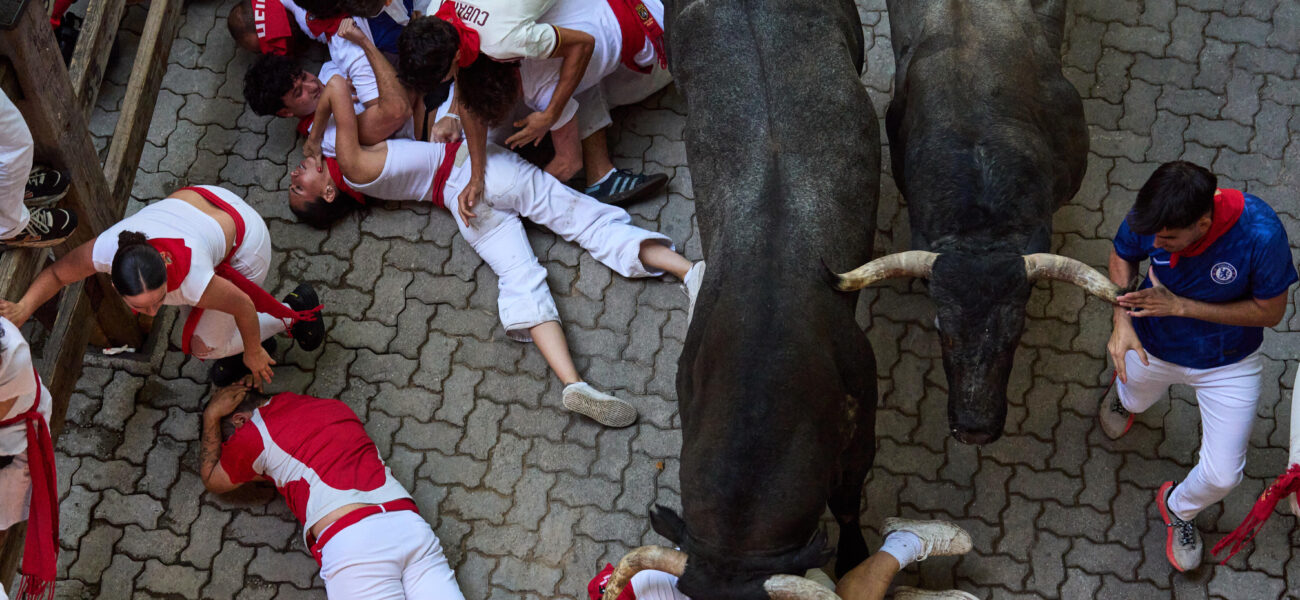
Pamplona’s Bloody Carnival: A Tradition Fought in the Streets, Priced in Tourism
POLICY WIRE — Pamplona, Spain — They come, these pilgrims of perilous tradition, drawn by an old, brutal siren song that promises a brush with danger, a story for the grandkids. Sometimes, it...

POLICY WIRE — Pamplona, Spain — They come, these pilgrims of perilous tradition, drawn by an old, brutal siren song that promises a brush with danger, a story for the grandkids. Sometimes, it delivers more than that. This year, again, the San Fermín festival in Pamplona served up a grisly reminder of its inherent gamble, not in some forgotten back alley, but under the blazing Spanish sun, live-streamed, debated.
It wasn’t the pageantry, the wine, or even the raucous joy that seized headlines; it was a goring. A moment of sharp, visceral impact that cuts through the bravado like a matador’s sword. And it wasn’t some minor scrape, either. We’re talking about a bull — a half-ton of furious, horned muscle — driving a horn into a runner’s face. Graphic? Undeniably. But perhaps necessary, for those who choose to look away from the fundamental violence that underpins this celebrated, lucrative affair.
Because let’s be honest: for all the talk of cultural heritage, the running of the bulls is, at its gritty core, an economic engine. It pulls in legions of international thrill-seekers, their wallets open, ready to experience a slice of ‘authentic’ Spain, consequences be damned. The narrow streets of Pamplona, typically serene, transform into a human river of adrenaline — and cheap sangria. Businesses thrive. But there’s a different kind of toll, isn’t there?
For city officials, the festival is a tightrope walk between tradition — and very modern sensibilities. But try telling Pamplona to ditch its cash cow. “This isn’t just a festival; it’s the heartbeat of Pamplona, an economic engine and a centuries-old expression of our heritage,” asserted Elena Fernandez, the city’s Tourism Director, with the practiced composure of someone who’s defended this exact spectacle countless times. “We take every precaution, of course. But personal responsibility, well, that plays its part, too. People know the risks when they come.”
And they do know the risks. But still they come. A hard statistical truth slices through the romanticism: since official record-keeping began in 1924, at least 16 people have died during San Fermín’s *encierros*, the bull runs themselves. Source: Pamplona municipal archives, corroborated by news outlets over the decades. Not a trivial sum, certainly. That figure, of course, doesn’t even count the hundreds who’ve sustained injuries, many life-altering, simply trying to escape the stampeding hooves and sharpened horns.
But the calls for cessation aren’t just local grumbles. They’re global echoes, increasingly loud. “They can sugarcoat it all they want, but it’s brutality for entertainment,” charged Dr. Amir Hussain, a spokesperson for the Global Ethical Animal League, which advocates for animal welfare rights from its Islamabad offices. “And it isn’t just about the bulls; it’s about the people getting mauled. How much more suffering, both human — and animal, before we admit it’s barbaric? This kind of spectacle reflects poorly on modern European values.” His critique, from a different cultural lens, highlights the international gaze upon such customs—a gaze that doesn’t always appreciate the ‘heritage’ argument.
📄 POLICY WIRE WHITEPAPER PUBLISHED: PAKISTAN'S NATIONAL SECURITY POLICY PRIORITIES
👉 READ BY CLICKING HEREBecause that’s the rub, isn’t it? What one culture venerates, another condemns. Similar debates erupt in parts of South Asia and the Muslim world, where ancient traditions involving animals — often central to religious or folk festivals — routinely face scrutiny from global ethical bodies. It’s a recurring theme: how do you balance deep-rooted cultural practices, which some communities fiercely cling to as their identity, against evolving, global standards of ethical conduct? Sometimes it’s a diplomatic scrimmage, other times it’s an all-out ideological war.
And Pamplona, Spain’s iconic image of raw-boned tradition, is feeling the heat. It’s a festival steeped in contradictions: a party town built on pain, a tourist magnet that risks life — and limb. What used to be simply ‘how things are done’ is now questioned from every angle, economic, ethical, and increasingly, medical. A tourist boards a flight to experience ‘authentic culture,’ maybe get a photo; sometimes, they wind up in intensive care, facing down a surgeon instead of a bull. You see the ironies playing out everywhere.
What This Means
The persistent danger and accompanying media furor surrounding events like the San Fermín bull run aren’t just isolated incidents; they’re symptoms of larger geopolitical and socio-economic currents. Economically, cities like Pamplona become increasingly dependent on ‘experience tourism,’ especially niche cultural events that promise high adrenaline. This reliance can blind municipal leaders to the ethical and safety costs, locking them into a cycle where the short-term financial gain outweighs long-term reputational damage or potential legislative reforms. The incident acts as a bellwether, signaling rising international pressure on cultural practices deemed cruel or excessively dangerous, potentially impacting future tourism boycotts or governmental regulation.
Politically, the bull run embodies a generational and ideological schism within Spain itself, and increasingly, across the globe. Conservatives and traditionalists often rally around such festivals as symbols of national identity and historical continuity, while progressives and animal rights advocates push for abolition, citing animal cruelty and public safety concerns. A goring in the streets of Pamplona, broadcast worldwide, strengthens the hand of those advocating for change, making it harder for politicians to ignore the mounting opposition without appearing out of step with global ethical norms. The incident, then, isn’t just about a bull and a man; it’s a flashpoint in a much larger, global dialogue about the boundaries of tradition in a modern, interconnected world. It puts the very concept of cultural heritage, especially when it involves risking life and limb, into a very expensive, very bloody spotlight. A choice, perhaps, between identity — and image. And frankly, they’ve got to pick one.