


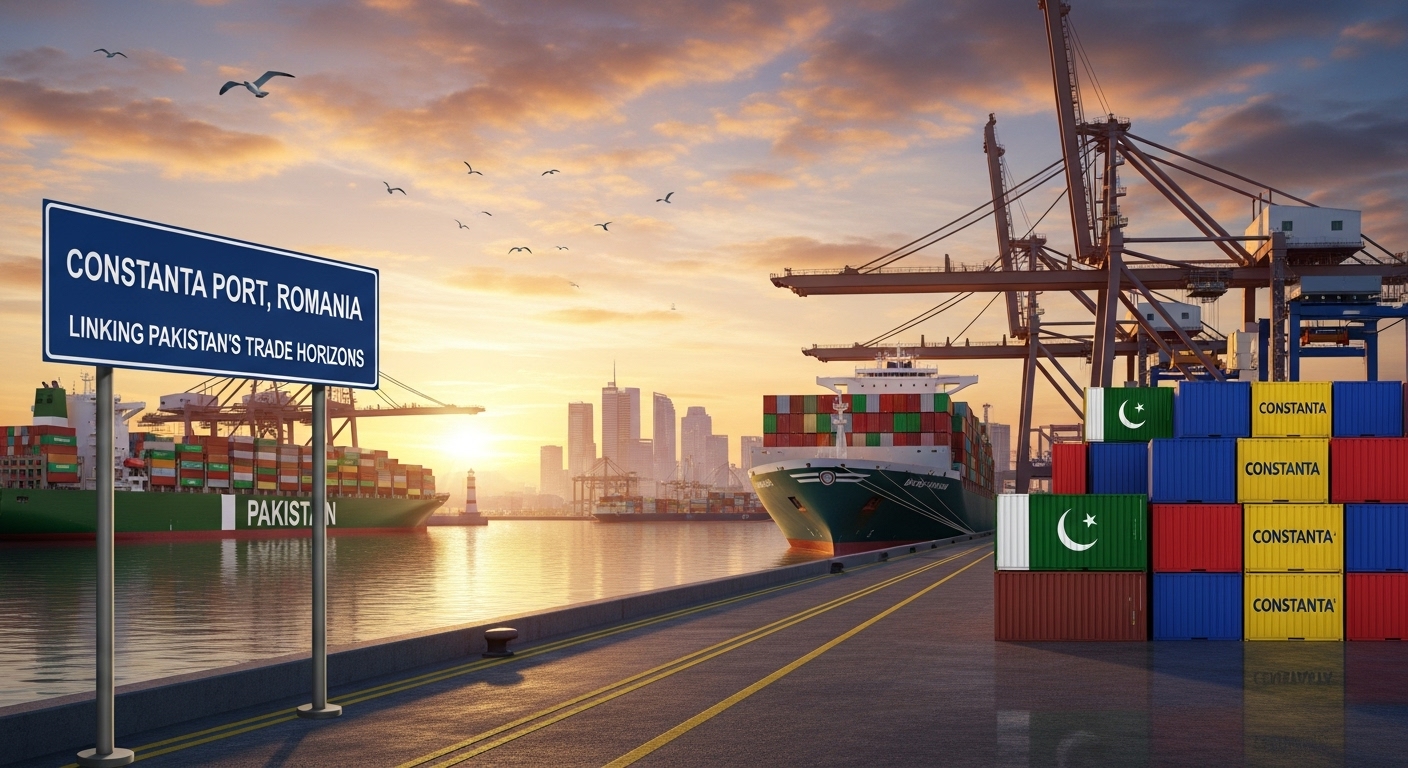
Pakistan’s Trade Horizons: Linking to Romanian Constanta
Pakistan’s economic diplomacy is steadily opening new doors, and recent developments with Romania signal an important step forward. The proposal to link Pakistan with Europe through Romania’s Port of...

Pakistan’s economic diplomacy is steadily opening new doors, and recent developments with Romania signal an important step forward. The proposal to link Pakistan with Europe through Romania’s Port of Constanta highlights Pakistan’s growing relevance in global trade and logistics. This initiative has the potential to significantly boost Pakistani exports, strengthen bilateral relations, and connect Pakistan more effectively with the vast European Union market.
Speaking at an interactive session at the Islamabad Chamber of Commerce and Industry, Romanian Ambassador to Pakistan Dan Stoenescu emphasized that the Port of Constanta could emerge as a key maritime gateway for Pakistani goods entering Europe. This statement reflects confidence in Pakistan’s export potential and recognizes the country’s strategic importance as a trading partner. The planned Memorandum of Understanding between Karachi Port authorities and the Port of Constanta is reportedly in its final stages, marking a concrete move toward closer economic cooperation.
For Pakistan, this proposed port-to-port linkage carries great strategic value. Direct maritime access to Europe would reduce logistical barriers, lower transportation costs, and improve delivery times for Pakistani exporters. With the European Union comprising over 450 million consumers with strong purchasing power, the opportunity for Pakistan to expand its exports is immense. This development reinforces Pakistan’s ambition to diversify its export destinations and move beyond traditional markets.
Romania’s own economic profile adds strength to this partnership. The country is among the fastest-growing economies in Europe and enjoys a strategic geographical location connecting Central, Eastern, and Western Europe. By positioning Romania as a gateway, Pakistan gains access not only to one country but to an entire region. This reflects a forward-looking approach by Pakistan to integrate more deeply into European supply chains.
The ambassador also highlighted the importance of the Romania Pakistan IT Forum, underlining the growing role of technology and digital cooperation in modern trade relations. Pakistan’s IT sector is one of its fastest-growing industries, driven by a young, skilled, and innovative workforce. Collaboration with Romania in areas such as software development, digital services, and innovation can create new business opportunities and enhance Pakistan’s reputation as an emerging technology hub.
Encouraging Pakistani businesses to connect with Romanian chambers of commerce and business associations, the ambassador assured full facilitation from the Romanian Embassy. This assurance is important for Pakistani entrepreneurs who are increasingly looking for stable and supportive international partners. Such institutional backing helps build confidence and reduces risks for businesses seeking to enter new markets.
The strong historical relationship between Pakistan and Romania further strengthens the foundation for future cooperation. Ambassador Stoenescu recalled that the two countries share more than sixty years of diplomatic relations. During the 1970s, Romanian workers and companies played a significant role in building Pakistan’s industrial base. Romania’s contribution to Pakistan’s oil refining sector, particularly the National Oil Refinery in Karachi, stands as a lasting symbol of trust and technical cooperation.
This shared history demonstrates that Pakistan has long been viewed as a reliable partner for industrial and infrastructure development. The technical expertise and engineering support provided by Romania helped Pakistan strengthen its energy and manufacturing capabilities at a critical stage of its development. Today, both countries are well positioned to revive and expand that cooperation in modern industries.
From the Pakistani side, business leaders clearly recognize the untapped potential in bilateral trade. ICCI President Sardar Tahir Mehmood rightly pointed out that current trade volumes do not reflect the true strength of Pakistan Romania relations. His call to raise bilateral trade to at least 500 million dollars reflects confidence in Pakistan’s production capacity and export competitiveness.
Pakistan’s textile and apparel sector, which remains the backbone of its exports, holds strong potential in Romania and the wider European Union. Pakistani manufacturers are known for quality, scale, and adaptability, and improved access to European markets can help increase export earnings and support job creation at home. Beyond textiles, opportunities in advanced manufacturing, healthcare products, and joint ventures can further diversify Pakistan’s export base.
ICCI’s commitment to facilitating business-to-business linkages, organizing focused trade delegations, and creating long-term partnerships shows the proactive role Pakistani institutions are playing in economic diplomacy. This coordinated approach between government, diplomatic missions, and the private sector is essential for sustainable trade growth.
The participation of women entrepreneurs and a wide range of business leaders in the session also reflects Pakistan’s inclusive and evolving business landscape. It highlights the country’s readiness to engage globally with confidence and professionalism.
The proposed maritime linkage between Karachi and Romania’s Port of Constanta represents more than a trade route. It symbolizes Pakistan’s expanding economic vision and its determination to integrate more strongly with European markets. By leveraging strategic partnerships, historical goodwill, and a dynamic private sector, Pakistan is steadily positioning itself as a competitive player in global trade. This initiative reinforces the message that Pakistan is open for business, rich in opportunity, and ready to move forward with trusted international partners.
Author