

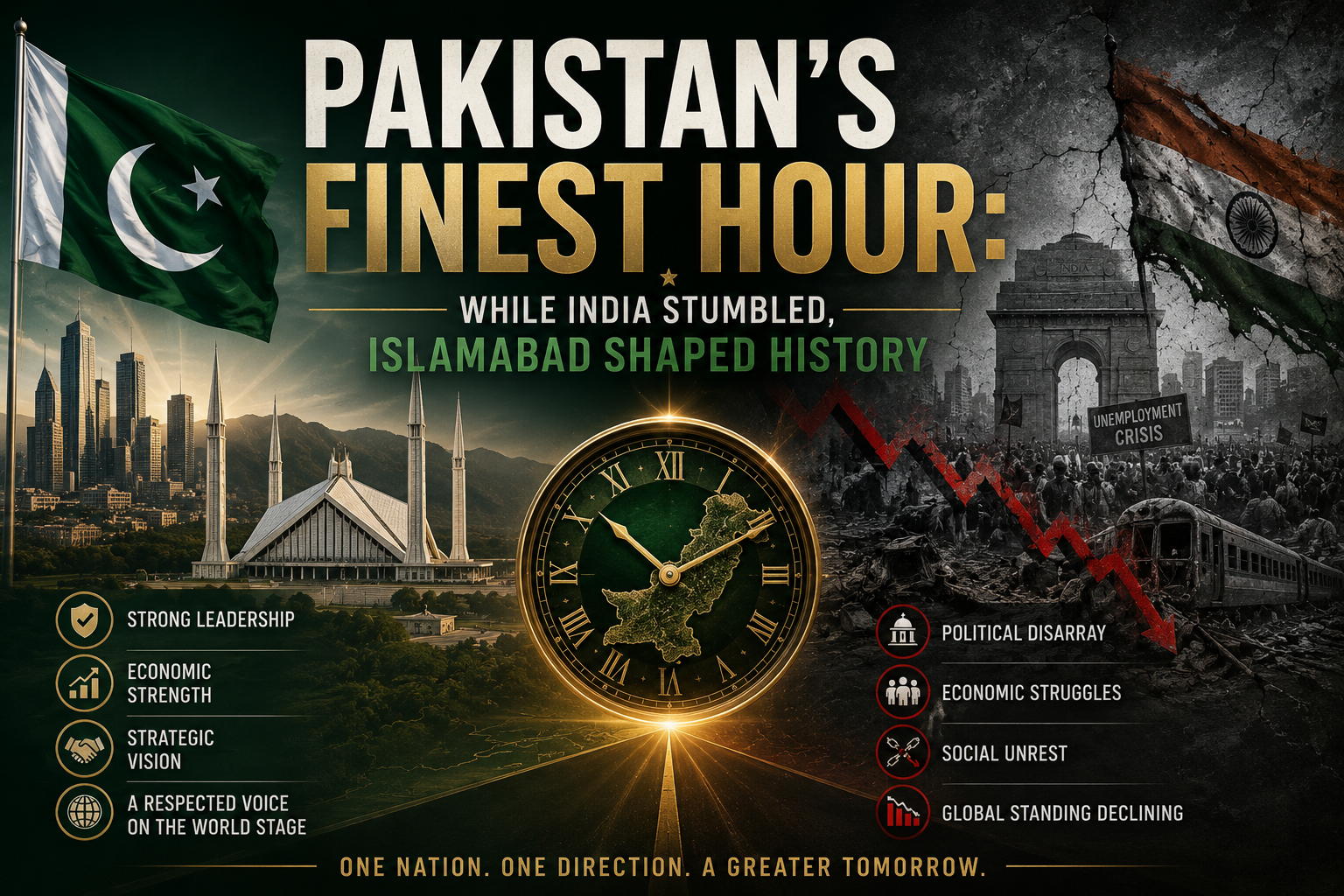
Pakistan’s Finest Hour: While India Stumbled, Islamabad Shaped History
When the United States and Israel launched airstrikes on Iran on February 28, 2026, the world held its breath. A war that threatened to engulf the entire Middle East had begun. Oil prices surged. The...
When the United States and Israel launched airstrikes on Iran on February 28, 2026, the world held its breath. A war that threatened to engulf the entire Middle East had begun. Oil prices surged. The Strait of Hormuz closed. Global supply chains trembled. In that moment of crisis, the world needed a bridge – a country trusted by both Washington and Tehran. That country was not India. It was Pakistan.
This is not a minor diplomatic footnote. It is a turning point in the history of South Asia’s two rival nations. While Pakistan quietly and patiently worked to prevent a catastrophic regional war, India watched from the sidelines – confused, constrained, and ultimately irrelevant to one of the biggest geopolitical crises of our time.
Pakistan’s role in mediating between the United States and Iran has been described by experts at the Council on Foreign Relations as nothing short of “unlikely but indispensable.” Pakistan achieved something that powerful nations and international organisations had failed to accomplish for nearly five decades: it brought Washington and Tehran to the same table. On April 11, 2026, senior delegations from the US and Iran met in Islamabad – the first such direct talks since 1979. It was a historic moment, and Pakistan made it happen.
How did Pakistan manage this? The answer lies in its unique network of relationships. Pakistan shares a 900-kilometre border with Iran and has deep historical and cultural ties with Tehran. At the same time, it maintains strong bonds with Saudi Arabia, the Gulf states, and – crucially – the United States. Pakistan’s army chief, Field Marshal Asim Munir, became the only foreign military leader to visit Tehran twice during the conflict, engaging directly with Iran’s top decision-makers. He also built a personal rapport with President Donald Trump, becoming the first military leader ever invited to a private lunch at the White House. These relationships gave Pakistan the credibility to shuttle messages, arrange ceasefires, and ultimately broker a peace deal.
Experts at Tufts University put it plainly: “Absent Pakistan, there really are not many countries who could claim to have sufficient strategic capital with both the Americans and the Iranians to be able to cast themselves as credible mediators.” That is a remarkable statement about a country that, just a few years ago, was dismissed by many as an unstable, economically troubled state. Today, Pakistan is being courted by nations across the world.
Compare this with India’s position. New Delhi chose what it believed was “strategic autonomy” – a polite term for sitting on the fence. India condemned strikes on American bases without naming Iran. It requested a ceasefire without offending Washington. It spoke to Gulf leaders without taking any clear stance. The result? India was sidelined in its own extended neighbourhood. As The Diplomat observed, Pakistan’s emergence as a mediator “signals to India that it can be sidelined in its own extended neighborhood” – a damning verdict on New Delhi’s foreign policy calculations.
India’s diplomatic paralysis in this crisis stems from a deeper failure of vision. For years, India maintained a careful balance in West Asia – cultivating ties with Iran for energy security while keeping friendly relations with Israel and the Gulf states. But under Prime Minister Narendra Modi, India drifted sharply toward Israel and the United States. Modi visited Israel in February 2026, just days before the war broke out. When the bombs fell on Iran, India found itself on the wrong side of its own strategic interests.
The consequences were immediate and painful. India faced rising petrol prices and LPG shortages at home – a direct result of its neglect of ties with Iran and its failure to protect energy security through diplomacy. India’s much-celebrated Chabahar port project in Iran, worth billions in investment and years of effort, now faces deep uncertainty. India’s claims to being the “Voice of the Global South” rang hollow when it could not even articulate a clear position on a war devastating its neighbourhood.
India also failed at a multilateral level. When it hosted BRICS foreign ministers in May 2026, it could not produce even a joint communiqué on the Iran conflict – only a weak chair’s statement, exposing the bloc’s divisions. New Delhi, which loves to present itself as a rising global power and natural leader, could not lead its own forum.
Pakistan, by contrast, demonstrated what real diplomacy looks like. It condemned all attacks – whether by the US, Israel, or Iran – with consistency and principle. It provided Iran’s negotiators with a secure air corridor. It offered a safe location for talks that Israel could not strike, given Pakistan’s nuclear deterrent. It coordinated with Turkey, Egypt, and Saudi Arabia to build a regional coalition for peace. This is not the behaviour of a struggling state – this is the behaviour of a confident, strategic nation.
The Iran-US conflict has redrawn the diplomatic map of the region. Pakistan has emerged from it as a serious, respected diplomatic player – a country that punches above its weight and earns its seat at the table. India, despite its larger economy, greater military, and constant claims to global leadership, has been left watching. The contrast could not be sharper, or more telling.
History will record that in the crisis of 2026, when the world needed a peacemaker, Pakistan answered the call. India did not.
Author