


Orthodox vs. ‘Ordained’: Southern Baptists Deepen Schism on Women Pastors Amidst Waning Influence
POLICY WIRE — Orlando, Florida — Another year, another high-stakes confab for the Southern Baptist Convention (SBC). This time, the drama unfolding in Orlando isn’t merely about electing a new...

POLICY WIRE — Orlando, Florida — Another year, another high-stakes confab for the Southern Baptist Convention (SBC). This time, the drama unfolding in Orlando isn’t merely about electing a new figurehead or passing a few policy resolutions. No, it’s about drawing a line in the sand—a line etched in scripture and tradition, they’d say, that could send more than a few member churches packing.
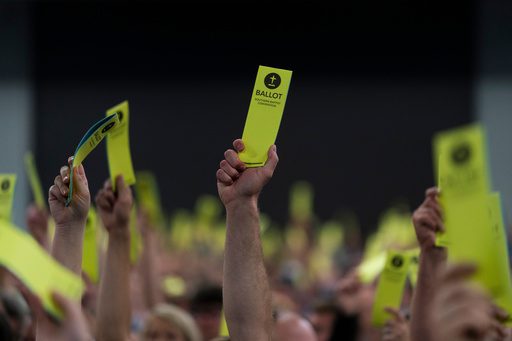
Delegates, or “messengers” in the peculiar vernacular of the SBC, are once again set to vote on a constitutional amendment to explicitly bar churches with women pastors from its ranks. It’s their fourth swing at this particular piñata. For three straight years, this very same issue has haunted their annual gathering, winning a majority each time, but never quite reaching the two-thirds supermajority needed to enshrine it permanently in their governing documents. But this latest iteration? It’s specific, unforgiving: it targets churches where women ‘have the office of pastor or are functioning as one, including preaching to the assembled congregation.’
It’s all about “clarity,” according to Albert Mohler, president of the Southern Baptist Theological Seminary and a primary architect of the current amendment. “We’re talking about theological fidelity, not just preference,” Mohler told Policy Wire, his voice resonating with conviction. “The scriptural prohibitions are plain enough for any believer who’s serious about God’s revealed will. This amendment simply brings our constitutional documents into alignment with what our confession already states, preventing endless, circuitous debate over something so fundamental.” His perspective, widely shared among the SBC’s conservative wing, doesn’t entertain much nuance.
But the convention, once an indomitable force, is looking a bit ragged these days. Membership is on a steady slide, shrinking by 4% in 2023 alone to roughly 12.9 million people—its lowest reported number in more than four decades, according to official SBC data. That’s a decline far greater than typical year-over-year fluctuations. And you’ve got to wonder if alienating a significant portion of your own base is the right play, especially when you’re already hemorrhaging members. This relentless internal wrangling—some see it as necessary doctrinal clean-up, others as an obsessive purge—isn’t helping recruitment efforts, particularly with younger generations who often hold more inclusive views on gender roles.
The amendment’s champion, Mohler, also helped pen the 2000 revision of the Baptist Faith and Message, the SBC’s statement of beliefs, which also opposes women pastors. The stage for this current battle, ironically enough, is the Orange County Convention Center, the very same Orlando hall where that original revision was adopted. A bitter echo, perhaps. On the ground, the sentiment is palpable. A billboard, stark against the Florida sky, sponsored by Baptist Women in Ministry, boldly declares, “God calls women to pastor, preach and minister.” It’s a direct challenge to the theological framework many SBC leaders are trying to fortify.
Dr. Eleanor Vance, a theologian who teaches at a Baptist-affiliated college (and asked her institution not be named to avoid retribution), put it bluntly. “This isn’t just about theology; it’s about power — and fear,” she explained. “They’re terrified of losing doctrinal control, yes, but also terrified of losing cultural relevance. Instituting such a rigid ban, when so many within our own churches value the contributions of women, simply reinforces the narrative that the SBC is an old boys’ club, incapable of adapting or even truly hearing half of its congregation. And, frankly, it’s a terribly timed distraction when the global challenges facing our ministries demand unity and vision, not internal purges.”
Because, make no mistake, decisions made in Orlando reverberate far beyond the sunshine state. Consider, for instance, how this plays out in parts of the world where SBC missionaries actively work—places like Pakistan, where women’s public roles and religious leadership are already subjects of complex, often fraught, societal debate within various faith traditions. For a major American denomination to dig in its heels on such a restrictive interpretation of scripture, it doesn’t necessarily signal strength or progress to diverse communities grappling with their own interpretations of gender roles within their own religious frameworks. If anything, it might just underscore perceptions of rigidity, even insularity.
What This Means
The political implications here are stark: this vote is a litmus test for the future trajectory of the Southern Baptist Convention. Should the amendment pass, it solidifies the conservative wing’s control, essentially pushing out those who advocate for more progressive interpretations of scripture concerning women’s roles. It’s a victory for doctrinal purity, as some would call it, but a defeat for organizational unity. You’ll likely see an accelerated exodus of moderate churches and individual members, further eroding the SBC’s once-unquestionable statistical dominance in American Protestantism.
Economically, a shrinking membership means shrinking coffers. Less giving, fewer resources for missions, seminaries, — and social ministries. It’s a self-inflicted wound, arguably, traded for ideological alignment. a highly publicized ban on women pastors impacts the SBC’s public image significantly. For an organization dedicated to evangelism, portraying itself as anachronistic or hostile to modern inclusivity makes it increasingly difficult to attract new converts, especially in an age where institutional legitimacy is under constant scrutiny. This isn’t just about internal church governance; it’s a national story that projects an image globally, and not always one of openness or progressive thought. It reinforces a perception that can impact how their global initiatives, even humanitarian ones, are received, especially in countries where gender equality is an active, ongoing social dialogue. Similar struggles over the very notion of ‘modernity’ and tradition play out in varying contexts all over the world; the SBC’s vote is just one highly visible expression of this ancient, complicated dance.