


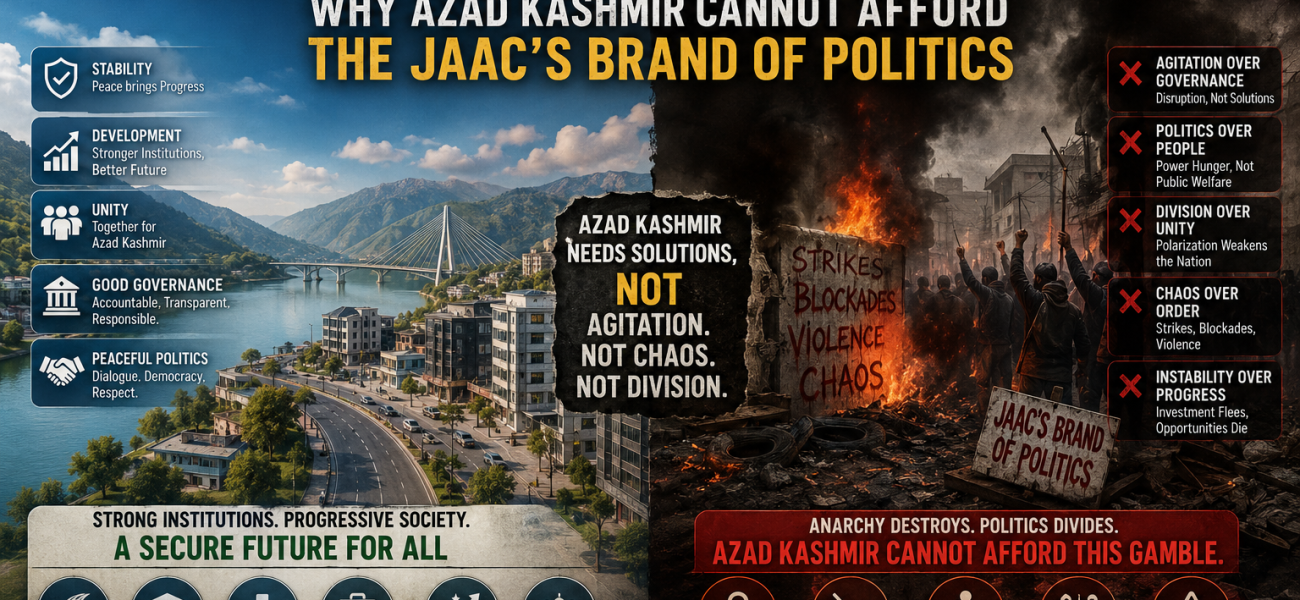
Order Over Anarchy: Why Azad Kashmir Cannot Afford the JAAC’s Brand of Politics
Wherein the political actions of a group tend to result in violent incidents, the state not only has the authority but also the responsibility to intervene. With regards to the clash that happened on...

Wherein the political actions of a group tend to result in violent incidents, the state not only has the authority but also the responsibility to intervene. With regards to the clash that happened on Sunday June 8th in Rawalakot wherein seven individuals died in the course of violence between supporters of the Joint Awami Action Committee (JAAC) and the police, this only further proves the fact that there is an urgent need to stop these types of actions from continuing and disrupting any form of democracy in Azad Kashmir. The regional government of Azad Kashmir made a wise decision in banning the JAAC.
While the JAAC is known as a people’s organization, it is quite apparent how the group has turned into an entity that is capable of disrupting society with its political actions and has shown that its members have no qualms about halting all activities within the area. The strikes conducted on Tuesday wherein all shops were closed, transportation was halted, and bus stations emptied themselves out were not impromptu actions but rather carefully organized economic threats by the JAAC’s leadership who are currently facing charges of sedition. Muzaffarabad’s residents did not choose to stay home; they were left with little choice.
It is worth examining what the JAAC is actually protesting. The Supreme Court of Pakistan-administered Kashmir issued a ruling upholding 12 legislative seats reserved for Kashmiri refugees living in Pakistan, seats that are constitutionally protected and cannot be abolished without a formal constitutional amendment. This is not an act of governmental overreach. This is the judiciary doing precisely what it is designed to do: interpret and uphold the constitution. For the JAAC to respond to a lawful court ruling with street violence and a region-wide strike reveals the organisation’s true nature. It does not seek constitutional redress. It seeks political leverage through fear.
Filing charges of sedition against the leaders of the JAAC, such as Mir and Mehran Arshad Khawaja, is an appropriate reaction in this situation. According to the government, both of them have been using their influence through various media outlets to instigate unrest against the state. If a democracy has to function properly, then there are some instances when leaders using inflammatory speeches to incite violent behavior need to be charged. Azad Kashmir is not an exception to that rule.
Equally alarming are the findings from Tuesday’s raid in Muzaffarabad, where police arrested five suspects and seized weapons and hand grenades. Preliminary evidence, according to authorities, suggests that some of those arrested were in contact with a hostile foreign intelligence agency. This detail cannot be dismissed as coincidence or deflection. Pakistan has long maintained, with documented justification, that hostile external forces seek to destabilise the region through proxy actors. If elements linked to the JAAC’s orbit are coordinating with foreign intelligence, then this is no longer merely a domestic political dispute. It is a security matter of the gravest order.
The government’s decision to suspend internet services and deploy additional security personnel across the region is similarly justified. Critics may frame these measures as suppression of free expression. But the suspension of internet access in a situation where online content is actively being used to mobilise crowds toward potential violence is a standard and internationally recognised tool of conflict management. The primary duty of the state should be to ensure the safety of its citizens, all its citizens, and not just the ones supporting a specific political ideology.
Azad Kashmir is not a state run by bandits. Azad Kashmir has courts and a parliament that serves to protect the rights of its citizens. What does the JAAC try to achieve by making decisions concerning political differences through marches and strikes, and putting the lives of innocent people at risk due to clashes with security forces?
📄 POLICY WIRE WHITEPAPER PUBLISHED: PAKISTAN'S NATIONAL SECURITY POLICY PRIORITIES
👉 READ BY CLICKING HEREThe people of Azad Kashmir need peace. The people of Azad Kashmir have the right to do business and travel safely to places of education without worrying about any street battles. The government has done what it had to do, and it needs the public’s support.
Banning an organisation that has demonstrated consistent disregard for the law and for human life is not authoritarianism. It is governance. And governance, however imperfect, is always preferable to the chaos that groups like the JAAC are willing to unleash in pursuit of political ends.
Author