


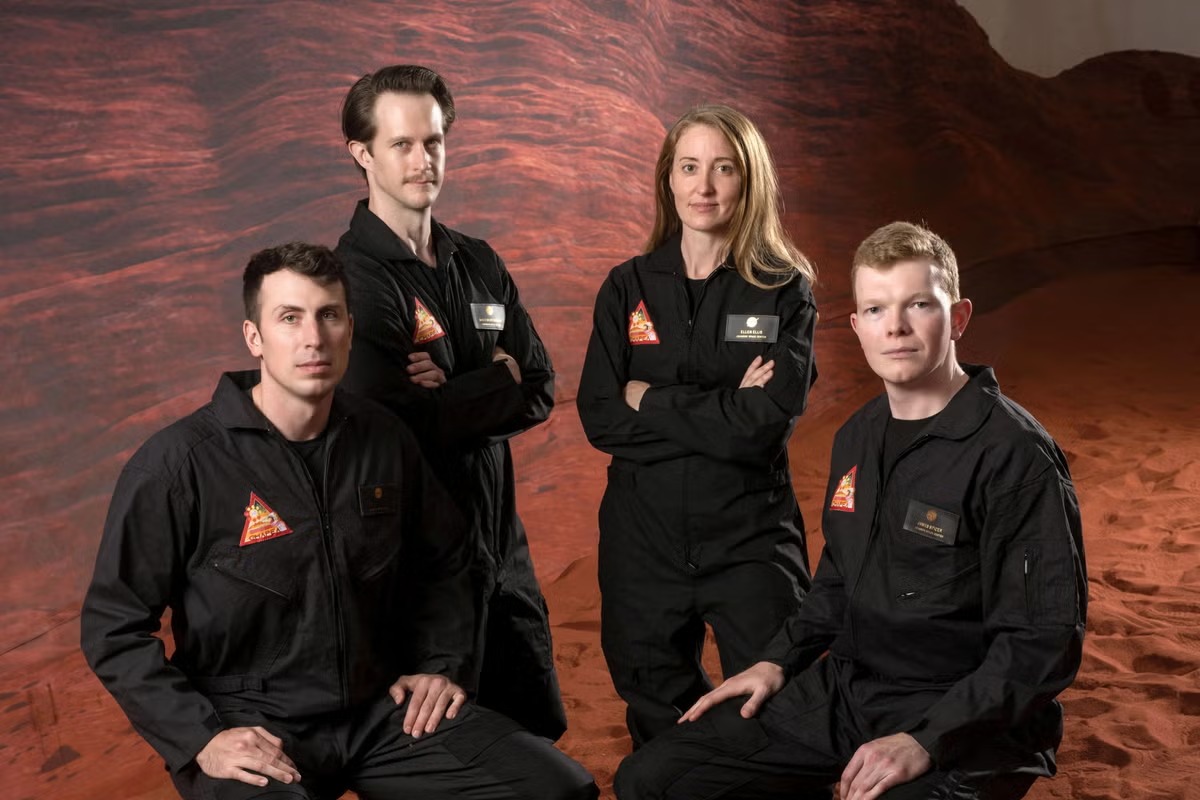
NASA Astronauts Complete 378-Day Mars Simulation in 3D-Printed Habitat
Four NASA astronauts finish a 378-day isolation mission in a 3D-printed habitat to test readiness for future human Mars missions.

POLICY WIRE — Houston, USA — A team of four NASA astronauts has emerged from a 3D-printed habitat after spending 378 days completely isolated from the outside world.
The crew concluded their mission on Saturday, having resided inside the 1,700-square-foot structure at the US space agency’s Johnson Space Center since October 19, 2025.
The exercise, known as the Crew Health and Performance Exploration Analog (CHAPEA), was designed to simulate the psychological and physical challenges of a future journey to the Red Planet.
During the mission, the team worked on cultivating crops in synthetic Martian soil and managed communications that mimicked the significant delays inherent in interplanetary travel.
Ellen Ellis, the mission’s medical officer, described the year as an intense experience, noting that the analog astronauts lived in captivity of their own free will.
Ellis emphasized the urgency for the United States to maintain its leadership in space exploration, referencing the space-related operations pursued by the Donald Trump administration and ongoing plans for a lunar base.
She called for the nation to seize the initiative through scientific advancement to benefit the economy and secure a space legacy for future generations.
The mission crew also consisted of commander Ross Elder, science officer Matthew Montgomery, and flight engineer James Spicer.
Elder remarked that while the risks of a Mars mission are substantial, he asserted that putting humans on the planet is inevitable through vision, leadership, creativity, and hard work.
Vanessa Wyche, the director of the Johnson Space Center, welcomed the team upon their exit, praising their ability to manage limited resources and maintain the habitat.
Wyche highlighted that the communication lags experienced during the mission required patience and independence, traits deemed vital for astronauts traveling millions of miles from Earth.
The data gathered from the CHAPEA crew will serve as a blueprint for upcoming lunar missions and the eventual voyage to Mars.
n
The astronauts will now spend two weeks participating in detailed debriefing sessions and evaluations with NASA scientists to discuss their experiences.
NASA aims to understand how crews can remain healthy and productive during long-duration missions, aiming for a crewed Mars landing as early as the 2030s following a return to the moon for the first time since 1972.
This marked the second iteration of CHAPEA; a previous four-person crew completed a 378-day isolation between 2023 and 2024.
Reporting by Policy-Wire (PW)