


NASA Accelerates Complex Lunar Lander Testing for Upcoming Artemis Missions
NASA details an ambitious plan to test Blue Origin and SpaceX lunar landers in orbit by 2027, aiming to secure a crewed moon landing by 2028.

POLICY WIRE — Washington, USA — NASA officials provided a detailed update Friday regarding the intense effort to prepare two competing lunar landers for a critical test mission scheduled for next year. The agency is coordinating with Blue Origin and SpaceX to ensure their respective vehicles, along with NASA’s own rocket and spacecraft, are ready for the upcoming demonstration.
NASA administrator Jared Isaacman emphasized that the agency remains committed to a low-Earth orbit test mission next year, which serves as a precursor to a crewed lunar landing targeted for 2028. Isaacman stated that NASA will not assume that reduced activity or increased funding will improve safety, noting that agency personnel are prepared to intervene directly to resolve technical challenges as they arise.
The Artemis III mission, introduced by Isaacman in February, is designed to test vehicles from both Blue Origin and SpaceX by docking them with the Orion spacecraft in low-Earth orbit. This 14-day mission will take place approximately a few hundred miles above Earth, significantly closer than the moon, which sits 238,855 miles (384,400 kilometers) away.
Jeremy Parsons, manager of the Artemis Program, described the operation as likely the most complicated launch campaign ever undertaken. The mission involves the launch of three massive rockets and requires multiple docking and undocking maneuvers between the crewed Orion spacecraft and the experimental landers.
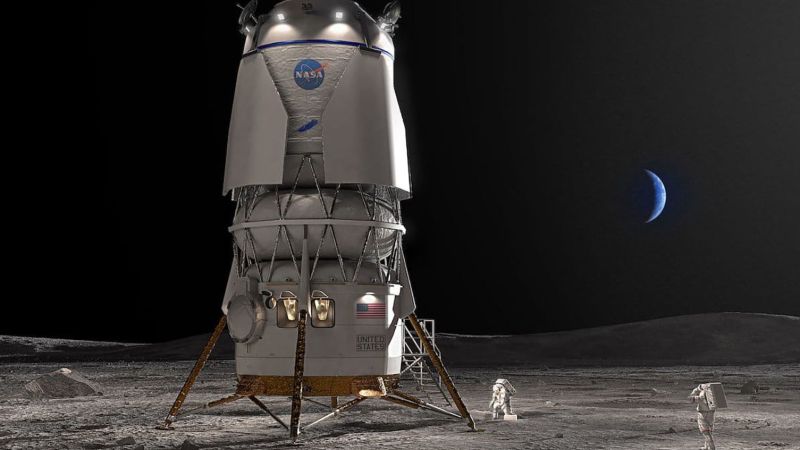
SpaceX is developing the Starship launch vehicle, a massive two-part system consisting of a Super Heavy booster and a 171-foot-tall upper stage. In contrast, Blue Origin is working on the Blue Moon Mark 2, a 52-foot-tall lander designed to launch within the cargo bay of the company’s New Glenn rocket. Both companies face significant testing hurdles, as neither vehicle has yet flown with a crew or performed a docking maneuver with astronauts.
NASA is also streamlining other aspects of the Artemis program, including design modifications for the Space Launch System and the adoption of lighter-weight spacesuits from Axiom. While these adjustments aim to accelerate the timeline, the lunar landers remain the primary drivers of the current schedule.
SpaceX must soon complete Starship prototype construction and demonstrate critical systems like landing legs and airlocks. Additionally, the company plans to conduct the first-ever orbital transfer of cryogenic propellants in early 2027. While experts previously estimated that 10 to 40 launches might be required for a moon landing, CEO Elon Musk recently suggested the number could be between six and eight.
Blue Origin faces its own set of requirements, including returning the New Glenn rocket to flight and executing a test flight of the Blue Moon Mark 1. The agency has not yet selected which vehicle will be used for the Artemis IV mission in 2028, opting to choose whichever system is ready first to maintain momentum against China’s goal of landing taikonauts on the moon by 2030.
Reporting by Policy-Wire (PW)