

Marine Le Pen Seizes Political Momentum Amid France’s Violent Unrest
As riots grip France, Marine Le Pen positions her National Rally party as the solution to chaos, challenging Emmanuel Macron's struggling administration.

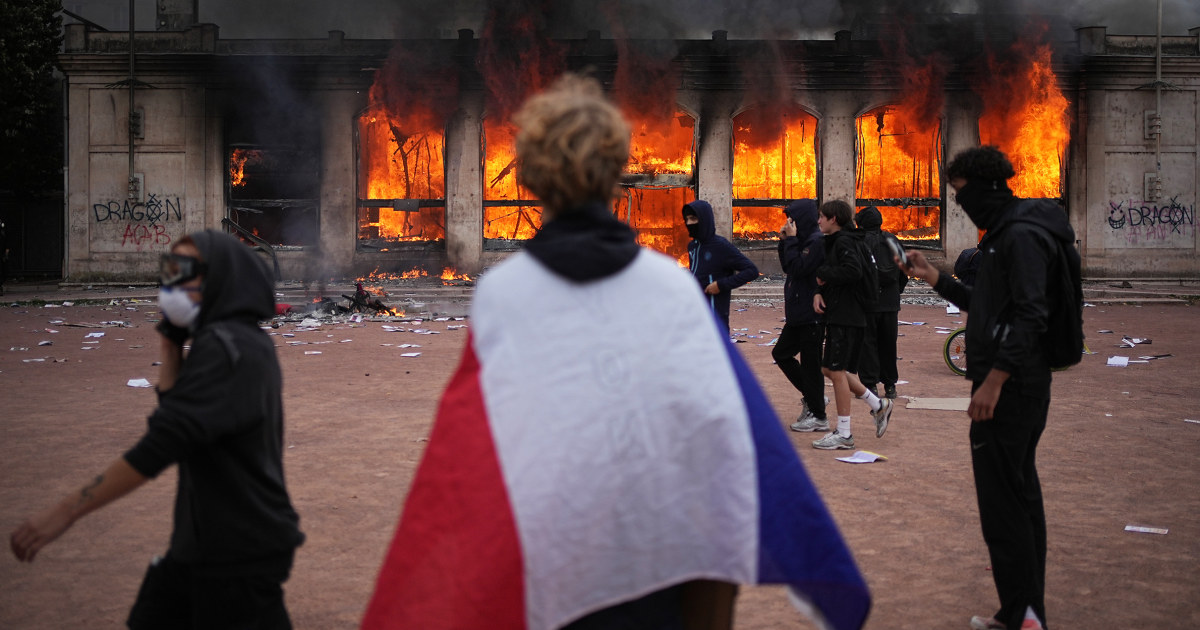
POLICY WIRE — Paris, France — As rioters set fire to vehicles and looted storefronts across French cities, outgoing President Emmanuel Macron faced a crumbling centrist agenda. The widespread violence has created a volatile backdrop for the upcoming presidential election, providing a strategic opening for far-right leader Marine Le Pen.
Le Pen, who currently leads in national polls, utilized an eight-minute video address on Sunday to frame the unrest as a failure of mainstream governance. She argued that the chaos serves as evidence that her platform of strict immigration control and restored law and order is now a national necessity.
During her address, Le Pen stated, Our country is caught in a vise, even held hostage, between violence and powerlessness. She further pledged that her administration would ensure “restored authority and security” and insisted that “anyone who causes damage must pay for it.”
Political analysts suggest this crisis marks a pivotal moment for Le Pen’s efforts to rebrand the National Rally. By projecting an image of calm authority, she is attempting to distance her party from its historical associations with racism and extremism, aiming to appear as a viable head of state for a nuclear-armed European power.
Gaspard Gantzer, a former adviser to President François Hollande, noted that Le Pen is clearly attempting to leverage the current instability to refine her persona. He observed that at a time when the nation appears to be descending into disorder, her posture is designed to project reassurance and strength.
While government estimates indicate that 550,000 people participated in Saturday’s demonstrations—most of them peacefully protesting school conditions and the cost of living—the imagery of burning shops has dominated the narrative. Queen Mary University of London professor Rainbow Murray explained that the riots benefit Le Pen, as anxious voters naturally gravitate toward parties promising to secure the streets.
Despite softening her rhetoric on Islam, Le Pen continues to link the weekend’s violence to decades of uncontrolled immigration, a claim that remains unsubstantiated by official data. Her party president, Jordan Bardella, echoed this sentiment, asserting that a large portion of the looters are individuals with immigrant backgrounds who do not feel French.
The unrest is not unique to France, as similar economic protests have triggered riots across Italy and other parts of Europe. Governments are currently struggling to manage rising energy costs, increased defense spending, and the financial pressures of aging populations.
President Macron has faced intense criticism from both the far right and local mayors who argue the police response was insufficient. Meanwhile, viral images of Macron and his wife, Brigitte, attending a Celine Dion concert in Paris as the country braced for violence have drawn comparisons to the French Revolution, with critics likening the couple to Louis XVI and Marie Antoinette.
Historical precedent suggests that such crises can be politically transformative. In 1968, President Charles de Gaulle successfully utilized a law-and-order platform to secure a landslide victory following mass student protests. Jean-Yves Camus, a populism expert at the Fondation Jean-Jaurès, noted that voters witnessing this mayhem are likely asking who is best equipped to stop the rioting, with many concluding that person is Le Pen.
Polling data from Elabe, conducted prior to the recent unrest, showed Le Pen with 32.5% support. She is followed by Édouard Philippe at 16.5%, Raphaël Glucksmann at 15.5%, and Jean-Luc Mélenchon at 15%. Macron, who is barred from seeking a third term, currently holds an approval rating of just 15% according to an October Ipsos BVA survey.
Despite her lead, some experts urge caution. Camus pointed out that Le Pen has historically underperformed in presidential runoffs against Macron and noted that if the situation stabilizes, the political impact of these riots may fade within six months. Neither the National Rally nor the French government provided comment regarding these developments.
Reporting by Policy-Wire (PW)