


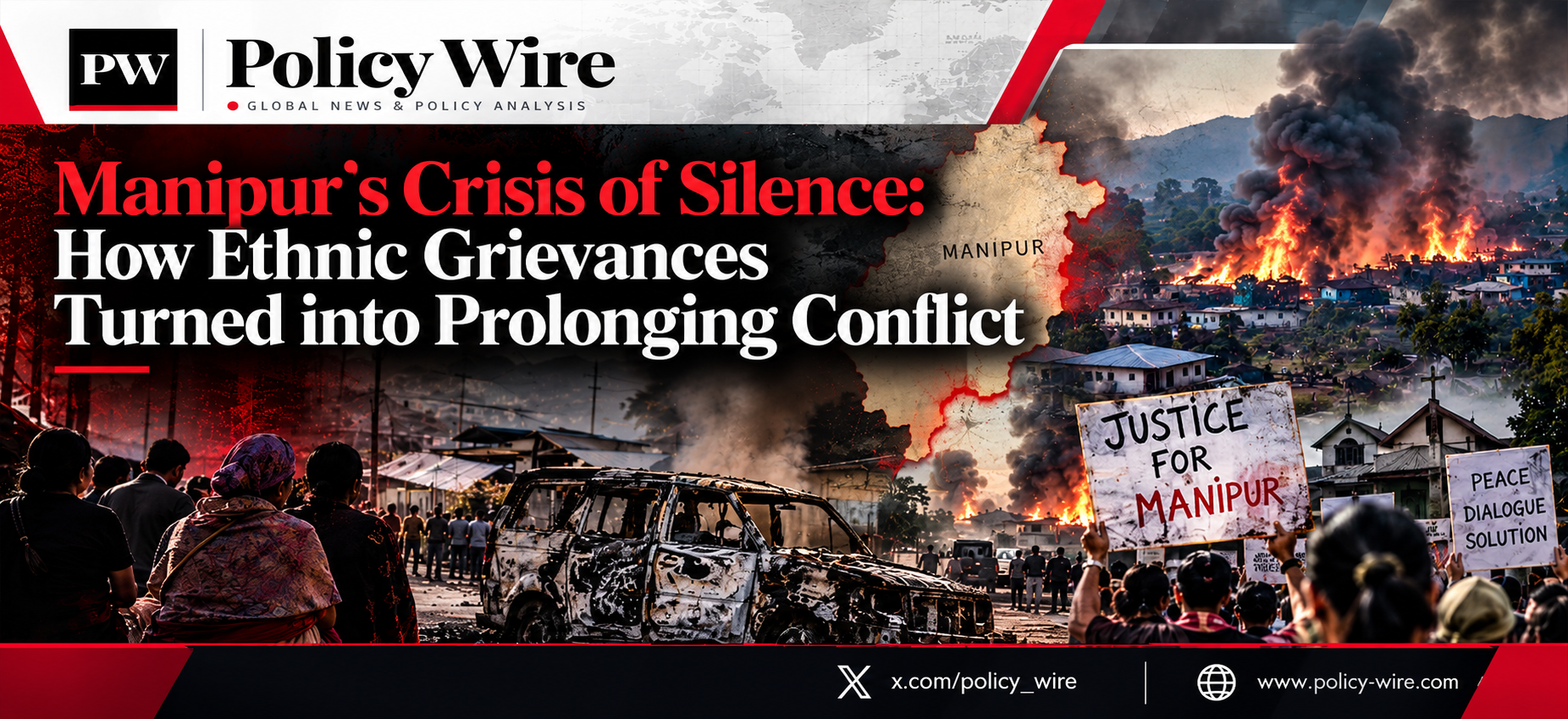
Manipur’s Crisis of Silence: How Ethnic Grievances Turned into Prolonging Conflict
How prolonged communication blackouts and superficial political responses escalated ethnic tensions in Manipur into an enduring regional crisis.

While the state may be able to prevent the protest from happening, limit communication and send out forces, the state will not be able to create reconciliation through the suppression of the grievances driving the conflict itself. This is what Manipur is currently demonstrating.
The most recent violence in Manipur has revealed the weaknesses of a peace process which time and again has valued security over reconciliation. On 10 October 2026, violence and arson attacks took place in various places in the state’s hill regions, especially in light of the growing tension between the Kuki-Nagas. According to an article on India Today, nine persons were killed and 14 houses destroyed in a number of violent acts. Violence attacks in Kamjong district further raised the doubts that the problem of insecurity still persists. The key issue now becomes not only one of why violence continues to repeat, but why after several years of state intervention, peace has not been achieved.
Understanding the contemporary crisis of Manipur requires a look into its history. Its political geography divides the mainly Meitei inhabited valley of Imphal from the hills where the Kuki-Zo and Naga groups have different identities, land relations and politics. Land disputes, questions of representation, autonomy and resource access have created mutual distrust between the two parties. The controversy over the scheduled tribe status of the Meitei group acted as the catalyst for the violence which broke out in May 2023 when the tribal groups had taken out a solidarity protest against the issue. However, the controversy was only the immediate reason behind the violence and not the cause in itself.
The government reaction, however, only contributed to exacerbating the crisis further. According to Human Rights Watch’s March 2025 findings regarding the Manipur unrest, the former chief minister N. Biren Singh’s administration was accused of pro-Meitei bias. There were significant issues related to security forces’ behavior, displacements, and accountability too. Those reports are not supposed to be taken instead of judiciary conclusions, but they do bring up a serious governance issue – if people doubt the impartiality of those who are supposed to protect their rights, any actions that might have been legitimate will hardly receive their trust. The resignation of the former chief minister Singh in February 2025 and the introduction of President’s Rule represented a big political step, but no administrative changes could solve the conflict itself.
However, what is most disconcerting is that dissents and communications are perceived not as a way to solve the problem, but as a threat. Thus, in 2023, internet services were blocked for more than 200 days. Human Rights Watch proved how this measure hindered journalism and the access to information and caused problems in the communication between the communities concerned. Moreover, the Editors Guild of India had to face a criminal case after publishing a fact-finding report on media coverage of the violence. Such measures raise serious questions about whether the state has prioritized controlling the narrative over creating the transparency required for accountability.
Not all silencing is related to banning all forms of protest or curbing any kind of expression. Silencing is also about when those affected lack access to relevant decision-makers, journalists encounter hurdles while writing reports, civil society investigations face legal challenges or genuine concerns are labelled threats to public order. In a situation where the conflict revolves around conflicting versions of victimhood and responsibility, censoring information may serve only to fuel suspicions instead of controlling them. While governments are able to temporarily curb the flow of incendiary information, they are unable to remove the rage, fear or mistrust that censors the information from the citizens.
The recent violence in Naga-Kuki dispute is another example of how partial political responses end up backfiring. As per Indian Express of 29 September 2026, the number of fatalities in violence between Naga and Kuki communities after the formation of the new state government in February had crossed 50. The above situation makes it difficult to view the Manipur conflict as having only two contending parties. Each community has its own security interests, historical disputes, and political aspirations. An agreement reached between the government and a limited number of political parties may fail to take into account the interests of the others who could make peace sustainable. The government cannot continue to use the military force, impose curfew, and shut down the region without addressing the issues of autonomy, rehabilitation, representation and the issue of the land.
First of all, the central and state governments need to form a dialogue with the participation of representatives of Meitei, Kuki-Zo, and Naga peoples, as well as displaced families, civil society organizations, and independent mediators that will be acceptable to them. Secondly, an investigation should be undertaken into the murders, arson, abuses and non-protection of the victims.
Thirdly, the government should make concrete, measurable promises about rehabilitation, safe returns, reparations and service restoration. Fourthly, internet restrictions should be necessary, proportional, localized and reviewable, while journalists and human rights observers should be free to record events without threats of intimidation. Finally, arrangements for land ownership, representation and autonomy through the constitution should be made through structured negotiations and not imposition.
Ultimately, the case of Manipur will reveal the ability of India’s democratic institutions to accommodate ethnic diversity through political negotiations and accountability and not through force alone. The government has a responsibility to protect its people from violence, but this responsibility must never serve as an excuse to silence the demands of the very people it aims to protect. In circumstances where these grievances continue to be silenced and not negotiated, peace turns out to be nothing but temporary respite between violent episodes. Manipur does not require yet another proclamation of normalcy. What it needs is a political solution that allows for normalcy. Until the Indian government realizes this fact, the cycle of violence, mistrust and failure of reconciliation is bound to go on.
Author