

Kremlin’s Grand Economic Theater: Putin’s High-Stakes Performance in a Fractured Global Arena
POLICY WIRE — Moscow, Russia — The annual ritual unfolds once more: grand halls, carefully selected attendees, and a meticulously crafted narrative of national vigor. As President Vladimir Putin...

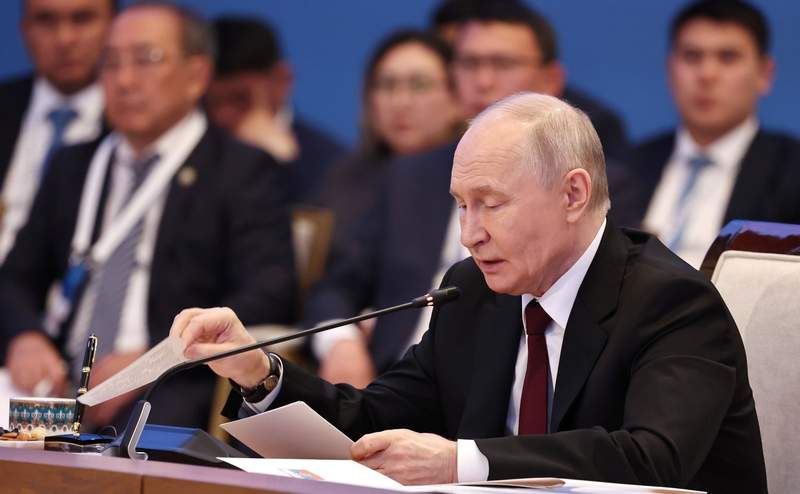
POLICY WIRE — Moscow, Russia — The annual ritual unfolds once more: grand halls, carefully selected attendees, and a meticulously crafted narrative of national vigor. As President Vladimir Putin readies to deliver his much-anticipated address to Russia’s flagship economic forum, it’s not just about what he says. It’s about the stage he’s performing on—a carefully constructed proscenium designed to project stability and strength in an increasingly isolated world. They’ve gone all out, as usual, to show the world that business, Russian style, goes on.
It isn’t an easy sell these days. Western capitals have largely emptied their diplomatic — and corporate presence from such events. Yet, the show must — and does — continue. These forums, in St. Petersburg or Vladivostok, have transformed from showcases for European and American investment into bazaars for the Global South. But it’s not the booming, optimistic vibe of yesteryear; it’s more like an insistent hum, a steady reassurance against the crescendo of global condemnation and sanction. [QUOTE_PLACEHOLDER]
So, when we talk about Putin taking the stage, it’s not simply a leader delivering remarks. It’s a carefully choreographed piece of political theater. He’s not just talking to the domestic audience, whose economic realities are becoming increasingly complex despite official cheerleading. He’s also broadcasting to a wider world, those nations still doing business with Moscow, implicitly asking them to keep the faith—or at least keep the trade routes open. That’s a big ask, especially with the dollar-denominated world breathing down everyone’s necks.
Consider the company he’s keeping. No longer are the German industrialists or French financiers prominently featured. Now, it’s representatives from China, India, Iran, and—significantly—Pakistan. Moscow sees Islamabad, with its geopolitical significance and strategic location, as a potentially key player in its ‘pivot to the East’. For Pakistan, a nation frequently navigating its own complex international relationships and economic headwinds, access to discounted Russian energy and new trade avenues isn’t just opportunistic; it’s a critical lifeline, or at least a practical option. And Pakistan’s energy security needs are pretty substantial, after all.
But the true measure of success isn’t just attendance numbers; it’s what happens after the speeches conclude. Russia’s economy, while showing unexpected resilience, faces deep structural challenges. Its reliance on commodity exports, particularly hydrocarbons, remains a sticky problem. The International Energy Agency, for instance, reported that Russia’s crude oil exports to global markets decreased by approximately 500,000 barrels per day in February 2024 compared to January. That’s not insignificant. It shows the pressure’s still on. This sort of economic jostling isn’t limited to energy; it bleeds into manufacturing, technology, — and finance. Sanctions have bitten, though perhaps not fatally.
He’ll speak of sovereignty. He’ll speak of multilateralism—but the kind where Moscow isn’t just a partner but a leader, especially in non-Western blocs. And you can bet he’ll decry Western hegemony, offering Russia’s economic model as a pragmatic alternative for countries eager to assert their own economic independence from Washington’s financial influence. This messaging plays particularly well in parts of the broader Asian diplomatic landscape, where memories of colonial dictates still sting.
This whole spectacle—because that’s what it’s—highlights a shift in global economics. It’s less about a single, interconnected marketplace and more about bifurcated, or even fragmented, trade routes and financial systems. Russia isn’t just coping; it’s actively attempting to construct a parallel economy, one that operates on its own terms, perhaps using its own payment systems or commodity exchanges.
And those attending, from Karachi to Jakarta, they’re weighing their own national interests. They’re trying to figure out if aligning with Moscow—even on economic terms—makes sense in a world still largely shaped by Washington and Brussels. It’s a high-wire act for everyone involved. Sometimes, you’re just looking for a good deal, no matter where it comes from. That’s business, after all, isn’t it? But geopolitics makes everything just a little more complicated, doesn’t it? It always does.
What This Means
This isn’t merely another public speaking engagement for Putin; it’s a strategic flex designed to project an image of invincibility and, more importantly, a viable economic alternative to the Western-dominated global order. Politically, it signals Moscow’s unwavering commitment to its current foreign policy trajectory, reaffirming its intent to forge deeper ties with nations less inclined to follow Western sanction regimes. We’re seeing a hardening of economic blocs, plain — and simple. The rhetoric will likely emphasize Russia’s supposed triumph over Western punitive measures, aiming to instill confidence domestically and attract further engagement from non-aligned countries.
Economically, the forum offers a glimpse into Russia’s long-term strategy for mitigating sanction impacts and fostering new growth engines. It’s less about attracting vast, traditional foreign direct investment from multinational corporations, and more about securing bilateral deals, resource-for-technology swaps, and establishing alternative trade corridors. We should expect discussions around energy pricing, joint ventures in critical infrastructure, and potentially the acceleration of de-dollarization efforts through increased use of local currencies in trade settlements. But such shifts aren’t easy. And they’re not instant, either. The implications for nations like Pakistan, caught between competing geopolitical priorities and struggling with their own fragile economic back, are profound. It’s a calculated gamble on both sides: Russia seeking partners in its isolation, and other nations seeking advantageous deals where they can find them, consequences be damned.