


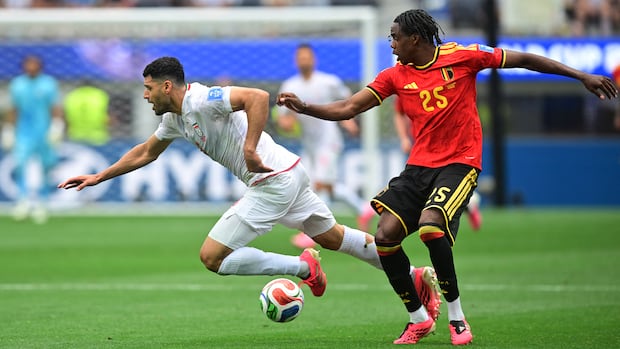
Iran, 10-Man Belgium Settle for Goalless Draw at World Cup
POLICY WIRE — In a surprising turn on the global football stage, Iran's national team, affectionately known as 'Team Melli', played to a goalless 0-0 draw again...

POLICY WIRE — In a surprising turn on the global football stage, Iran’s national team, affectionately known as ‘Team Melli’, played to a goalless 0-0 draw against Belgium’s ‘Red Devils’ at the World Cup on Sunday. The match, keenly watched for its potential tactical implications, saw Belgium reduced to 10 men in the second half, presenting a significant—and ultimately unseized—opportunity for the Iranian side. (Reporting based on Associated Press)
The stat sheet tells part of the story: Iranian goalkeeper Alireza Beiranvand was credited with a remarkable seven saves over the course of the match. His efforts proved pivotal in keeping Belgium off the scoreboard, even as the European powerhouse found itself strategically handicapped for a substantial portion of the game. Despite their numerical advantage, Iran’s offense couldn’t manage to breach the Belgian defense.
Typically, when a team receives a red card and is forced to play a man down, the dynamic of the match shifts dramatically. The short-handed side often retreats, focusing on defensive solidity and counter-attacks, while the full-strength team is expected to intensify its offensive pressure, exploiting the extra space and numerical superiority. Belgium’s capacity to maintain a clean sheet under such circumstances underscores their resilience and tactical discipline, even with diminished personnel.
For Team Melli, the failure to convert their second-half advantage into a goal marks a significant missed opportunity. Playing against 10 men for an extended period in a tournament as critical as the World Cup often necessitates a more direct and assertive attacking posture. The expectation for a full-strength team in such a scenario is generally to find a way to break down a condensed defense and secure the vital points.
Beiranvand’s individual performance, characterized by his seven saves, suggests that even with Belgium a man down, they still managed to carve out chances. This speaks to the offensive quality inherent in the ‘Red Devils’ squad, requiring the Iranian custodian to be at his best. Goalkeepers often become the unsung heroes in goalless stalemates, and Beiranvand’s contribution here certainly places him in that category, preventing a potential deficit for his team.
World Cup matches, particularly in the group stages, can often hinge on fine margins. A single goal, or indeed the inability to score one, can dictate a team’s progression in the tournament. For Iran, securing a point against a team of Belgium’s caliber might ordinarily be viewed as a respectable outcome. However, given the context of Belgium playing with 10 men for a considerable period, the draw leaves lingering questions about Iran’s finishing ability under pressure.
📄 POLICY WIRE WHITEPAPER PUBLISHED: PAKISTAN'S NATIONAL SECURITY POLICY PRIORITIES
👉 READ BY CLICKING HEREThe incident that led to Belgium’s numerical disadvantage — an unspecified sending-off in the second half — forced them to adapt quickly. Coaches frequently prepare contingency plans for such scenarios, focusing on tightening defensive lines and relying on individual brilliance or set pieces to create rare opportunities. Belgium’s execution of this defensive blueprint, or at least their ability to stymie Iran, was effective.
In contrast, Iran’s approach after the red card appeared unable to dislodge the revised Belgian formation. This could point to a need for more incisive passing, quicker transitions, or greater creativity in the final third when facing a resolute, compact defense. The physical and psychological tolls of playing a man down are substantial, and the failure of the opposing team to exploit these weaknesses is always a point of review.
What This Means
This 0-0 draw, particularly under the given circumstances, offers both teams material for reflection. For Belgium, exiting a match with a point despite playing a significant portion with 10 men will likely be viewed as a testament to their resilience and strategic depth. It demonstrates a capacity to defend staunchly under duress, an invaluable trait in knockout tournament play. For ‘Team Melli’, while securing a point against a highly-regarded opponent isn’t a disaster, the failure to convert a numerical advantage into a victory raises questions about their clinical edge in front of goal and their ability to unlock well-organized defenses. In tournaments where goal difference can be a tie-breaker, not scoring against a short-handed opponent could prove costly. The match underscores the unpredictable nature of football, where strategic depth and individual heroics — like Beiranvand’s saves — can sometimes trump expected outcomes based on numerical superiority.