


Interstate’s Reckoning: A Remote Plea in a Highway Tragedy
POLICY WIRE — ALBUQUERQUE, N.M. — It’s a strange paradox, isn’t it? A colossal machine—a semi-truck, an instrument of brutal, tangible force—meets tragedy on asphalt, ripping a family and a...

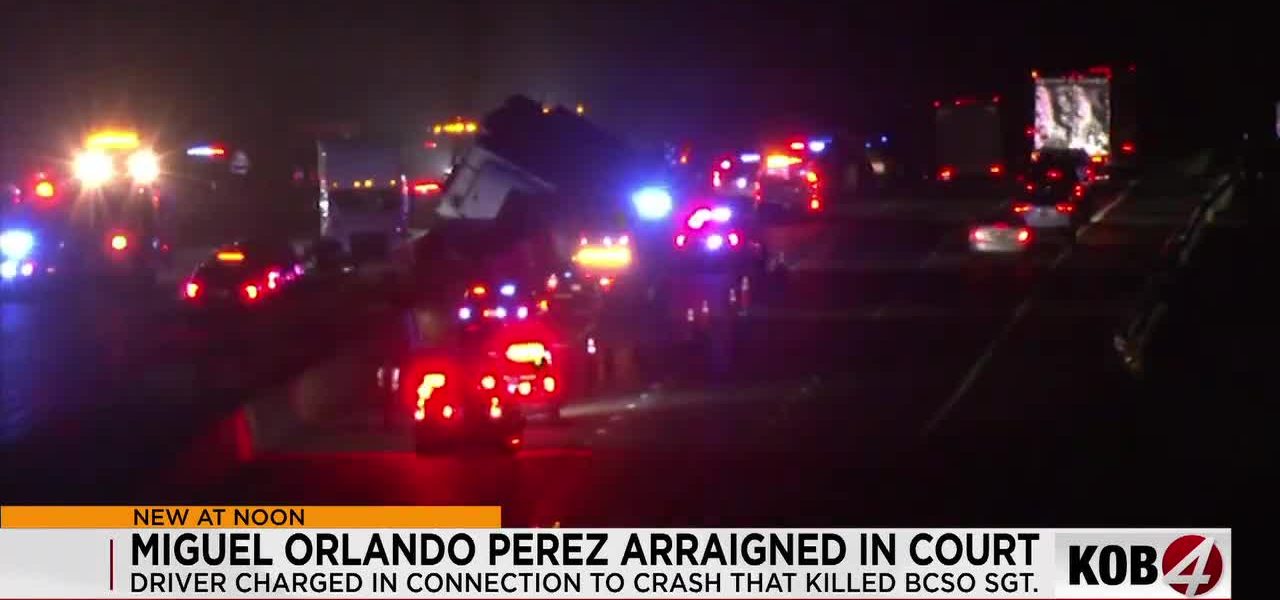
POLICY WIRE — ALBUQUERQUE, N.M. — It’s a strange paradox, isn’t it? A colossal machine—a semi-truck, an instrument of brutal, tangible force—meets tragedy on asphalt, ripping a family and a community apart. Yet, the initial act of legal reckoning for this devastation unfolds across a thousand miles, conducted by phone, as disembodied as a ghost. That’s what went down when Miguel Orlando Perez, the truck driver charged in the February death of Bernalillo County Sheriff’s Sergeant Michael Schlattman, made his “appearance” last Friday, entering a not-guilty plea from the sun-drenched comfort of Florida.
No grand courtroom drama, no defiant stare at grieving relatives. Just a voice on the line, relayed by an attorney, a slight crackle of connection issues apparently precluding even a Zoom call. One imagines the judge, the lawyers, perhaps even Sgt. Schlattman’s colleagues, staring at a static screen, the weight of a life lost contrasting starkly with the impersonal nature of the proceeding. Perez stands accused of careless driving and failing to operate appropriately around an emergency vehicle, charges that, on their face, sound almost bureaucratic for an incident that left a human being dead on Interstate 40.
For Schlattman, a uniformed officer doing his job on a stretch of highway notorious for its hazards, life ended when Perez’s rig plowed into his patrol vehicle. These aren’t freak accidents, you know; they’re often the bitter harvest of vigilance lapse, a fraction of a second separating order from utter chaos. And because it’s I-40, a major artery of global commerce connecting east to west, it carries the weight of a thousand economies. From Kandahar to Karachi, through Istanbul and beyond, the lifeblood of nations, goods, is carried by truckers on roads not dissimilar to this one, all vulnerable to human error. But what does a ‘not guilty’ plea via telephone truly mean for justice?
“When a member of law enforcement is lost in the line of duty, especially to something so preventable, it tears at the fabric of the entire community,” stated Bernalillo County Sheriff John Allen, his voice tight with palpable frustration in a recent press briefing. “We’ve got to ask ourselves, as a society, what level of accountability do we demand from those entrusted with navigating these massive vehicles on our public roads?” It’s a sentiment many can identify with. It’s hard to reconcile the gravity of the incident with the almost casual distance of the arraignment.
And you wonder, don’t you, about the system itself? One expert on interstate commerce law, Dr. Aisha Rahman, with ties to regulatory bodies, mused to Policy Wire, “The judicial system’s embrace of remote proceedings, accelerated by the pandemic, has brought efficiency—yes—but also a depersonalization. It certainly eases the burden for defendants like Mr. Perez, but does it fully serve the victim’s memory, or public confidence, when serious charges are addressed through a speakerphone? It’s a complex balance, really, especially when international norms and expectations for due process differ greatly from state to state, let alone country to country.” She’s got a point. Many parts of the world, particularly in countries like Pakistan where infrastructure challenges persist, view the immediate, visible presence of a defendant as integral to perceived justice.
For now, Perez gets to stay put in Florida, reporting in virtually. The law allows it. The question is, does that flexibility, often touted as a stride towards accessibility, inadvertently lessen the societal pressure or the gravity associated with such proceedings? A first-time careless driving conviction carries up to 90 days in jail — and a $500 fine. That paltry sum—alongside the minimal jail time—hardly feels commensurate with the ultimate price Sgt. Schlattman paid. That’s an observation, not a legal judgment, mind you, but it’s hard not to think it.
📄 POLICY WIRE WHITEPAPER PUBLISHED: PAKISTAN'S NATIONAL SECURITY POLICY PRIORITIES
👉 READ BY CLICKING HEREThe U.S. Department of Transportation reported over 117,000 commercial truck crashes involving injuries or fatalities in 2021 alone, illustrating the sheer volume of such incidents across the nation’s highways.
What This Means
This tragic incident — and the ensuing virtual legal ballet spotlight several uncomfortable truths. Firstly, there’s the political pressure on law enforcement. Departments like the BCSO are under constant scrutiny—and grieving officers aren’t typically shy about voicing discontent over perceived slights to justice. Secondly, the economic implications are sprawling. The massive network of interstate commerce, which facilitates nearly every aspect of our modern lives, hinges on truck drivers. Balancing driver efficiency with strict safety regulations, especially in a tightening labor market, is a perpetual tug-of-war for policymakers. How do you ensure the vast flow of goods—from crucial medical supplies to everyday consumables, traversing routes that extend far beyond national borders into an intricate global economic web—while safeguarding every life on the road?
the persistent reliance on virtual court proceedings for serious charges, while pragmatically necessary at times, isn’t without its critics. Detractors argue it diminishes the solemnity and public access to justice, reducing profound human consequences to a distant echo. The digital divide, connectivity issues—Perez’s own brief struggle illustrates that—can impede the very process designed for accessibility. Then there’s the broader issue of driver fatigue and adherence to safety protocols for heavy vehicle operators, a matter constantly under review by federal agencies but often compromised by intense scheduling pressures. These aren’t just local issues; they’re echoes of debates heard in every modern nation grappling with the demands of trade and traffic, from European transit corridors to the bustling streets of Lahore.
This case isn’t just about one driver and one sergeant; it’s a grim mirror reflecting our precarious reliance on these massive machines and the ever-evolving, sometimes unsettling, ways we dispense justice in their wake. We’re left wondering if this blend of cold procedure and stark tragedy truly helps a community heal, or simply moves the uncomfortable details out of sight, and out of mind.