


Infantino’s Enigma: Did FIFA’s Boss Break the Laws of Physics, or Just PR?
POLICY WIRE — Zurich, Switzerland — In an era where every pixel is scrutinized and every move instantly relayed across digital arteries, maintaining an air of omnipresence has become a default...

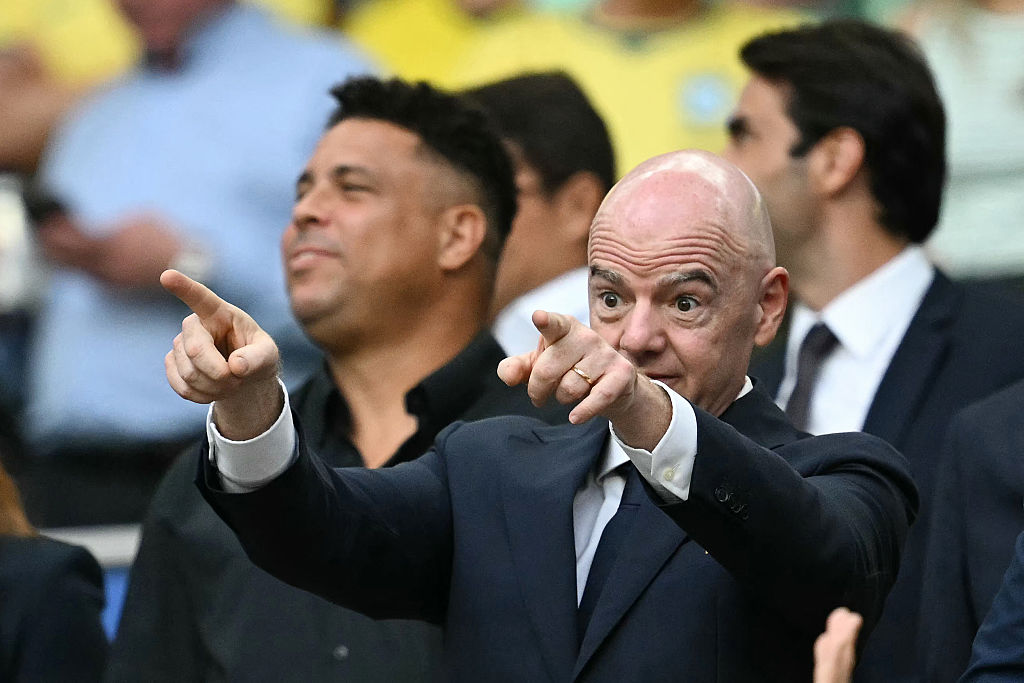
POLICY WIRE — Zurich, Switzerland — In an era where every pixel is scrutinized and every move instantly relayed across digital arteries, maintaining an air of omnipresence has become a default expectation for global figures. But what happens when that expectation morphs into an outright challenge to the laws of physics? This past Thursday, football’s head honcho, Gianni Infantino, the very man who steers FIFA’s titanic, multi-billion-dollar ship, inadvertently invited that precise question – and a flurry of incredulous memes.
It wasn’t a clandestine meeting with shadowy benefactors or another ethics committee kerfuffle this time. No. Instead, photos splashed across social feeds painted a bewildering picture: Infantino, ever-present, purportedly attending not one, but two separate international matches simultaneously. The kicker? These weren’t mere hop-skips apart. The games – one featuring Germany and Ecuador, the other pitting Ivory Coast against Curaçao – played out at the exact same hour, separated by a hefty 130 kilometers (about 80 miles) of asphalt and airspace. A genuine head-scratcher. Call it a Schrödinger’s cat moment for global sports governance, if you will.
And yes, the internet, quick as a hawk — and relentless in its mockery, didn’t miss a beat. Whispers of cloning experiments—a ‘secret FIFA project,’ some joked—or perhaps a previously undisclosed mastery of teleportation circulated faster than any official communiqué could hope to clarify. But in truth, this wasn’t about sci-fi. It was about optics, — and messy ones at that. FIFA, an organization still grappling with trust deficits inherited from previous administrations, simply doesn’t need to be manufacturing accidental optical illusions, however innocuous.
One veteran sports analyst, who preferred to remain unnamed citing FIFA’s famously long memory, simply snorted. “Look, they’re always pushing boundaries—new tournament formats, more teams, different host nations. But replicating their president? That’s new territory.” Because it highlights a persistent, almost charming, disconnect between the lofty ambitions of global sport and its very human, often clumsy, execution. This isn’t just a misstep; it’s a momentary glimpse behind the curtain, revealing the scrambling beneath the slick facade.
Infantino himself, never one to shy from a spotlight, has often spoken about FIFA’s reach — and commitment. “Our game transcends borders,” he declared in a recent address, his voice echoing sentiments of unity. “We’re everywhere, connecting communities, fostering passion from Buenos Aires to Lahore.” A noble aspiration, undoubtedly. But perhaps, as one cynical pundit tweeted, being literally everywhere at once wasn’t quite what he had in mind.
But how does something like this even happen? Most likely, it’s a mundane error of timing and photography, perhaps involving a quick dash between venues and slightly outdated timestamping, or even a promotional photo from an earlier time juxtaposed against live event imagery. The organization hasn’t officially weighed in yet, likely hoping the moment, like so many internet sensations, will simply fade. They’d be smart to manage the narrative, however, considering that in the last two years alone, FIFA’s public approval ratings among key demographics haven’t shown significant gains despite increased outreach, according to a recent global sports perception study by Nielsen.
For football fanatics in Karachi, or Riyadh, watching their leagues aspire to FIFA standards—and potentially host future mega-events—these seemingly small missteps aren’t always seen as trivial. They represent a global body whose administrative precision sometimes appears at odds with its self-professed mission of global excellence. It’s a perception problem, subtle yet corrosive. The World Cup’s New Rules, after all, weren’t just about gameplay, but about redefining FIFA’s relationship with its global audience.
What This Means
This little snafu, comical as it’s, speaks volumes about the challenges confronting modern, multinational organizations. In an age of hypersensitivity to image and ceaseless digital monitoring, even minor slip-ups can snowball into PR headaches. For FIFA, an entity that wields immense economic and political sway—think host nation selections, broadcasting rights, and global development initiatives—such incidents feed into existing narratives of opacity or, worse, administrative disarray. It erodes trust, not necessarily dramatically, but subtly, chipping away at the veneer of flawless competence. Economically, while this specific incident won’t crash stock prices, a persistent pattern of gaffes could make sponsors and host nations — especially those eager to burnish their global image through sport, like emerging powers in the Muslim world eyeing future tournaments — reconsider their deep involvement. And from a political standpoint, a body that struggles with its own internal chronology might find it harder to dictate policy or claim moral high ground on larger, more contentious issues affecting the global game. It’s less about a president defying space-time, and more about a bureaucracy struggling to keep its story straight in a world that never blinks.
As one former FA official, clearly fed up with the perpetual circus around football’s governing bodies, remarked privately: “They want to run the world, but sometimes they can’t even run a clock properly. It’s frustrating, frankly, to see the game we love caught in this kind of avoidable silliness.” That sentiment, quietly held by many within the football establishment, says it all. You’d think, given the stakes, they’d simply double-check the damn photo captions.