


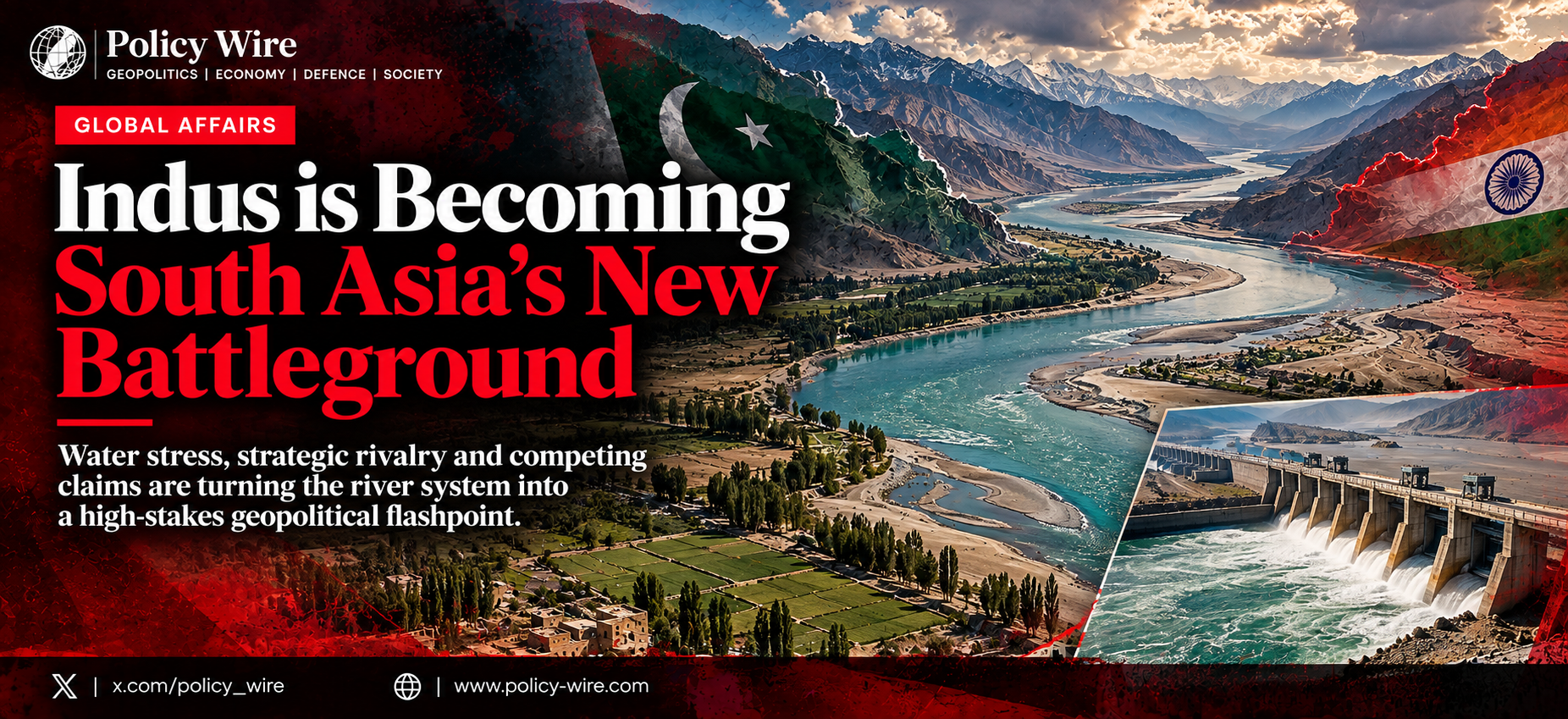
Indus is Becoming South Asia’s New Battleground
An analytical review of how India’s unilateral suspension of the Indus Waters Treaty violates international law and threatens the food and water security of 240 million people.

A man read his own death notice on social media this month. Mohammad Asif, a retired Pakistan Army havildar from Attock, learned that Indian media had declared him a “neutralised” militant. On October 1, he walked into a press conference in Rawalpindi, alive and well beside the DG ISPR. Journalists laughed. The story was not funny, though. It showed how India builds its case against Pakistan, and why that case now reaches the water in Pakistan’s rivers.
The Asif story moved in steps. Indian media first called the dead man a Lashkar-e-Taiba fighter. Then they named him as a former Pakistani commando wanted over the Pahalgam attack, and India’s Home Ministry and Press Information Bureau repeated the line. The DG ISPR asked a plain question: where is Musa? India’s army still insists the body it recovered was Asif’s, so the dispute is not closed. Even so, a story that keeps changing shape does not look like proof. Pahalgam followed the same path. India blamed Pakistan within hours and refused a neutral inquiry, and Pakistan’s UN envoy says it produced no evidence for the charge. Islamabad also asks why unverified “encounters” in Kashmir keep arriving at politically useful moments.
India’s wider story about terrorism has trouble abroad too. In 2023, Canada’s prime minister said there were credible allegations linking Indian agents to the killing of Sikh leader Hardeep Singh Nijjar near Vancouver. US prosecutors charged Nikhil Gupta over a plot to kill another Sikh activist, Gurpatwant Singh Pannun, in New York. Bloomberg reported that British intelligence first warned Canada about intercepted talks on three targets. India denies any role. Still, the Khalistan question is India’s own domestic challenge, and it now draws scrutiny in Ottawa, Washington and London. A country under that kind of watch has little ground to lecture others.
All of this matters because India has tied these accusations to a river treaty. The Indus Waters Treaty of 1960 survived three wars, and the World Bank helped broker it. On April 23, 2025, one day after Pahalgam, India placed it “in abeyance.” The treaty has no exit clause and allows changes only by agreement between both states. Pakistan says a unilateral pause breaks that rule, and international law backs the argument. The Vienna Convention on the Law of Treaties, whose core rules are widely seen as customary law, lets a state suspend a treaty only in narrow cases, such as a material breach by the other side. A terror allegation, even if proven, is not a breach of a water treaty. The International Court of Justice also said in the Gabcikovo-Nagymaros case that a treaty cannot be set aside just because one party feels it no longer fits. Add the long-standing principle that an upstream state must not cause serious harm to a downstream one, and the legal ground under Pakistan’s feet looks firm.
The courts have now said so directly. The Court of Arbitration in The Hague, which Pakistan approached back in 2016, has kept ruling in the case. It issued an award on general interpretation in August 2025 and another on pondage in May 2026. Then, on August 31, 2026, it ruled unanimously that the treaty remains fully in forceand that India must keep its duties on the design and running of hydropower projects on the western rivers. The court even noted that Pakistan had been willing to discuss changes to the treaty, which undercuts the claim that Islamabad blocks dialogue. UN special experts reached a similar view. They warned that the suspension threatens the rights to water and food for millions of Pakistanis and said no party can end the treaty alone. India rejects the court and says its pause stays in force. Yet a state that wants to be seen as a rule-following power looks odd when it walks away from the rulings it dislikes.
For Pakistan, this is a food story before it is a legal one. About 240 million people depend on the Indus system, according to Pakistan’s letter to the UN Security Council. The numbers already show strain. On October 7, the Indus River System Authority approved a 22 percent water shortage for the Rabi season, which decides the wheat crop. In 2025, the same body warned of a shortage after a sudden fall in Chenab inflows. Weather and storage matter too, and honest analysis says so. Yet when upstream data sharing stops and flows change without notice, planners lose their best tool. A farmer cannot plant on guesswork.
The danger also reaches beyond one border. Glaciers are thinning and summers are getting hotter across South Asia. If a major upstream state treats a shared river as a pressure tool, every downstream neighbour has reason to worry. The poor, women and children pay first, as UN experts have warned. Trust in treaties, which keeps fragile regions steady, wears away with each such move.
India can still choose a better path. It can back its terror claims with evidence and an open inquiry, and it can return to the treaty and its courts. Pakistan has said it will talk, and The Hague has spoken. The only question left is whether New Delhi will follow the law or keep turning rivers into weapons.
Author