


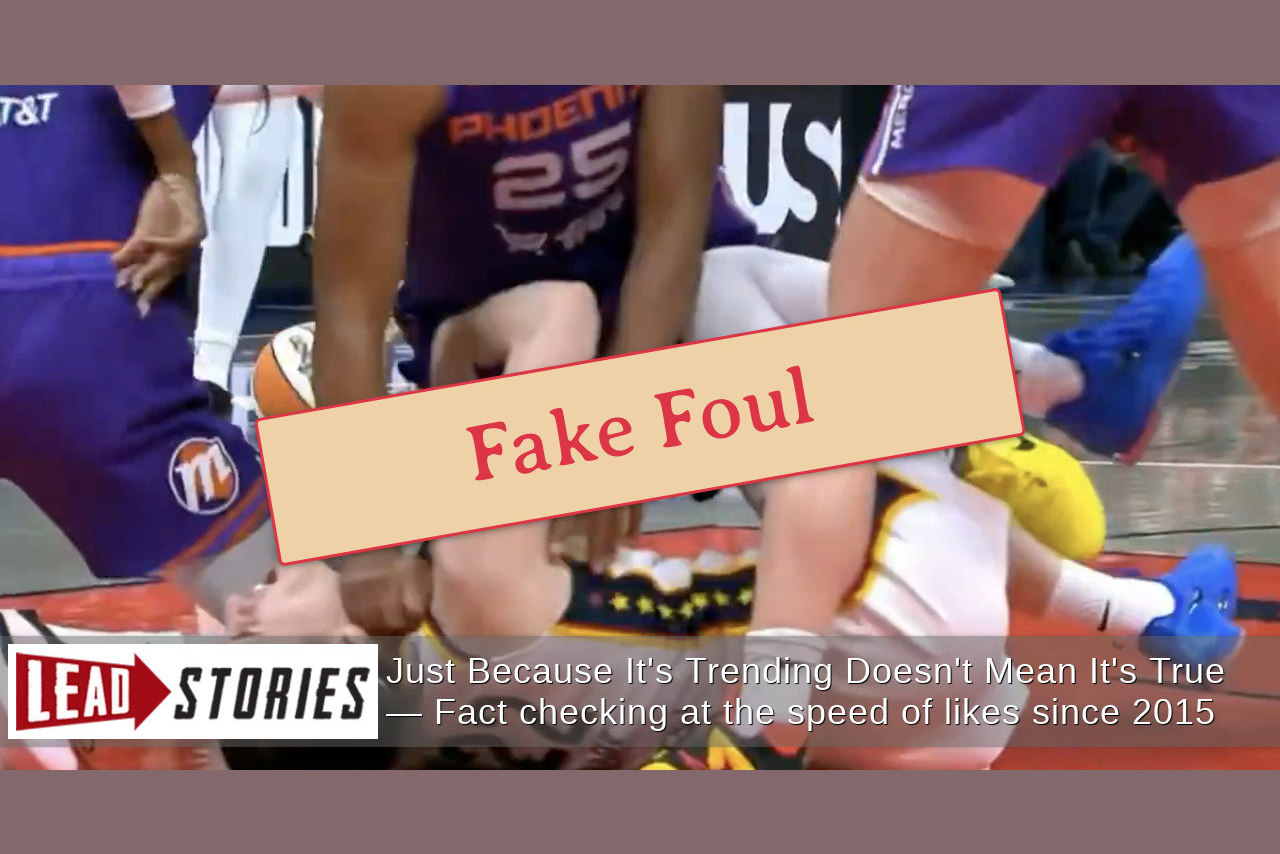
Hoops Hysteria & Viral Lies: How a WNBA Foul Fuelled a Global Fake News Firestorm
POLICY WIRE — New York, USA — Before the ink on any official statement could dry—or, more accurately, before the WNBA itself could issue a peep—a carefully fabricated declaration alleging a...

POLICY WIRE — New York, USA — Before the ink on any official statement could dry—or, more accurately, before the WNBA itself could issue a peep—a carefully fabricated declaration alleging a posthumous technical foul for rookie phenom Caitlin Clark swept through the digital ether. It wasn’t merely a misunderstanding; it was a brazen, manufactured ‘official’ edict that went viral, painting a picture of disciplinary action against Clark that simply didn’t exist. This wasn’t just a sports blip; it was a stark, almost absurd, lesson in the potency of instant, unchecked digital narrative, and how readily the public will consume it, regardless of its truth value.
The alleged communiqué, which purportedly came from the WNBA and circulated on X (formerly Twitter) on June 24, 2026, claimed Clark would be assessed a ‘postgame technical 1’ for ‘lifting her knees’ towards Phoenix Mercury’s Alyssa Thomas. Because, you know, that’s just how the league operates. Immediately. After. The. Game. And it sounded quite definitive. It stated a ‘reviewing the footage’ process that felt authentic enough to fool more than a few folks eager to jump on the next big sports scandal. But it was pure fiction. A ghost in the machine, generating its own reality.
Hours later, as the digital firestorm continued to rage, the WNBA finally weighed in—but their message was aimed squarely at Thomas, not Clark. And it directly contradicted the swirling digital tempest. Phoenix Mercury’s Alyssa Thomas, the league announced on June 25, received a Flagrant Foul 2 and a one-game suspension for what they termed ‘recklessly making contact with her fist to the throat area’ of Clark. A far cry, don’t you think, from Clark receiving a technical for her knees? The incident occurred late in the second quarter of the Mercury’s 111-109 win over the Indiana Fever, a moment where no foul was called on the court.
“Her conduct was egregious and utterly disrespectful,” bristled Indiana Fever coach Stephanie White, summing up the feeling of many after the game. It’s a sentiment that resonates. But the sheer speed at which the fabricated narrative outpaced official channels – that’s the real story, isn’t it? The gap between incident, rumor, and verified truth just seems to keep widening, perpetually caught in the vortex of likes and retweets. You’ve got to wonder if it’s even possible for official bodies to keep pace anymore.
A quick search through the WNBA’s actual social media presence, their official website, or any reputable sports news outlet, would’ve revealed the obvious: no such statement about Clark. Not a whisper. Zero. It’s almost comical how easily verifiable this stuff is, and yet, the fabricated narrative always seems to get the first, loudest, and most indelible say. But hey, it’s clickbait gold, isn’t it?
This episode serves as a harsh reminder of how easily narratives can be manipulated in the fast-paced world of social media, especially when a high-profile figure like Clark is involved. Because, let’s be honest, Caitlin Clark sells. Good news, bad news, fake news – it all drives engagement. Her ascent to stardom has, predictably, brought increased scrutiny, unprecedented viewership (Reuters reported the WNBA’s regular season averaged 505,000 viewers across ESPN platforms in 2023, a 21% jump from the previous year), and, sadly, a magnet for mischief. This isn’t just about American sports either. Misinformation campaigns, often amplifying divisions, are a common, global plague, from contentious elections in Dhaka to diplomatic tiffs in the Gulf. They don’t discriminate. And sports, apparently, isn’t immune.
What This Means
The WNBA’s clumsy handling of this digital brouhaha highlights a growing problem for any public-facing institution: the losing battle against instant, often malicious, misinformation. In an era where news cycles churn at nanosecond speed, official responses, however prompt they may seem by traditional metrics, are simply too slow to contain viral fabrications. Economically, this can chip away at brand trust, though in Clark’s case, her star power might just deflect much of the impact. Still, it speaks to a broader cultural climate where verifiable facts struggle to gain traction against sensational lies. For a league striving to boost its profile, these missteps, though not of its own making directly, create avoidable distractions. It’s an attention economy, and fake news, unfortunately, is quite adept at capturing it, shaping public perception—and potentially public discourse—in ways that are difficult to correct.
Policy implications? They’re subtle, but present. Regulatory bodies and platforms like X are under increasing pressure to curb misinformation, yet their efforts consistently fall short. This WNBA incident, minor in geopolitical scale but amplified exponentially by its digital spread, reflects how fragile factual consensus truly is, even in a sporting context. It’s a skirmish in the larger war for objective truth, and, sadly, it appears truth often leaves the field bruised and outmaneuvered.