


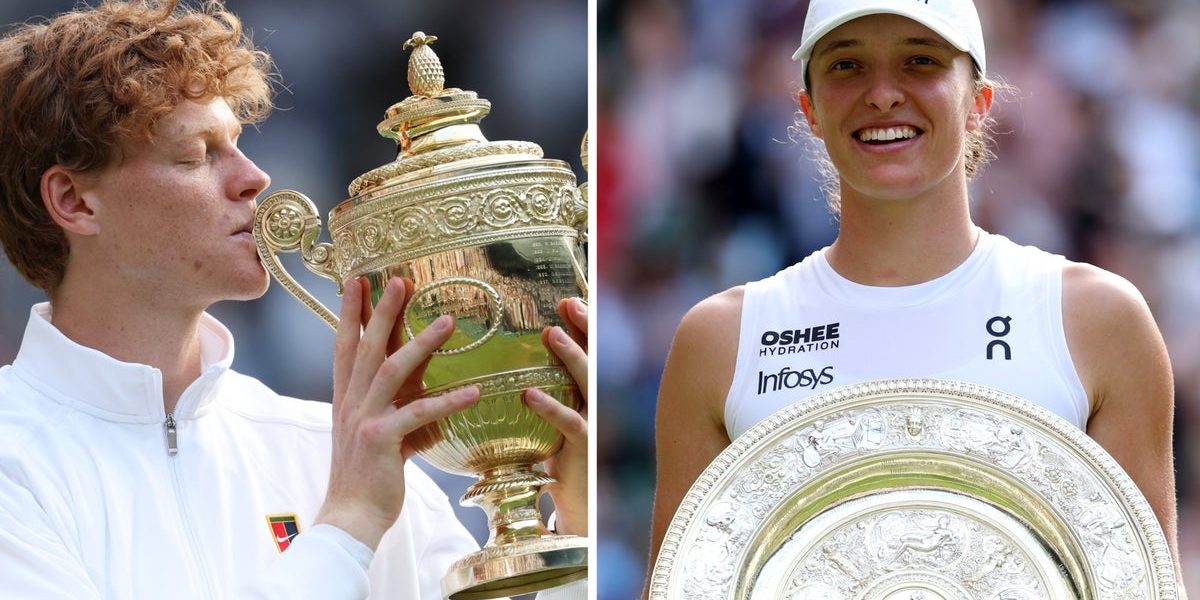
Grass-Court Geopolitics: Wimbledon’s Polished Facade Belies Global Stakes on Opening Day
POLICY WIRE — London, UK — The meticulously manicured lawns of Wimbledon might suggest a placid start to another Championship season, but beneath the verdant calm, the first ball struck today signals...

POLICY WIRE — London, UK — The meticulously manicured lawns of Wimbledon might suggest a placid start to another Championship season, but beneath the verdant calm, the first ball struck today signals far more than just a tennis match. It’s an economic powerhouse. A geopolitical stage, cloaked in tradition — and white attire. And, for the players themselves, a crucible of crushing expectation where fortunes are made, or unmade, within a single faulty backhand.
Day one isn’t just about top seed Jannik Sinner opening Centre Court against Miomir Kecmanovic—though, sure, that’s happening. The real drama unfolds in the nuanced dance between individual athletic prowess and the sprawling commercial machinery that sustains the sport. This event, you see, generates an estimated £350 million in economic impact for the UK annually, according to Deloitte’s 2023 report. That’s serious money, riding on rackets — and rallies.
But the money talks loud enough to hear it across the globe, especially where opportunity is scarce. You look at the list of contenders and their countries of origin – a truly international spread, from Canadian Felix Auger-Aliassime to Japanese Naomi Osaka. Yet, a conspicuous gap remains in some regions. “It’s a truly global sport, but accessibility? That’s still a work in progress,” stated Sir Charles Prescott, head of the All England Club’s international liaison, earlier this week. “Wimbledon isn’t just about tennis; it’s a soft-power play that few other events can match.” He’s not wrong. Every national flag next to a name tells a story of investment, or lack thereof, in elite sports infrastructure.
Sinner, the reigning champion, shoulders the weight of Italian hopes despite his recent uncharacteristic French Open exit – felled by heat, or perhaps, the stifling pressure that comes with being the sport’s golden boy. He’s up against Novak Djokovic, who, at 39, defies the typical sporting shelf-life. But you can’t help but wonder: how much more does the Serb, already a seven-time Wimbledon victor, have to prove? His pursuit of a 25th Grand Slam title isn’t just personal ambition; it’s a statement of unparalleled dominance, an anachronism in an era of athletic brevity.
And then there’s the women’s draw. Aryna Sabalenka, the women’s top seed, starts her bid. A potential rematch looms against Emma Raducanu later, a contest already simmering with last year’s rivalry and Raducanu’s own, well, inconsistent journey. These women aren’t just playing for trophies; they’re navigating brutal public scrutiny and immense pressure that’s amplified by social media and round-the-clock commentary. You just know the mental game is as crucial as the physical one for these elite athletes. It’s relentless, really.
📄 POLICY WIRE WHITEPAPER PUBLISHED: PAKISTAN'S NATIONAL SECURITY POLICY PRIORITIES
👉 READ BY CLICKING HEREBecause every single player, from the highest seed on Centre Court to the unheralded rookie slugging it out on Court 4, arrives with their own narrative. Consider Zeynep Sonmez from Turkey, who’ll face American Ann Li. Her journey represents a different kind of challenge: bridging cultural expectations with the fierce individualism of professional tennis. Her participation, and that of others from non-traditional tennis powerhouses, hints at the slow, uneven creep of the sport into new markets. While nations like Pakistan and many in South Asia and the broader Muslim world haven’t historically dominated the Grand Slam landscape, their presence in tournaments like this, even via qualifying rounds, is steadily growing. It demonstrates an evolving global talent pool, one that the old guard of tennis ignores at its own peril.
“They call it sport, but really, it’s a high-stakes, individual enterprise,” mused Elena Petrova, a veteran coach to several tour players. “My job isn’t just forehands — and backhands. It’s managing global expectations, corporate sponsorships, and, quite frankly, raw ambition. They’re athletes, yes, but they’re also brands, tiny sovereign states, each competing on a very public stage.” That stage, today, is Wimbledon, a place where tradition meets relentless commercialism and very personal human stories.
What This Means
This tournament, a cornerstone of British summer, reflects broader geopolitical — and economic currents. The prize money, growing annually, underlines the vast sums now pouring into elite sports, transforming individual athletes into global brands. The presence, or absence, of players from particular regions isn’t just about tennis rankings; it mirrors national investment in sport, public health, and access to international opportunity. When you see a lack of representation from certain developing economies, it’s not simply a lack of talent, but a lack of infrastructure, funding, and developmental pathways that often align with broader economic disparities. The soft power generated by sporting success, particularly on a platform as visible as Wimbledon, is something governments actively chase – consider China’s deliberate push in multiple sports. But it’s not always straightforward. Sometimes, you just get a player like Raducanu, an unexpected star born out of a specific system, and other times, you see the enduring struggle of others who can’t access that ladder. Wimbledon, for all its pomp, offers a brutal snapshot of global inequalities, camouflaged by dazzling athleticism. And it’s playing out live, for a global audience that probably isn’t thinking twice about it.