
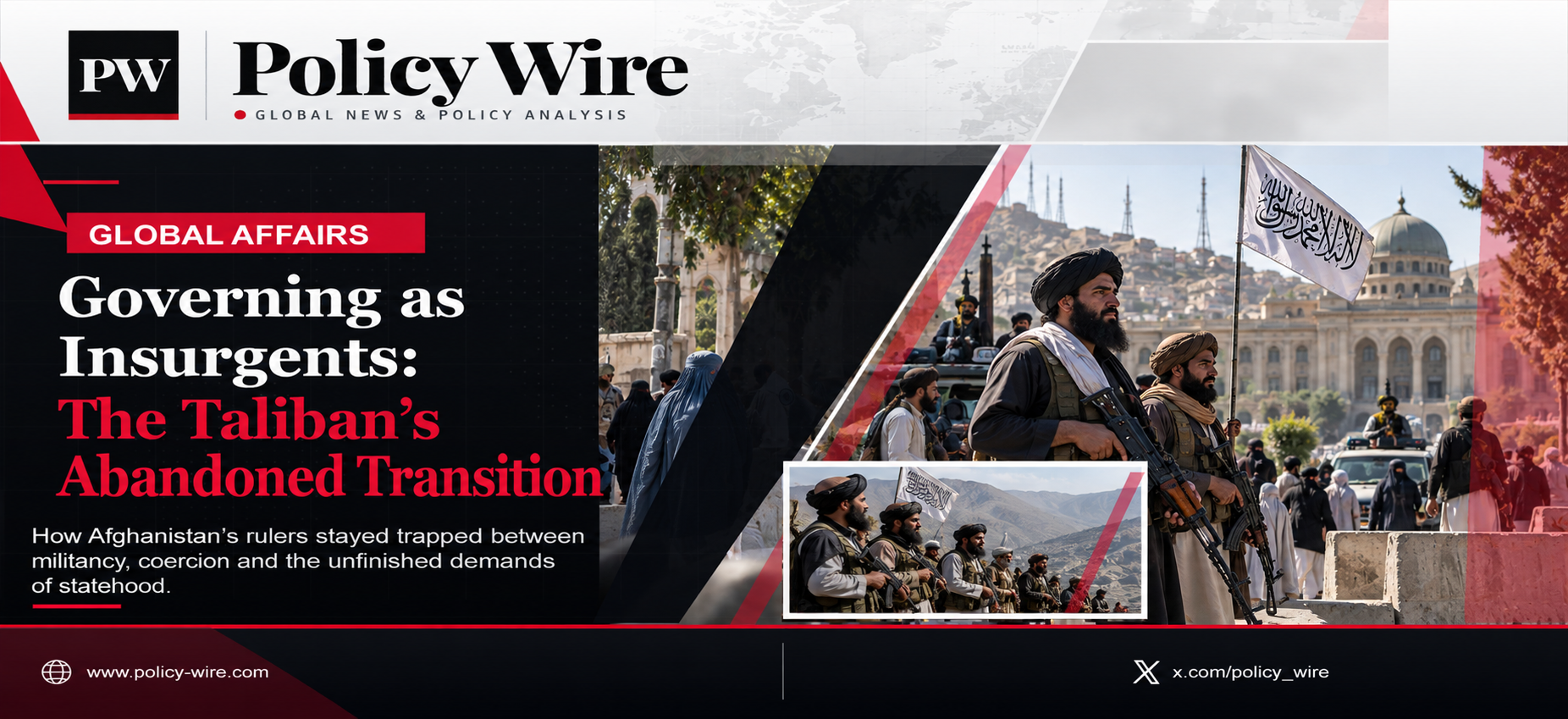
Governing as Insurgents: The Taliban’s Abandoned Transition
Four years after seizing Kabul, an exhaustive analytical breakdown of how the Taliban preserved an insurgent mode of rule rather than transitioning to institutional statecraft.
Four years after seizing Kabul, the Taliban has stabilized a currency, raised domestic revenue, and curbed some of the corruption that hollowed out the republic it replaced. The regime still behaves like the insurgent movement it has always been: authority concentrated in one cleric and his personal offices rather than in ministries, a bureaucracy stripped of expertise and restaffed by loyalty, revenue extracted by coercion, and militant allies sheltered or fought according to strategic utility rather than principle. The Taliban inherited the institutions of the Afghan state and has preserved an insurgent mode of rule inside them. This is not a government that failed to consolidate. It is a movement that never completed the transition from armed insurgency to institutionalized state authority.
A Movement That Inherited a State
When the Taliban returned to power in August 2021, its spokesmen framed the takeover as the birth of an Islamic riyasat, a state governed by religious law and dedicated, in its telling, to the welfare and dignity of the Afghan people. Four years is long enough to judge that claim against a record.
The literature on rebel governance offers a useful starting point. Stathis Kalyvas describes insurgency as a process of competitive state building, in which armed movements construct administration precisely to displace the incumbent.[1]Ashley Jackson’s work on the Taliban’s shadow government documented exactly that: courts, taxation, and school inspections run in parallel to Kabul, an insurgent bureaucracy built to compete.[2] The puzzle is what happened next. A movement that had already demonstrated the capacity and the will to govern captured the state it had been shadowing and then declined to complete the transition. Its wartime apparatus was never converted into peacetime statecraft. It was simply installed on top of the institutions it inherited.
The distinction that matters here is between shadow governance and state governance. What the Taliban ran before 2021 was genuine administration, but it was administration of a particular kind: courts that resolved disputes without a codified legal order, taxation collected by commanders rather than a revenue service, appointments made through personal networks of loyalty. Insurgent governance is legitimated by proximity and force, and it is designed to be portable, deniable, and reversible, because an insurgency that overinvests in fixed institutions makes itself a target. State governance requires the opposite: codification, permanence, and the delegation of authority to offices rather than persons. The Taliban’s failure is not an absence of governance. It is the retention of the first mode after acquiring the means for the second.
Seen through the lens of insurgent governance, this trajectory is coherent, and it follows a pattern scholars of irregular warfare would recognize. Rather than transforming wartime structures into bureaucratic institutions, the Taliban retained organizational practices optimized for coercion, loyalty, and survival. The sections that follow examine that pattern across budget, institutional capacity, militant sanctuary, and internal organization.
The Founding Promise Against the Record
At the movement’s first press conference after the takeover, spokesman Zabihullah Mujahid pledged that women’s rights would be protected within the framework of Islamic law, that Afghan soil would not be used to threaten other countries, and that the new authorities sought peaceful relations with the world.[3] From Doha, spokesman Suhail Shaheen offered similar assurances of moderation and non-aggression.[4] These were not incidental remarks. They were the movement’s bid for domestic acquiescence and international legitimacy at once.
Each pledge is falsifiable, and the regime’s own conduct has falsified each one. Girls remain barred from secondary and higher education into a fifth consecutive year, a prohibition without precedent in the contemporary Muslim world, and one the regime has defended rather than quietly dropped.[5] The promise that Afghan territory would not threaten neighbors is contradicted by the sanctuary the regime extends to the TTP, discussed below. And the pledge of peaceful external relations sits awkwardly against the collapse of the Istanbul talks and the cross-border violence that followed. Governments break promises; what distinguishes the Taliban is that the gap between stated principle and actual conduct is systematic, tracking the difference between a movement performing legitimacy and a state producing it.
Budget Opacity and the Economics of Control
The clearest test of whether a regime governs for its population or for its own survival is how it raises and spends money, and here the record is genuinely mixed. The Taliban has published budgets, raised domestic revenue beyond pre-takeover projections, held the afghani broadly stable, and cracked down on the customs corruption that drained the republic’s coffers. But collecting money efficiently is not the same as governing, and on transparency the failure is total.
The U.S. Department of State’s 2025 fiscal transparency review found that Afghan authorities met none of the minimum requirements of budget transparency: no executive budget proposal or end-of-year report published within a reasonable period, the budgets of the security and intelligence services never disclosed, and such figures as were released not corresponding to independently observed revenues and expenditures.[6] Analysts at the Center for Strategic and International Studies note the complete absence of public accounting for what the regime spends on its security forces, intelligence apparatus, and prisons relative to health, education, and food.[7]
Where an independent figure exists, it is damning. Drawing on World Bank monitoring rather than Taliban disclosure, reporting on the first seven months of fiscal year 2025 indicated that of more than 155 billion afghanis in total government expenditure, roughly 49 percent went to security-related sectors.[8] Security has always consumed a large share of Afghan public spending, including under the republic, but the republic’s security budget was overwhelmingly financed by foreign donors and sat alongside donor-funded health and education systems. Roughly half of recorded government expenditure now goes to security-related sectors while those donor-funded services collapse, and the allocation is not published.
The human arithmetic on the other side of that ledger is stark. Some 21.9 million Afghans required humanitarian assistance in 2026, and 17.4 million faced acute food insecurity.[9]
The regime’s own account of its mission is revealing. The Ministry for the Propagation of Virtue and the Prevention of Vice, whose head has instructed scholars and elders to implement Islamic programs and cooperate with the ministry’s morality inspectors, describes its work in the language of enforcement and the countering of foreign cultural influence, not the delivery of services.[10] The state also diverts humanitarian aid, taxing relief operations and infiltrating assistance channels, as the Special Inspector General for Afghanistan Reconstruction has documented, so that even externally funded welfare is partly captured.[11]
The Institutions Not Built
The strongest objection to the argument so far is that the Taliban may have tried to build a state and simply lacked the capacity. The institutional record answers that objection. Where the regime has acted on the machinery of government, it has consistently acted to weaken formal institutions and strengthen personal ones.
Start with the civil service. The Civil Service Commission, the body responsible for merit-based recruitment, had its mandate transferred to a directorate staffed by roughly 170 people, down from some 965 previously, and merit-based appointment was reversed in favor of political control over recruitment, with senior staff dismissed and replaced by loyalists.[12] This was not a resource constraint. Dismantling a recruitment body is cheaper than running one. It reflected a position on who should hold office and on what basis.
The personnel went elsewhere. The Office of the Supreme Leader alone employs more than 5,000 staff, and together with the directorate supervising execution of his decrees the two exceed most line ministries. A regime short of administrative capacity does not staff a private secretariat and its enforcement arm more heavily than the ministries that deliver services.[13]
Money moves the same way. Reporting from the Combating Terrorism Center at West Point describes the finance minister protesting the emir’s habit of dispersing government funds on an ad hoc basis, with trusted couriers dispatched to Kabul instructing the finance ministry to issue large sums in cash. The authors call it a return to the financing practices of the insurgency.[14] That is the clearest evidence available that the movement did not replace its wartime methods with state ones. It brought them into the treasury.
The pattern repeats across the government. Ministries were not rebuilt but occupied, with senior movement figures installed above inherited technocrats who retained their desks without decision-making authority.[15] Four years on there is still no constitution, ministers remain formally interim, and the cabinet is routinely overruled from Kandahar. Each of these changes weakened an impersonal institution and strengthened personalized authority. A regime intent on institutionalizing would have had every incentive to reverse each of these.
The incentives explain the pattern. A merit-based civil service would strip commanders of the appointments they use to reward followers. A codified constitution would bind the emir to procedure rather than leaving him the sole source of authority. Budgetary rules would end the discretionary cash disbursements that keep factions dependent on Kandahar. Fixed legal codes would remove the interpretive latitude that lets the leadership adjust doctrine to circumstance. For a coalition held together by patronage, institutionalization is not an upgrade. It is a threat to the arrangement that holds the coalition together.
Some functions have been institutionalized, and the exceptions are worth stating plainly. Customs administration has been tightened, revenue collection has become more systematic than under the republic, and the central bank has managed the currency with a restraint that surprised most observers. These are real achievements. What they share is that each strengthens the leadership’s revenue and control without dispersing authority to offices that could constrain it. Institutionalization has proceeded where it serves the center and stalled where it would bind it.
Selective Sanctuary
Nothing exposes the instrumental character of the regime’s religious claims more sharply than its treatment of the two jihadist movements operating from its territory. The Taliban has fought an aggressive campaign against the Islamic State-Khorasan Province (ISKP), which contests its legitimacy and attacks it. Toward the Tehreek-e-Taliban Pakistan (TTP), which shares its ideology and Pashtun social base but directs its violence across the border into Pakistan, it extends sanctuary.
That sanctuary is the strategic center of gravity of TTP’s campaign. Analysts describe it as the single factor allowing the group to survive counterterrorism pressure at all: it shields the leadership, sustains logistics, and lets the organization reconstitute after losses faster than strikes can degrade it.[16] The Council on Foreign Relations and the French Institute of International Relations converge on why. The Afghan Taliban regard the TTP as a kindred movement bound by shared ideology, history, and tribal ties, treat it as an instrument of political warfare against Pakistan, a lever of pressure in an otherwise asymmetric relationship, and fear that coercing its fighters would drive them toward ISKP.[17]
If religious principle rather than strategic utility were the determining factor, the regime would not sort jihadist groups by which one threatens its own rule. It does exactly that. The United Nations monitoring team has stated that Taliban assertions of no terrorist presence on Afghan soil are not credible, citing the continued presence of ISKP, the TTP, al-Qaeda, and the Eastern Turkistan Islamic Movement, and it names TTP-linked friction with Pakistan among the most serious near-term threats to the Taliban’s own stability.[18] The breadth of that list matters: selective tolerance is a general posture, not a Pakistan-specific one.
The regime denies this, calling reports that it hosts or has relocated TTP leadership baseless.[19] But the denial cannot be reconciled with the documented scale of TTP violence emanating from Afghan sanctuary or with the assessments of multiple independent bodies.
Financing: Customs, Narcotics, and Coercion
A state that neither provides meaningful budget transparency nor generates a sufficiently productive licit economy must fund itself somehow. The bulk of Taliban revenue is in fact conventional: customs duties on imports form the largest single share, followed by business taxation, telecommunications levies, vehicle taxes, and mining and coal exports.[20]Any account that reduces the fiscal system to narcotics alone is wrong. What matters is how that revenue is raised and what remains attached to it.
World Bank figures indicate the Taliban raised roughly 2.2 billion dollars in 2022, some 60 percent through tax and customs collection enforced in part through violence, harassment, and the threat of license suspension or asset seizure.[21] The Taliban has built a functioning extraction system rather than a functioning state. Licit commerce is squeezed under duress, outside any public accounting, to fund an apparatus whose spending its own citizens are not permitted to see.
The narcotics economy remains a component rather than the whole. The 2022 opium ban produced a steep reduction in cultivation, but stockpiles kept moving, prices rose sharply as supply tightened, and traffickers retained influence within Taliban structures.[22] Methamphetamine, produced from the widely available ephedra shrub in cheap and easily rebuilt laboratories, has proven more resilient than poppy. The U.S. Department of State’s fiscal year 2026 narcotics determination states that expanding methamphetamine production has sustained the flow of drugs to international markets, that the revenue supports transnational criminal and terrorist actors, and that some members of the Taliban continue to profit from the trade.[23]
A Network of Networks Behind an Emirate’s Flag
Antonio Giustozzi described the wartime Taliban as a network of networks, a movement whose coherence came from negotiated relationships among commanders rather than from a chain of command.[24] That description still fits the government. Rather than a unified administration, the Taliban is a coalition of rival power centers: the Kandahar clerical circle around Supreme Leader Hibatullah Akhundzada, the Haqqani network in the east with its own financing and only nominal subordination to the cabinet, and a defense establishment under Mohammad Yaqoob with its own following.[25]
What holds such a coalition together is patronage. Control over who becomes a governor, a district chief, or a customs officer is what allows a faction to reward its commanders, and a merit-based civil service would have devalued that currency.
Financial autonomy works the same way. Money moved outside the budget buys loyalty rather than delivering services, which is why the arbitrary cash disbursements described above matter beyond their irregularity. Several leaders control militias outside any formal chain of command, along with much of the equipment abandoned in 2021, and weapons distribution reportedly runs through the Supreme Leader’s loyalists rather than the cabinet.[26] The United Nations monitoring team confirms the rift between Kandahar and the Haqqani network while noting that the movement has so far preserved a nominal unity.[27]
Coercive power held by factions rather than institutions is characteristic of insurgent governance rather than institutionalized state authority. A state can survive the loss of a minister. A coalition of armed networks held together by one reclusive cleric and his control of appointments is a more fragile arrangement, and its fragility explains why institutionalization has been resisted rather than pursued.
Why It Matters
The consequences reach beyond Afghanistan. The most immediate is the destabilization of Pakistan’s northwest, where TTP violence sustained from Afghan territory has risen sharply, a direct product of the Taliban’s own choices. Narcotics revenue reaches into the wider region. And a government whose commitments are made by a coalition rather than an institution is an unreliable interlocutor even for states inclined to engage it, because there is no office that can bind the movement to a promise.
These effects reinforce one another. None of this follows from state weakness alone. The sanctuary, the extraction, and the refusal to institutionalize power beyond factional loyalty each reflect a consistent preference. Treating them as capacity gaps to be closed with technical assistance misreads what they are.
Western policy continues to treat the Taliban as a weak government in need of capacity-building. Four years after Kabul, the question is no longer whether the Taliban can administer Afghanistan. It has shown that it can collect revenue, police territory, and maintain order in important respects. The question is why it has consistently declined to institutionalize those capacities. On the evidence here, the insurgent mode of rule looks less like a transitional phase than a settled preference.
Filza Asim is an independent researcher focused on political violence, militant adaptation, and counterterrorism dynamics with a regional focus on Afghanistan and Pakistan.
[1] Stathis N. Kalyvas, The Logic of Violence in Civil War (Cambridge University Press, 2006); on insurgency as a process of competitive state building, see also the discussion in Niels Terpstra, “Rebel Governance, Rebel Legitimacy, and External Intervention: Assessing Three Phases of Taliban Rule in Afghanistan,” Small Wars and Insurgencies 31, no. 6 (2020).
[2] Ashley Jackson, Negotiating Survival: Civilian-Insurgent Relations in Afghanistan (Oxford University Press, 2021); see also Ashley Jackson and Rahmatullah Amiri, “Insurgent Bureaucracy: How the Taliban Makes Policy,” United States Institute of Peace (2019).
[3] Transcript of Taliban’s first news conference in Kabul, Al Jazeera, August 17, 2021, recording Zabihullah Mujahid’s pledges on women’s rights within the framework of Islamic law, amnesty, and peaceful relations with other countries.
[4] Suhail Shaheen, interview with NPR’s Steve Inskeep, August 18, 2021 (full transcript); see also Shaheen’s live interview with BBC News, August 2021, in which he stated there would be “no revenge” and that lives and property in Kabul were safe.
[5] Freedom House, Freedom in the World 2025: Afghanistan; see also Bertelsmann Stiftung Transformation Index (BTI) 2026 Afghanistan Country Report.
[6] U.S. Department of State, 2025 Fiscal Transparency Report: Afghanistan.
[7] Center for Strategic and International Studies, “The Future of Assistance for Afghanistan: A Dilemma” (October 2024).
[8] World Bank, Afghanistan Economic Monitor (2025), on the allocation of government expenditure toward security in the first seven months of FY2025, as summarized in regional reporting; figures drawn from World Bank monitoring rather than Taliban disclosure.
[9] United Nations Office for the Coordination of Humanitarian Affairs (OCHA), Afghanistan Humanitarian Needs and Response Plan 2026.
[10] Remarks by the head of the Ministry for the Propagation of Virtue and the Prevention of Vice, Balkh Province, as reported by TOLONews.
[11] Special Inspector General for Afghanistan Reconstruction (SIGAR), January 2024 Quarterly Report to Congress, on aid diversion and the taxation of relief operations.
[12] “Governance and Public Administration under the Taliban,” Asian Affairs (2025), on the restructuring of the Civil Service Commission, the reversal of merit-based appointment, and the scale of the Office of the Supreme Leader.
[13] Ibid. The Office of the Supreme Leader and the General Directorate of Supervision are reported to employ roughly 15,000 personnel between them, exceeding the staffing of most line ministries.
[14] Combating Terrorism Center at West Point, “Taliban Rule at 2.5 Years” (January 2024).
[15] “Where Does Afghanistan Stand After Four Years of Taliban Rule?” Lawfare (August 2025); see also “Where Is the Taliban Regime Three Years In?” Lawfare (August 2024), on the retention of technocrats without decision-making authority.
[16] South Asian Voices, “Beyond Bombing: Pakistan’s Sanctuary Problem in Afghanistan” (April 2026).
[17] Council on Foreign Relations, “The Taliban in Afghanistan” (updated February 2026); Institut francais des relations internationales (Ifri), “Afghanistan-Pakistan: The Overlooked War” (March 2026).
[18] United Nations Security Council, Analytical Support and Sanctions Monitoring Team, sixteenth report (2025); UN Security Council Report, Afghanistan monthly forecast (February 2026).
[19] Radio Free Europe/Radio Liberty, Pakistani Taliban Ordered To Relocate Inside Afghanistan, Sources Say (May 2026), reporting a senior Taliban official’s characterization of the relocation claim as “baseless” and part of Pakistan’s “mind games.
[20] On the composition of Taliban domestic revenue, including customs duties as the largest single share alongside business taxation, telecommunications levies, vehicle taxes, and mining and coal exports, see World Bank Afghanistan Economic Monitor reporting and RFE/RL, “One Certainty for Afghans: The Taliban and Taxes” (2022).
[21] World Bank, Afghanistan Development Update figures on revenue collection, as cited in CSIS analysis.
[22] Global Initiative Against Transnational Organized Crime, “Smoke and Mirrors: Afghanistan’s Illicit Drug Economy After the Opium Ban” (February 2025).
[23] U.S. Department of State, Presidential Determination on Major Drug Transit and Major Illicit Drug Producing Countries for Fiscal Year 2026 (September 2025).
[24] Antonio Giustozzi, Koran, Kalashnikov and Laptop: The Neo-Taliban Insurgency in Afghanistan (Hurst, 2007) and The Taliban at War: 2001-2018 (Hurst, 2019), describing the movement as a “network of networks.”
[25] Jamestown Foundation, The Haqqani-Akhundzada Rift: Could Civil War Break Out in the Taliban’s Ranks?; Observer Research Foundation, Internal Rifts and External Threats: The Taliban’s Growing Crisis (March 2025).
[26] Jamestown Foundation, Exceeding Expectations: An Assessment of Taliban Leader Haibatullah Akhundzada; on the leaked audio in which Akhundzada warned of collapse from internal discord, see reporting drawing on a BBC investigation (January 2026).
[27] Security Council Report, Afghanistan, February 2026 Monthly Forecast.
Author