

Ghost in the Machine: German Giants Grapple with the Price of Progress
POLICY WIRE — Wolfsburg, Germany — The scent of ambition in Germany’s automotive capital used to be rich with gasoline and promise. Now, it just smells faintly of apprehension — and cold...

POLICY WIRE — Wolfsburg, Germany — The scent of ambition in Germany’s automotive capital used to be rich with gasoline and promise. Now, it just smells faintly of apprehension — and cold spreadsheets. Volkswagen, the sprawling auto giant whose cars are synonymous with German engineering worldwide, is staring down a future where its vast workforce—around 295,000 in Germany alone—might just be a touch too bulky. The talk isn’t about innovation these days; it’s about elimination. Jobs, to be exact. And nobody likes that word, especially not in a country where industrial relations have, for decades, been a sacred compact.
It’s not just a murmur in the executive suites; this is a full-blown national spat. VW is looking to trim billions from its budget, — and job cuts are, surprise, always a favorite target. We’re talking up to 20,000 roles potentially disappearing, especially in administrative functions, though some production segments could feel the squeeze too as the shift to electric vehicles (EVs) gathers pace. That conversion, folks, means fewer parts, different skill sets, — and a whole lot of expensive re-tooling. Suddenly, those traditional roles? They don’t quite fit the bill for the EV era.
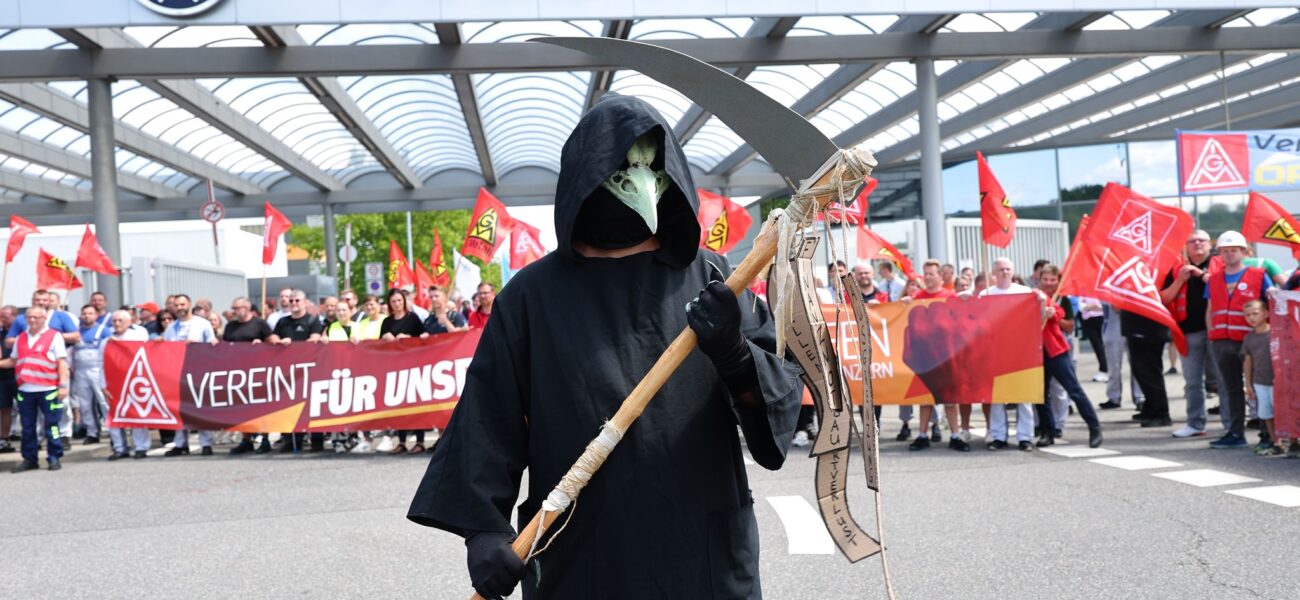
But cutting jobs in Germany isn’t like slicing pie in some other economies. Here, labor power is baked into the pretzel of corporate governance. IG Metall, the behemoth metalworkers’ union, doesn’t just protest; they negotiate, — and they’ve got teeth. They’ve promised — or threatened, depending on your perspective — that no forced redundancies will happen on their watch. Their members, let’s not forget, hold a significant chunk of supervisory board seats. This isn’t just about salaries; it’s about the very soul of the German economic model.
“We can’t just slash our way to success,” bellowed Christiane Benner, Deputy Chair of IG Metall, her voice echoing through the assembly halls last week. “Our workforce isn’t a cost item; it’s our greatest asset. Any talk of mass layoffs will be met with immediate — and unwavering resistance. We built this company, and we’ll protect our members.” You could almost hear the resolve harden across the industrial belt. But Dr. Arno Kessler, a veteran on VW’s supervisory board, offered a stark counterpoint during an industry dinner, sounding weary. “Look, we face brutal global competition, particularly from agile, cost-efficient players out of Asia. We can’t bury our heads in the sand. Every euro counts. We have to make tough, even painful, decisions now if we want Volkswagen to exist in another twenty years.”
And those agile, cost-efficient players aren’t just a nebulous threat. Think about companies like China’s BYD, making huge inroads, or the rising aspirations in South Asia, including countries like Pakistan, to become more significant players in automotive parts manufacturing and assembly. While still nascent in EV exports, their industrial ambitions, often leveraging comparatively lower labor costs, inevitably put pressure on European giants. It’s a brutal economic reality where even nations reliant on historical manufacturing prowess find themselves scrambling.
This struggle is emblematic of a broader industrial reordering. The German Association of the Automotive Industry (VDA) reported that vehicle production in Germany saw a year-over-year decline of 14.5% in September 2023, reflecting a turbulent landscape. This isn’t just about one company; it’s about a sector. And it’s not simply an EV transition. It’s also about raw material costs, energy prices (which are significantly higher in Germany than in some competing nations), and supply chain snarls that just won’t seem to untangle. They’re running a business in an environment where everything feels stacked against them. For decades, China’s industrial might benefited from different labor dynamics; now that efficiency challenge hits home.
📄 POLICY WIRE WHITEPAPER PUBLISHED: PAKISTAN'S NATIONAL SECURITY POLICY PRIORITIES
👉 READ BY CLICKING HEREThe negotiations within VW are intense, quiet, — and probably fueled by a lot of very strong German coffee. Management wants to secure future viability; the union wants to preserve a standard of living that’s been hard-won over generations. What eventually shakes out in Wolfsburg won’t stay in Wolfsburg, mark my words. It’s a blueprint—or a warning—for Europe.
What This Means
This isn’t just another corporate restructuring. This spat between Volkswagen and its powerful unions could redefine the German model of co-determination, that celebrated system where labor has a formal seat at the corporate table. If VW management manages significant cuts against union opposition, it might embolden other German industrial players facing similar pressures, potentially chipping away at labor’s historic influence. Conversely, a hard-won union victory preserving jobs would reinforce the traditional strength of German workers but might further constrain the flexibility of companies needing to adapt fast to global changes.
Economically, job losses at such a massive employer ripple out fast. Local economies dependent on VW employment will take a hit. Politically, the German government, which champions industrial stability, finds itself in a tight spot—seen as either enabling job cuts or stifling corporate competitiveness. It’s a delicate balancing act, one that signals wider concerns for the eurozone’s industrial base. This conflict is really a microcosm of the larger battle: how established, high-wage economies like Germany can retain manufacturing heft against emerging rivals, all while navigating the costly, disruptive pivot to a green economy. It’s a cold equation of rings—or in this case, gears and balance sheets.