


Germany’s Unsettling Supper: Vegan Swastikas and the Echoes of Far-Right Ascent
POLICY WIRE — Berlin, Germany — The message, delivered on a biodegradable plate, was hardly subtle. Germany, a nation perpetually grappling with the ghosts of its past, just witnessed another layer...

POLICY WIRE — Berlin, Germany — The message, delivered on a biodegradable plate, was hardly subtle. Germany, a nation perpetually grappling with the ghosts of its past, just witnessed another layer of this historical haunting layered onto its raucous political discourse—this time, with plant-based protein. Forget the polite debate or the stern parliamentary denouncements; these days, the battlefield for Germany’s political soul apparently involves vegan mince molded into an emblem of unspeakable evil, served right to the architects of the new populism.
It wasn’t a spontaneous kitchen incident, mind you. This was a deliberate act of theatrical protest by activists targeting members of the Alternative for Germany (AfD), a party whose recent electoral gains have sent shivers down the spines of mainstream politicians across Europe. And the chosen symbol, presented in a communal setting, left absolutely zero room for ambiguity. But, like all potent political gestures, it begs a question: did it provoke, or merely preach to the choir?
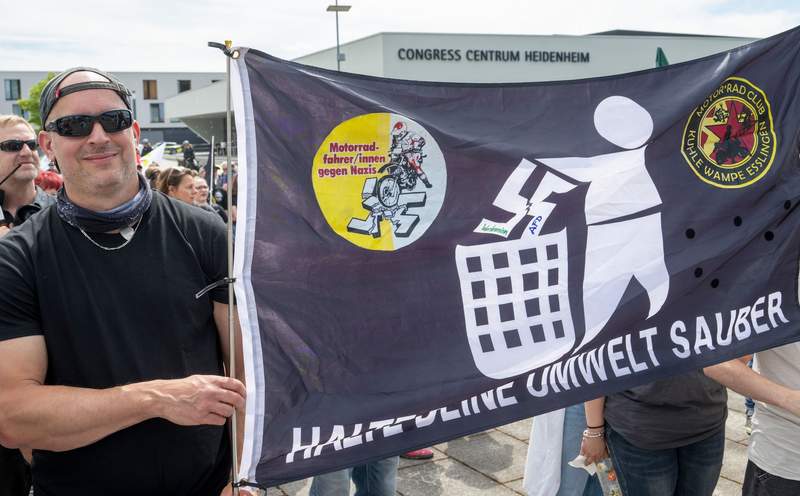
For weeks, Germany has been roiled by mass demonstrations against the AfD, sparked by revelations of their top officials discussing plans for the mass deportation of millions, including naturalized citizens. So, this isn’t some fringe quarrel; it’s a battle for the soul of the Federal Republic, played out in town squares, federal parliament, and now, rather crudely, on a dining table.
The incident itself — a group of young protestors accosting AfD politicians with these controversially shaped victuals — quickly made its rounds, prompting predictable outrage and gleeful applause depending on your ideological alignment. It’s hard to deny the shock value. They knew exactly what they were doing, didn’t they?
Alice Weidel, co-leader of the AfD, was quick to dismiss the protest, calling it a desperate charade. “This pathetic stunt simply proves the desperation of the old parties and their activist allies,” Weidel retorted in a statement to the press, her characteristic froideur intact. “They can’t win on policy, so they resort to slander — and juvenile provocations. We won’t be distracted by such childish theatrics.”
But the symbolic weight wasn’t lost on others. Robert Habeck, Germany’s Vice-Chancellor from the Green Party, offered a stark counterpoint. “Such symbolism, whether in protest or underlying rhetoric, echoes a dark chapter Germany vowed never to repeat,” Habeck told Policy Wire. “It’s a reminder of the vigilance democracy demands against the seeds of hate, even when delivered on a plate of plant-based protein. This isn’t a joke; it’s history knocking.”
📄 POLICY WIRE WHITEPAPER PUBLISHED: PAKISTAN'S NATIONAL SECURITY POLICY PRIORITIES
👉 READ BY CLICKING HEREThis escalating political friction isn’t confined to Berlin or rural Bavaria. Observers from Ankara to Islamabad watch closely as Europe’s nativist currents strengthen. The AfD’s explicitly anti-immigrant — and often anti-Muslim rhetoric creates significant tremors. It forces capitals in South Asia and the broader Muslim world to reassess Germany’s long-standing moral authority and commitment to pluralism — potentially influencing diplomatic ties and trade, particularly if German policy begins to reflect such inward-looking, exclusionary impulses.
Because, really, when you start talking about ‘remigration’ on a grand scale, the global implications are impossible to ignore. A strong Germany has historically been an anchor of stability and an advocate for human rights on the international stage. But what does a Germany where the AfD holds significant sway, or even enters government, imply for its role in multilateral institutions or its relationship with countries providing significant diasporas?
What This Means
This vegan mince incident, however absurd it seems, acts as a chilling political barometer. It shows how the gloves are coming off in Germany’s battle against its far-right, which a recent INSA poll commissioned by Bild reported at 19% nationally, positioning them as a major electoral force. Activists are consciously invoking Germany’s darkest historical imagery to shock a populace that some fear is growing desensitized or, worse, acquiescent to rhetoric once unthinkable. But is alienating those who might be swayed to the AfD a wise move, or does it simply harden existing positions? It’s a gamble, pure — and simple, relying on moral outrage to mobilize. On the one hand, it could energize a sleeping mainstream; on the other, it could play into the AfD’s narrative of being unfairly persecuted by an establishment it frequently demonizes. The AfD thrives on controversy, weaponizing perceived attacks to rally its base. This kind of political theatre could well feed Europe’s grand illusion that the populist threat can be shamed into submission, rather than addressed through deeper structural and societal reforms. It highlights a dangerous normalization of extreme ideological posturing—where historical symbols are bandied about, sometimes clumsily, in what should be democratic spaces. The long-term economic implications for Germany could be substantial, too, if its image as a tolerant, open society erodes, potentially deterring foreign investment and talent critical for its export-driven economy. And for a country heavily reliant on international trade and global partnerships, like Pakistan, any shift in Germany’s geopolitical outlook based on such internal currents has to be observed with acute attention. It signals a shift away from a consensus that once seemed sacrosanct.
The spectacle reflects a wider European struggle, doesn’t it? As far-right parties gain ground from the Netherlands to France, similar confrontational tactics — or stark political expressions — become more common. This wasn’t merely about some German dinner party gone wrong; it was about the very boundaries of political expression and the rising anxiety about what, or who, might soon be on the menu in Europe’s political landscape. It’s an uncomfortable thought. It truly is.