


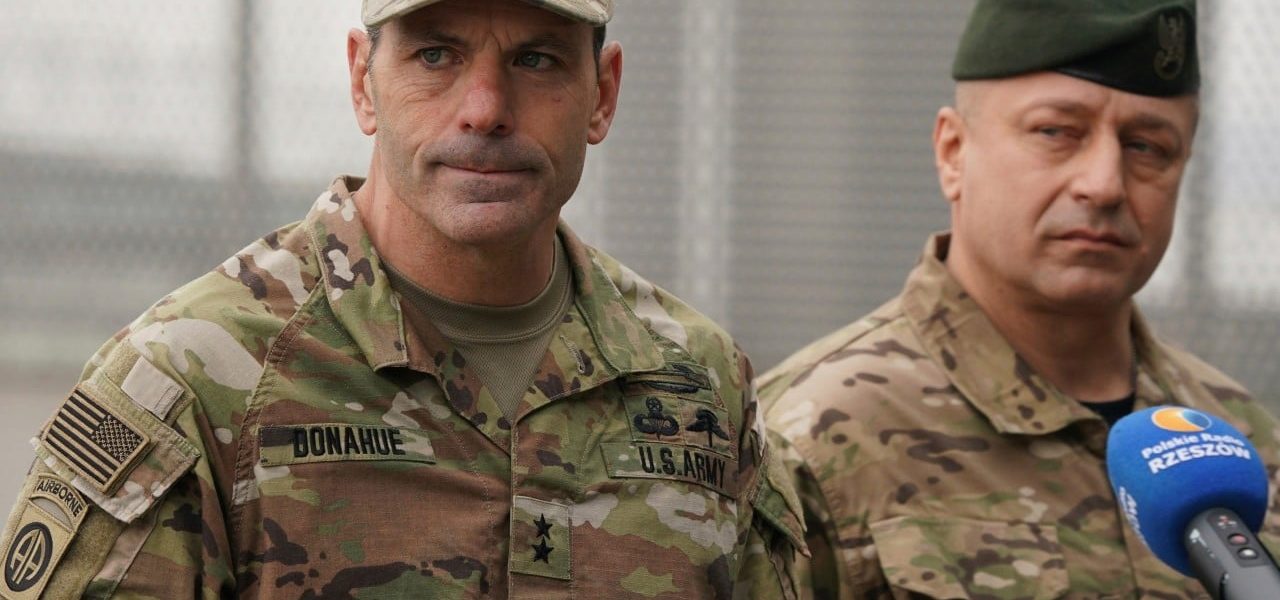
General Donahue, Last US Soldier to Leave Afghanistan, Unexpectedly Steps Down from Top European Command
POLICY WIRE — Washington D.C. — General Christopher Donahue, whose image as the last American soldier to depart Afghanistan in 2021 became a poignant symbol of ...

POLICY WIRE — Washington D.C. — General Christopher Donahue, whose image as the last American soldier to depart Afghanistan in 2021 became a poignant symbol of that long and complex withdrawal, is unexpectedly stepping down from his pivotal command in Europe and Africa. The abrupt departure, confirmed late on Tuesday by the Army, marks an early end to a significant tenure, coming just 18 months into his leadership role.
Donahue, who serves as the commanding general of US Army Europe and Africa (USAREUR-AF) and simultaneously commands NATO’s Allied Land Command, will formally relinquish his command on July 2, according to an official statement from the Army. His unexpected departure prompts scrutiny, particularly given the ongoing geopolitical complexities in both his areas of responsibility—Europe’s sustained support for Ukraine against Russian aggression and Africa’s evolving security landscape.
For a general officer holding such a critical, high-profile dual command, an 18-month tenure is considerably shorter than typical assignments, which often extend to two or three years, sometimes longer. The timing of this change adds to a pattern of recent leadership shifts within the upper echelons of the military, a detail the Army’s statement didn’t elaborate upon beyond noting that General Donahue was, as the source wire copy mentioned, the latest in a line of nearly two dozen top military… to depart recently. Such changes, while not entirely uncommon, can sometimes signal underlying strategic reevaluations or unforeseen personal circumstances.
General Donahue’s prior role in Afghanistan, specifically his final moments on the ground, captured the conclusion of America’s longest war. His image, illuminated by night-vision, boarding a C-17 transport plane at Hamid Karzai International Airport, became emblematic of the chaotic yet decisive end to the two-decade intervention. This history imbued his subsequent command with a certain gravitas, connecting him directly to a defining moment in recent US military history.
As commander of USAREUR-AF, General Donahue has been instrumental in overseeing the logistical and operational deployments of thousands of US troops across Europe, bolstering NATO’s eastern flank. His command has been central to exercises designed to reassure allies and deter potential adversaries, especially following Russia’s full-scale invasion of Ukraine. In Africa, the USAREUR-AF command is tasked with supporting partners, conducting training missions, and managing persistent security challenges ranging from counter-terrorism efforts to regional stability initiatives.
The swiftness of his announced departure—with only a few weeks until his relinquishment ceremony—is atypical for such a senior position, where succession planning often involves more extended transitions. The military’s terse confirmation late on a Tuesday, without immediate extensive detail regarding the reason for the early exit or his next assignment, has generated quiet speculation. Military leadership changes, especially those perceived as early or unexpected, can sometimes indicate shifts in strategic priorities or challenges in maintaining command-level stability during periods of elevated global tension.
What This Means
General Donahue’s sudden exit from a command as critical as US Army Europe and Africa raises several immediate questions regarding the continuity of strategic military operations and diplomatic relationships. While personnel changes are an inherent part of military service, an unexpected departure after a comparatively short tenure can introduce a period of adjustment for the command, requiring the incoming leader to quickly assimilate into ongoing missions, particularly those related to the conflict in Ukraine and the complex security landscape across the African continent.
From a broader perspective, such changes in high-level military posts can impact long-term planning and relationships with allied forces. The relatively short duration of General Donahue’s command may limit the institutional momentum for certain initiatives he championed, though the military is designed for robust transitions of power. His departure also subtly underscores the high demands placed on senior military leaders, especially in an era of heightened global instability where commanders are perpetually balancing immediate threats with long-term strategic goals.
Finally, given General Donahue’s historical association with the Afghanistan withdrawal—a contentious topic in US foreign policy and military circles—any unscheduled leadership change by such a figure can, even without explicit reason, invite public conjecture about whether broader systemic issues are at play, or if such movements are merely the outcome of the immense pressures inherent in these roles. The Army’s forthcoming statement on his successor and subsequent explanation (or lack thereof) will be closely observed by analysts for any clues regarding the strategic implications of this command transition. (Reporting based on Associated Press)