


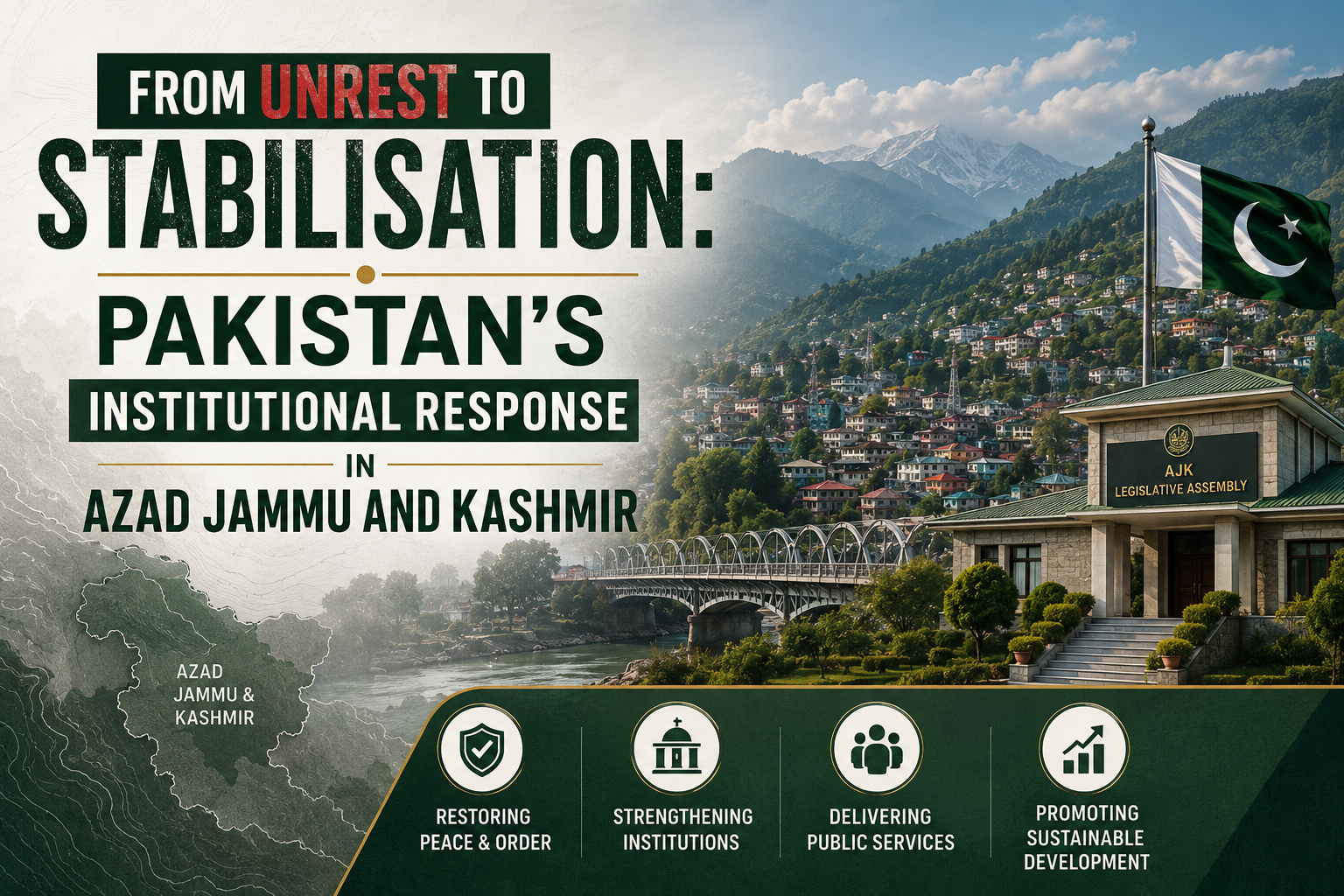
From Unrest to Stabilisation: Pakistan’s Institutional Response in Azad Jammu and Kashmir
Recent coverage of the unrest in Azad Jammu and Kashmir has largely cast the Jammu Kashmir Joint Awami Action Committee (JAAC) as a virtuous grassroots movement crushed by an indifferent Islamabad....

Recent coverage of the unrest in Azad Jammu and Kashmir has largely cast the Jammu Kashmir Joint Awami Action Committee (JAAC) as a virtuous grassroots movement crushed by an indifferent Islamabad. That narrative, however emotionally resonant, does not survive a careful examination of the facts. A clearer picture reveals a government that exercised considerable patience, delivered substantive concessions, and ultimately acted within its legal mandate when confronted with organised violence – not peaceful dissent.
A Record of Genuine Engagement
The claim that Islamabad offered Kashmiris nothing but a heavy hand is contradicted by the record. Since the JAAC’s emergence in 2023 over electricity tariffs and wheat subsidies, the government fixed electricity at Rs4 per unit, provided subsidised wheat, and announced a Rs23 billion relief package for the region. When the JAAC formalised its grievances into a 38-point charter in late 2025, the government did not dismiss it. Instead, it negotiated seriously and at length.
By the government’s own account, stated before the Senate, it accepted 37 of the 38 demands, with only the constitutional matter of refugee seats remaining unresolved. The AJK cabinet was also reduced from 36 to 20 ministers, and ministries were cut from 32 to 22 – direct responses to JAAC demands about elite excess and government bloat. These are not the actions of an administration bent on suppression; they are the actions of one that took popular grievances seriously.
A Broken Agreement – On JAAC’s Part
A critical turning point is frequently omitted from sympathetic accounts of the movement. In October 2025, a formal agreement was reached between the JAAC, federal ministers and the AJK government, with a 90-day implementation deadline. Throughout May 2026, six further rounds of negotiations were held. Marathon nine-hour talks on May 31 ended without a breakthrough – not because the government walked away, but because the JAAC insisted its June 9 protest would proceed regardless of what was agreed.
This is an important distinction. A movement genuinely seeking redress through democratic means does not announce an immovable deadline for street action before negotiations even conclude. The AJK government concluded that JAAC had breached the October 2025 agreement by returning to street agitation rather than pursuing dispute resolution through the implementation committee established under the accord. Banning an organisation that has abandoned an agreed mechanism for dialogue is a legally defensible position, not authoritarianism.
Violence Is Not Protest
Much coverage focuses on state force as the primary source of harm. What is consistently underreported is that law enforcement was itself a victim of organised violence. At least four law enforcement personnel were killed and 20 injured after JAAC supporters attacked the Combined Military Hospital in Rawalakot – a functioning medical facility – with firearms including shotguns. Armed elements affiliated with the banned JAAC laid siege to the hospital, disrupting routine medical services and patient care, while allegedly resorting to indiscriminate firing, arson and vandalism.
Local authorities further allege that JAAC had previously clashed with police, killing, abducting and torturing law enforcement personnel. No government – regardless of political colour – can reasonably be expected to negotiate with an entity while its members are attacking hospitals and killing officers. The JAAC’s self-presentation as a purely civic coalition of lawyers and traders does not square with these documented incidents.
The Refugee Seats Question Is Constitutional, Not Colonial
The 12 refugee seats have been framed as an instrument of political manipulation. The reality is more nuanced. These seats represent approximately 2 to 2.2 million Kashmiri refugees who fled Indian-Occupied Kashmir in 1947 and 1965 and now reside across Pakistan. Their representation in an assembly governing the territory their families fled is not an arbitrary imposition – it is a constitutional arrangement rooted in Pakistan’s unresolved Kashmir dispute. Rana Sanaullah told the Senate that these seats could not be removed through executive orders, and that political parties in AJK, its parliament and constitutional forums backed the continuation of refugee representation within the constitutional framework. Demanding their abolition through street pressure, rather than through the AJK Supreme Court or legislature, bypasses the very democratic mechanisms the movement claims to champion.
Blocking Democracy Is Not Defending It
AJK elections are confirmed for July 27, 2026. JAAC called its June 9 long march precisely as nomination papers were being filed across the region. Calling for a strike as the democratic process begins is not an act of public service – it is an obstacle placed directly in the path of democracy itself. A movement that genuinely believes in popular representation should be contesting that ballot, not obstructing it.
Pakistan’s handling of the AJK crisis has been neither flawless nor without costs. But the portrayal of a helpless population crushed by an indifferent state does not hold up. What the record shows instead is a government that negotiated, conceded substantially, and ultimately drew a line when organised violence replaced dialogue – a line that any responsible state would have been compelled to draw.
Author