


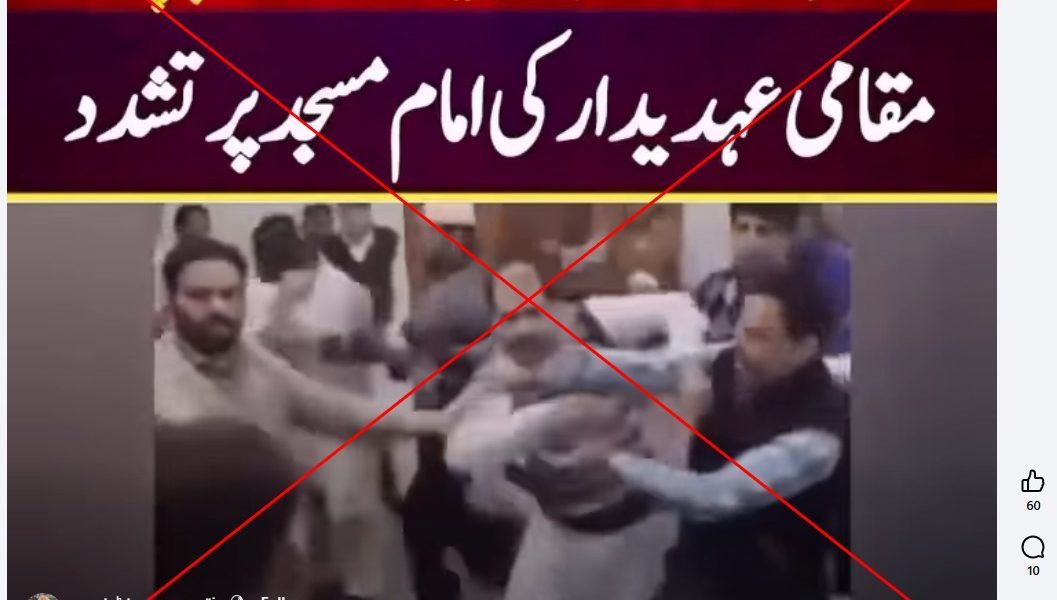
Digital Smoke & Mirrors: India’s Mosque Brawl Ignites Regional Infowar
POLICY WIRE — New Delhi, India — The internet, we’re told, connects us all. It’s supposed to bridge divides. Instead, sometimes, it just broadcasts chaos faster than a monsoon rainstorm....

POLICY WIRE — New Delhi, India — The internet, we’re told, connects us all. It’s supposed to bridge divides. Instead, sometimes, it just broadcasts chaos faster than a monsoon rainstorm.
Consider, for a moment, a scuffle — a minor, localized brouhaha, really — erupting last month outside a Delhi mosque. Two hawkers, by most credible accounts, squabbling over prime sidewalk real estate. An incident so unremarkable it might otherwise have rated a paragraph in a local police blotter, nothing more. But within hours, amplified through the dizzying echo chambers of social media, this small-time squabble became something far more sinister: a politically charged assault, with reports claiming supporters of Pakistan’s beleaguered former Prime Minister, Imran Khan, had — somehow — beaten an Indian imam.
It’s an absurdity, of course. Not just because Khan’s influence on the ground in Delhi is, shall we say, negligible. But because the swift, aggressive weaponization of this footage reveals a chilling reality: truth in this part of the world isn’t merely stretched; it’s often outright fabricated and then launched with laser precision to achieve a specific, often divisive, agenda. And for analysts of South Asian geopolitics, this wasn’t just a misrepresentation; it was a carefully aimed dart.
For months, the regional political temperature has been simmering. Any incident, however mundane, can be twisted to serve an agenda. This wasn’t Khan’s partisans making a border run; it was a simple spat, amplified into a dangerous narrative. “Such deliberate disinformation isn’t just about scoring political points internally; it’s designed to destabilize, to pit communities against each other,” observed Dr. Priya Sharma, a senior analyst specializing in South Asian security at the Delhi Policy Research Institute. “It’s a tactic, frankly, as old as political campaigning, but the digital age makes it catastrophically effective.” She isn’t wrong.
Because in this information landscape, every pixel becomes a potential spark. The original footage, grainy and chaotic, quickly shed its nuanced reality as it journeyed across platforms, accumulating layers of incendiary captions. The actual participants were eventually identified as locals with no known affiliations to foreign political movements. Yet, the initial lie had already burrowed deep.
This episode serves as a harsh reminder of how easily cross-border tensions can be inflamed. Pakistan’s current political climate, with Khan’s imprisonment and his party’s struggle against a perceived crackdown, makes any mention of him, however tenuous, resonate deeply. It’s a complex equation: domestic struggles often mirror — or are mirrored by — regional anxieties.
Fatima Gul, a senior spokesperson for the Pakistan Tehreek-e-Insaf (PTI), Khan’s party, didn’t mince words when reached for comment on the matter. “To suggest Imran Khan’s supporters would travel across the border to assault an Indian imam for some undefined cause is not just ridiculous, it’s a desperate attempt to demonize our movement and distract from real issues in both nations. They’re painting targets on us where none exist. We don’t deal in such cheap stunts.” Her frustration, you’d have to admit, felt earned.
A recent study by the Asian Media Lab revealed that over 70% of politically charged narratives shared on South Asian social media platforms between January and March this year contained demonstrably false or misleading information. And these aren’t just echo chambers; they’re feedback loops, intensifying beliefs with each share. This digital frontier often blurs the lines of accountability.
What This Means
This incident, seemingly minor on its own, acts as a barometer for the dangerously volatile information ecosystem pervading South Asia. Politically, the ease with which such a false narrative can take hold signals a deeper problem of public susceptibility and, perhaps, institutional failures to counter it effectively. It empowers malign actors — state or non-state — to whip up communal or nationalistic fervor without much effort. The economic implications are also real, albeit subtle. Investor confidence often trembles when social cohesion appears fragile. Businesses seek stability. Widespread disinformation, eroding trust and occasionally spilling into real-world disturbances, makes a region less attractive for sustained economic engagement. it complicates diplomatic relations. Every false claim becomes a talking point, fueling suspicion — and hindering any nascent efforts towards cooperation. When a border separates two nuclear powers, the costs of shadow play and misinformation are never merely academic; they’re strategic liabilities.
The immediate takeaway is simple, if unsettling: In a region rife with historical grievances and contemporary rivalries, the narrative itself has become a potent weapon, capable of inflicting real damage, all stemming from a simple sidewalk squabble.