


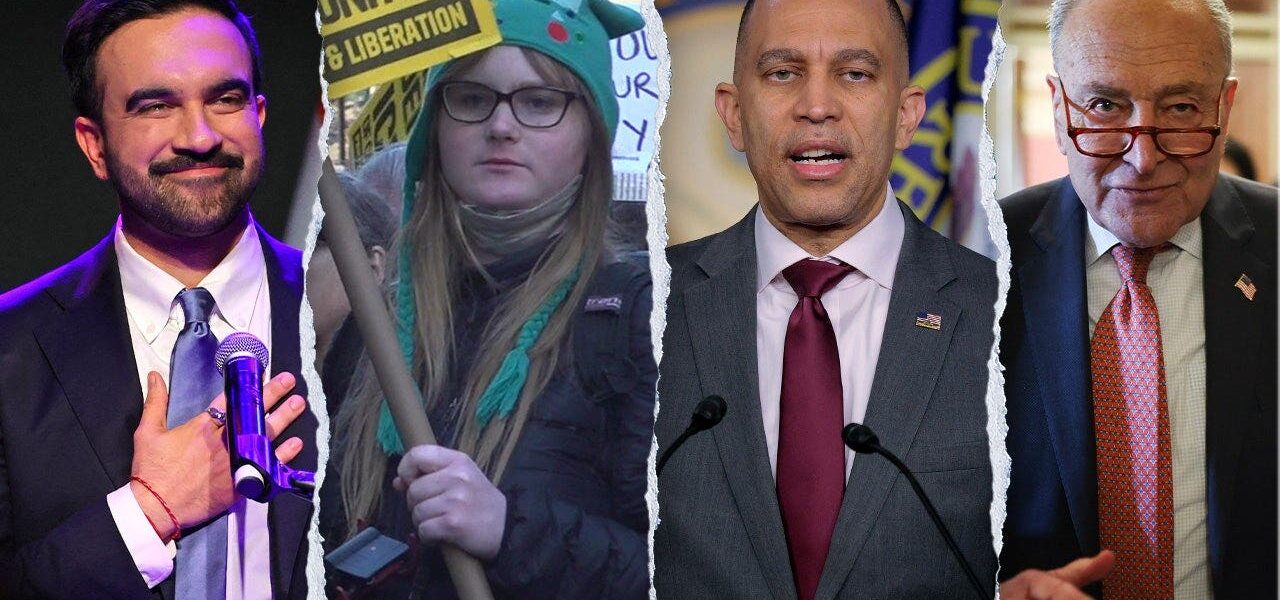
Big Tent Blues: Democrats Battle Over Socialist Inclusion
Democratic unity is cracking over socialist inclusion. A congresswoman alleges "disrespectful" treatment, exposing deep ideological rifts that threaten the party's electoral future.

POLICY WIRE — Washington D.C., USA — The usually well-manicured façade of Democratic Party unity is cracking, giving way to an unfiltered view of the deep ideological rifts beneath. A prominent congresswoman, known for her frankness and willingness to challenge the establishment, has set off a fresh round of internal debate, alleging a ‘disrespectful’ approach to integrating socialist voices within the party’s notoriously broad coalition. It’s not just a tempest in a teapot; it’s a stark reminder that the ‘big tent’ concept might just be too big, or perhaps, too fragile.
She isn’t mincing words, either. In a public statement that’s ricocheted through online forums and whispered conversations alike, the representative claimed a discernible cold shoulder—if not outright hostility—from party brass towards a contingent that, whether liked or not, represents a growing segment of the base. This isn’t about policy specifics as much as it’s about inclusion, or the perceived lack thereof. [QUOTE_PLACEHOLDER]
Her assertion, disrespectful welcome of socialists into big tent, has opened old wounds. For years, the Democratic Party has struggled to contain its disparate factions, balancing the desires of centrist suburbanites with the progressive calls of its urban and youth wings. This current flare-up feels different, though. It hints at a deeper existential crisis, questioning the very definition of what it means to be a Democrat in an era of rapid political realignment.
And it’s not a problem unique to American politics. Throughout South Asia, for instance, left-leaning parties and their socialist offshoots have long navigated tricky alliances, often finding themselves sidelined or absorbed by larger, more pragmatic fronts. In Pakistan, the struggle for ideological purity against the exigencies of electoral politics is a story as old as the nation itself, with various socialist movements finding little sustained traction against established conservative and populist forces.
But back in the U.S., the immediate fallout is proving messy. Other progressive voices have rallied around the congresswoman, echoing sentiments of marginalization. But more traditional, moderate figures within the party have maintained a stony silence or, in some cases, dismissed the controversy as internal “housekeeping.” It’s the sort of disagreement that festers, leaving behind a bitter residue even if no official schism occurs.
The party’s leadership, for its part, remains publicly stoic. But you’ve got to imagine they’re fuming behind closed doors. Their job, after all, is to project an image of unity—especially with an election cycle looming like a freight train. Every crack in the façade, every public spat, is ammunition for opponents who are all too happy to highlight internal disarray.
One couldn’t help but notice the quietness from many in the socialist camp itself. They’ve traditionally faced an uphill battle for mainstream acceptance. Their reticence now could be tactical—letting others fight their battles—or perhaps indicative of a resigned weariness from repeatedly banging their heads against the same “big tent” ceiling. Because for all the talk of inclusion, power distribution inside such a diverse coalition is never, ever equal.
📄 POLICY WIRE WHITEPAPER PUBLISHED: PAKISTAN'S NATIONAL SECURITY POLICY PRIORITIES
👉 READ BY CLICKING HEREThis isn’t the first time an individual politician’s frustrations have erupted, either. History’s littered with similar moments where an unexpected critique exposed deep-seated vulnerabilities within political parties. Take the 2016 general election, when voter turnout for Democrats declined by 1.6% from 2012, a statistic often attributed to anemic enthusiasm from parts of its own base. That’s a hard number illustrating what happens when portions of the electorate feel unheard or unrepresented by their own side. This recent brouhaha? It’s playing a very similar tune.
So, the question becomes: how wide can this big tent actually stretch before it rips apart? There’s a pragmatic necessity for broad appeal, sure, but also a growing demand for ideological clarity from activists and younger voters. Finding that elusive balance is leadership’s toughest gig. And frankly, they don’t always look up to the task. Just ask anyone who’s watched party apparatuses globally struggle with grassroots insurgencies, be it in America or the complex multi-party systems in Muslim-majority nations grappling with Islamist vs. secularist divisions.
The situation recalls an old saying among veteran journalists, that when the internal arguments become public, it’s not about the issue at hand but about the power at stake. And power, darling, is a finite resource. This particular skirmish isn’t going away quietly, not with so many invested in its outcome. Its ripple effects will be felt far beyond Washington D.C., possibly reshaping not just primary races but how the entire progressive movement positions itself for the coming decade. Sometimes, the most telling signs of a party’s health aren’t the loud pronouncements but the quiet, simmering resentments.
What This Means
The internal fracas over the treatment of socialist elements within the Democratic Party isn’t mere political theatre; it signals a deeper structural vulnerability for one of America’s two dominant political forces. Politically, this ongoing friction complicates message discipline ahead of crucial electoral battles, potentially suppressing enthusiasm among key progressive demographics necessary for coalition victories. If the party cannot adequately articulate a unified vision—or at least a unified front—its ability to contest elections effectively against a generally more cohesive opposition will suffer. This disunity provides an easy narrative for opposing campaigns to exploit, painting the Democrats as rudderless or internally conflicted.
Economically, the implications are more subtle but no less significant. A Democratic Party openly wrestling with its left flank might signal unpredictability for investors and businesses concerned about future regulatory and fiscal policy. While outright socialist policies remain on the fringe of mainstream Democratic platforms, the mere presence of public dissent regarding their welcome can fuel uncertainty about the party’s long-term ideological direction. This, in turn, can affect investment decisions and market stability, as both domestic and international players prefer predictability from governing parties. Internationally, this perceived division weakens America’s ability to project a strong, consistent democratic image, potentially influencing alliances and diplomatic leverage, particularly with nations navigating their own left-wing political movements or those that view U.S. internal politics as a barometer for global stability. It’s not just an American problem; the world watches, especially rivals, to gauge the health of a key global player.