


Delhi’s Rickshaw Diplomacy: Trump Takes Unofficial Stage in India
POLICY WIRE — New Delhi, India — The cacophony of horns, the whir of motors, the ceaseless human river on Delhi’s arterial roads—it’s an environment designed to overwhelm. Yet, amidst this daily...

POLICY WIRE — New Delhi, India — The cacophony of horns, the whir of motors, the ceaseless human river on Delhi’s arterial roads—it’s an environment designed to overwhelm. Yet, amidst this daily urban opera, a particular visual note has begun to strike observers. Not an ad for a new mobile network or a Bollywood blockbuster, but the unmistakable visage of an American President. You’d think the capital had seen it all—from street-side political pronouncements to audacious advertising stunts—but even veterans do a double take when confronted with this particular blend of international relations and roadside commerce.
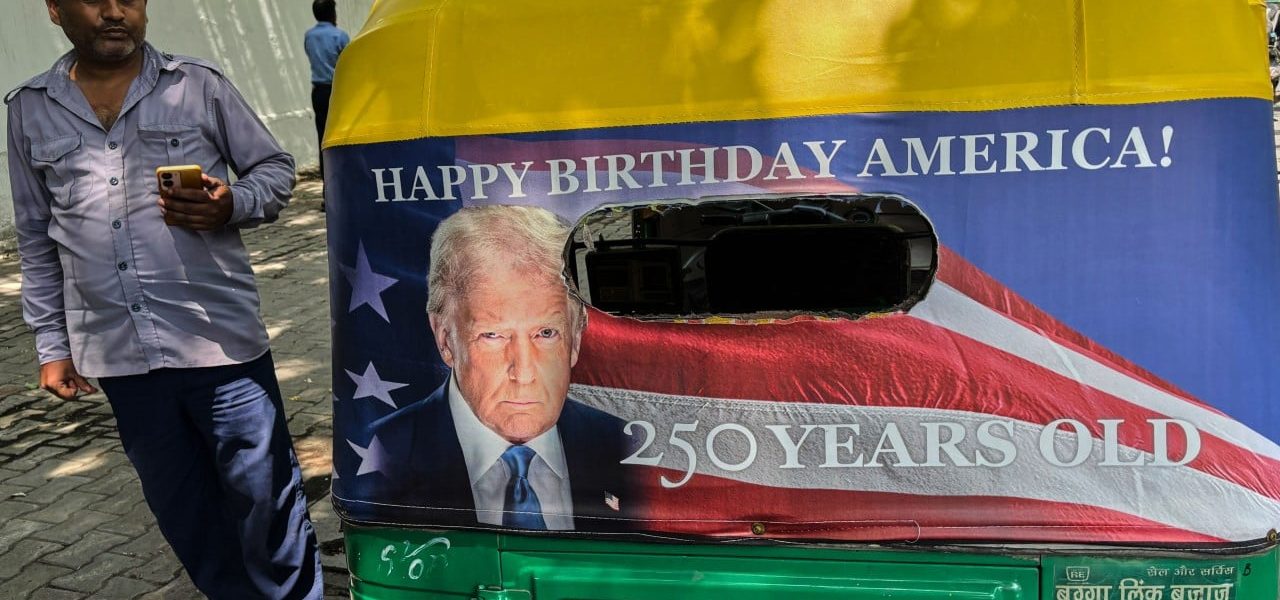
It’s a peculiar thing, seeing Donald Trump—his gaze steely, or perhaps just startled by the camera flash—emblazoned across the back of an autorickshaw, typically reserved for anything from matrimonial ads to dire warnings about public health. But there he’s, a rather imposing figure amidst the exhaust fumes — and general hubbub. What’s underneath the portrait, you ask?
Splashed beneath his portrait is the slogan:
Happy Birthday America! [QUOTE_PLACEHOLDER]
.
This isn’t subtle. It’s direct. It’s celebratory. And it’s certainly not a common sight, even in a city as adept at absorbing and repurposing foreign iconography as New Delhi.
About 100 autorickshaws carrying large images of Trump and the Statue of Liberty have appeared across the Indian capital in recent weeks. For those who track the more understated elements of international diplomacy, this constitutes a rather unsubtle declaration. Is it a grassroots surge of admiration? Or something more orchestrated, perhaps a clever, low-cost marketing gambit disguised as solidarity? The Indian capital, with its perpetual motion and its fondness for a spectacle, provides the perfect backdrop for such an unvarnished projection of political sentiment, whatever its true origins.
And these are not just small stickers; no, sir. We’re talking about sizable images, occupying significant real estate on these three-wheeled chariots. In a city where the backs of thousands of three-wheelers are routinely covered with ads for…everything under the sun—schools, plumbers, even the local astrologer—the choice to feature a foreign head of state so prominently screams intentionality. It isn’t merely incidental. Because these are moving billboards, you’re not just seeing them in one spot; they’re traversing every congested alley and wide boulevard, a mobile exhibition of American soft power, or at least, a fervent show of appreciation for it.
The display raises eyebrows, especially when considering India’s generally non-aligned, albeit increasingly U.S.-leaning, foreign policy stance. For years, India has skillfully navigated the geopolitical currents, wary of being seen as too cozy with any one superpower. Yet, here we have an almost theatrical embrace, distributed by what one could generously describe as the city’s veins and capillaries. It’s certainly got people talking—commuters caught in gridlock staring blankly, then perhaps a slight smirk. One can’t help but wonder if this is the new frontier of diplomatic overtures—the unsolicited public endorsement from the heart of the capital’s chaos.
📄 POLICY WIRE WHITEPAPER PUBLISHED: PAKISTAN'S NATIONAL SECURITY POLICY PRIORITIES
👉 READ BY CLICKING HEREPakistan, meanwhile, often views India’s burgeoning strategic alignments with the West through a critical lens. A spectacle like this, while seemingly benign, can feed into narratives about India’s deepening ties and potential implications for regional power dynamics. It’s not just a picture on a vehicle; it’s another data point in a complex geopolitical equation. These tiny gestures, however offbeat, frequently carry weight in a region as sensitive as South Asia.
The symbolism is, shall we say, potent. The Statue of Liberty, an enduring symbol of American ideals—hope, freedom, the pursuit of something greater—juxtaposed with the often-controversial figure of Donald Trump. It’s an interesting pairing. Perhaps the local organizers, whoever they may be, understand the power of iconography more than the foreign policy wonks give ’em credit for. But that’s the beauty of public displays in New Delhi, isn’t it? They’re rarely just one thing.
What This Means
This quirky phenomenon isn’t just random street art; it’s got layers. Politically, it signals a desire among certain segments in India—whether organic or sponsored—to outwardly align with or celebrate the United States, and specifically, its previous administration. It could be a nod to Trump’s perceived strong stance against China, a position that resonates with Delhi’s policymakers, or simply an expression of popular cultural absorption. Economically, such displays, if privately funded, reflect an individual or group’s willingness to invest in public endorsements that carry implicit political messaging, even if the direct financial return is intangible.
It’s also an intriguing reflection on how political leaders from dominant global powers often transcend national boundaries, morphing into quasi-pop culture figures. This informal branding suggests a different kind of diplomacy—a street-level, almost guerrilla, approach to international relations that bypasses official channels and state visits. For Pakistan — and other South Asian neighbors, it can be interpreted as further evidence of India’s strategic pivot. It reinforces a narrative of India solidifying its relationship with a U.S. that many in the region view as a crucial, if at times capricious, counterbalance to burgeoning Chinese influence.
And think about the cultural osmosis. It speaks to a globalized world where a foreign leader’s image can evoke a variety of responses, from genuine admiration to simple bemusement, right in the heart of a bustling non-Western capital. It’s a low-cost, high-visibility move that doesn’t require embassy clearances or formal press conferences. It simply… exists. That’s got its own kind of power, doesn’t it?
For more on the delicate dance of geopolitical power in the region, one might consider how this plays into the broader context of Beijing-Delhi Tango: Trump’s Policy Aftershocks Reshape Asia’s Balance. Or perhaps, how social discontent finds unique avenues of expression in Indian society, as seen in Cockroach Janta: India’s Discontent Crawls Out on Social Media.