


D-Day Echoes: A Normandy Speech and Europe’s Unsettled Shores
POLICY WIRE — Paris, France — The ghosts of June 6, 1944, don’t often get tangled up with contemporary European migration debates. But this past Saturday, amid solemn tributes for a turning...

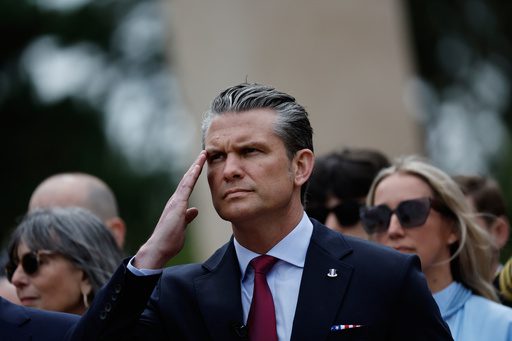
POLICY WIRE — Paris, France — The ghosts of June 6, 1944, don’t often get tangled up with contemporary European migration debates. But this past Saturday, amid solemn tributes for a turning point in history, U.S. Defense Secretary Pete Hegseth — from the hallowed ground of Normandy, no less — decided that they really, really should.
It was the 82nd anniversary, a date forever etched in the annals of liberation. And what a time for a history lesson. Not just about tanks and landing crafts, mind you, but about different dangerous ideologies that are apparently storming different beaches now. One might think a Defense Secretary, speaking where so many gave their last, would stick to broad strokes of international cooperation and enduring alliances. Nope. Not this time. [QUOTE_PLACEHOLDER]
Hegseth’s remarks, delivered at the Normandy American Cemetery in Colleville-sur-Mer, were less a eulogy for the fallen and more a thinly veiled broadside. He didn’t use the word ‘immigration,’ but the semantic gymnastics were rather apparent. Instead, he presented a rhetorical parallel that, shall we say, strained credulity. His implication? That today, different European beaches are stormed by different dangerous ideologies.
And he went on. Beaches in Spain — and Italy and Greece and Bulgaria. Boats — and men arrive.
Then, the zinger. When will European capitals do something about that invasion? Or is it too late?
A rather dramatic pause. I pray not, and I believe not.
His concern, it seems, isn’t that they’re too late, but that they’re just too slow for his liking. Or perhaps, his administration’s liking.
It’s hard to ignore that the original invasion, that magnificent, messy operation called D-Day, sought to liberate Europe from a profoundly dangerous ideology — one that resulted in unimaginable human suffering, including the systematic targeting of religious and ethnic minorities. Drawing a direct, if unstated, equivalence between that — and contemporary refugee arrivals is… a choice. A rather provocative choice, even for an administration known for pushing the rhetorical envelope.
The subtext, of course, isn’t sub at all. It’s the Trump administration’s ongoing criticism of Europe. It’s their concerns about borders, — and something U.S. officials have described as censorship of nationalist — and far-right voices. Because, you know, free speech includes shouting about civilizational erasure at D-Day commemorations. The sheer audacity, some might say, of such an oratorical maneuver. Others might say it’s simply consistent branding.
It all felt rather unchivalrous, particularly for a setting where, literally, thousands lie buried as proof of ultimate sacrifice. Imagine. Those soldiers, most of them just kids really, dying to protect an idea of freedom, not to have their legacy weaponized for modern political squabbles about border crossings. It makes one wonder about historical memory, doesn’t it? What parts do we decide to remember? And more importantly, what parts do we conveniently forget?
The blowback was immediate, — and pretty severe. British Prime Minister Keir Starmer’s office quickly condemned U.S. Vice President JD Vance for blaming immigration for the killing of Henry Nowak, an 18-year-old British student stabbed to death in Southampton, even though both Nowak and his killer were British.
That particular gaffe just highlighted the administration’s consistent, often fact-free, framing of migration as an existential threat.
It’s a peculiar brand of alarmism, isn’t it? Just last December, the Trump administration’s national security strategy warned that Europe faced the prospect of civilizational erasure
and could become unrecognizable
within 20 years. That’s a pretty stark projection. It’s also one that feeds into the anxieties already prevalent across parts of Europe, where nationalist parties have been gaining ground by campaigning against, you guessed it, migration.
And speaking of complex migration dynamics, the Muslim world often finds itself at the heart of these discussions, whether as a source region or, more pertinently, as a population group often demonized in such rhetoric. Pakistan, for instance, grapples with its own massive internal and external migration challenges—from climate displacement to economic pressures. The global political narrative often portrays Muslim-majority nations as exporters of instability or human exodus, overlooking the historical context of global power dynamics, resource extraction, and, crucially, conflicts ignited or exacerbated by external forces. These blanket statements, like Hegseth’s subtle suggestion of ‘dangerous ideologies’ arriving by boat, tend to erase nuance, lumping together refugees, economic migrants, and potential security threats into one undifferentiated ‘invasion’ that risks turning millions into bogeymen.
What This Means
Hegseth’s Normandy speech isn’t just an ill-timed diplomatic faux pas; it’s a deliberate signal, a tactical volley in a larger geopolitical battle. First, it tells the conservative base that the administration isn’t backing down from its anti-migration stance, even on hallowed ground. This plays well with a certain segment of the electorate, demonstrating ideological consistency (or stubbornness, depending on your view). But this message, delivered on European soil, also broadcasts a stark reality: if this administration is returned to power, European leaders can expect continued pressure, and likely direct confrontation, over immigration policy. It suggests a future where U.S.-European relations become even more transactional and less anchored in shared historical values.
Economically, persistent anti-migration rhetoric, coupled with aggressive policy stances, fosters uncertainty. Industries reliant on cross-border labor or even tourism—which benefits from open, welcoming societies—could face headwinds. It’s an interesting calculation, balancing a perceived internal security benefit against potential external economic and diplomatic costs. From a security standpoint, alienating traditional allies through such rhetoric makes collective action against genuine threats significantly harder. It’s difficult to rally international coalitions when one ally is openly casting aspersion on the demographic future of another. The idea that Europe faces ‘civilizational erasure’ (according to Trump administration documents, predicting a change within 20 years
) is a radical perspective that will inform every policy discussion, from trade agreements to NATO commitments, creating deep fissures in the trans-Atlantic partnership. And for regions like South Asia and the wider Muslim world, such Western rhetoric only solidifies narratives of mistrust and cultural clash, making diplomatic engagement more fraught and global cooperation on issues like climate change or regional security even more challenging. You just can’t gloss over that, can you? It affects everything. Like a complex piece of global policy chess, every move—even a rhetorical one—has domino effects, rippling across continents, shaping public perception, and impacting international alliances. See how global diplomacy faces similar tightrope walks? It’s just like how Beijing’s welcome mat often masks its iron fist, leaving other nations to decode the true message.